


Aquaculture Products Market Size
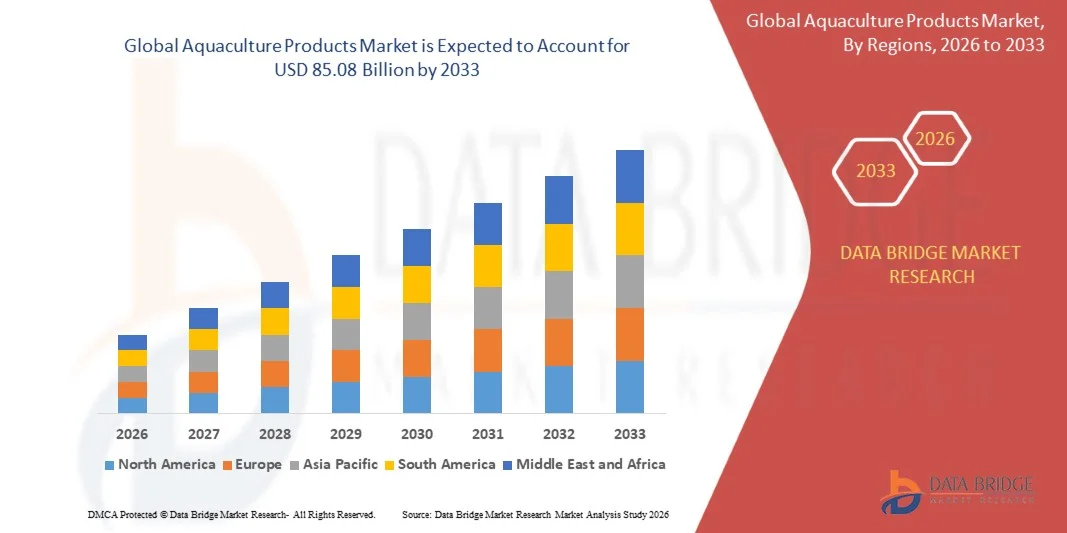
- The global aquaculture products market size was valued at USD 49.52 billion in 2025 and is expected to reach USD 85.08 billion by 2033, at a CAGR of 7.00% during the forecast period
- The market growth is largely fueled by the rising global demand for seafood protein, rapid expansion of commercial aquaculture farming, and increasing pressure on wild fish stocks. These factors are driving large-scale adoption of modern aquaculture systems, advanced feed solutions, and aquatic health management products to improve yield efficiency and sustainability
- Furthermore, increasing investments in aquaculture infrastructure, government support for fisheries development, and growing focus on sustainable food production are strengthening industry expansion. These converging factors are accelerating the adoption of recirculating aquaculture systems, automated monitoring technologies, and high-performance aquafeed, thereby significantly boosting the industry's growth
Aquaculture Products Market Analysis
- Aquaculture products include fish feed, breeding systems, water treatment solutions, health management products, and farming equipment used to support controlled aquatic food production systems. These solutions are essential for improving productivity, disease control, and environmental efficiency in both inland and offshore aquaculture operations
- The escalating demand for aquaculture products is primarily driven by increasing global seafood consumption, declining wild fish catch availability, and the rapid modernization of aquaculture farming practices. In addition, rising adoption of sustainable production systems and technological advancements in farm monitoring and feed efficiency are further supporting market expansion
- Asia-Pacific dominated the aquaculture products market with a share of 68.5% in 2025, due to high seafood consumption, rapid expansion of aquaculture farming, and strong demand for fish feed, broodstock, and aquatic health products
- North America is expected to be the fastest growing region in the aquaculture products market during the forecast period due to rising demand for seafood protein, expansion of aquaculture farming, and increasing investment in land-based production systems
- Freshwater segment dominated the market with a market share of 55.5% in 2025, due to widespread inland aquaculture activities and ease of cultivation in controlled environments such as ponds and lakes. Freshwater farming of finfish species remains highly popular due to lower operational complexity and reduced infrastructure requirements. Strong domestic consumption patterns across emerging economies further support segment dominance
Report Scope and Aquaculture Products Market Segmentation
|
Attributes |
Aquaculture Products Key Market Insights |
|
Segments Covered |
|
|
Countries Covered |
North America
Europe
Asia-Pacific
Middle East and Africa
South America
|
|
Key Market Players |
|
|
Market Opportunities |
|
|
Value Added Data Infosets |
In addition to the insights on market scenarios such as market value, growth rate, segmentation, geographical coverage, and major players, the market reports curated by the Data Bridge Market Research also include import export analysis, production capacity overview, production consumption analysis, price trend analysis, climate change scenario, supply chain analysis, value chain analysis, raw material/consumables overview, vendor selection criteria, PESTLE Analysis, Porter Analysis, and regulatory framework. |
Aquaculture Products Market Trends
“Rising Adoption of Sustainable and Alternative Aquafeed Solutions”
- A significant trend in the aquaculture products market is the rising shift toward sustainable and alternative aquafeed solutions, driven by increasing pressure on marine resources and the need to reduce dependency on fishmeal and fish oil. This transition is strengthening the adoption of insect-based proteins, algae-derived feed ingredients, and plant-based formulations across commercial aquaculture operations
- For instance, Skretting Vietnam and Entobel have collaborated to introduce insect-based shrimp feed using Entobel’s “H-Meal” protein, supporting reduced marine ingredient dependency and lowering environmental impact. Such innovations are improving feed efficiency while supporting circular economy practices in aquaculture production systems
- The expansion of sustainable feed innovation is also supported by increasing regulatory emphasis on environmentally responsible aquaculture practices and carbon footprint reduction targets. This is encouraging feed manufacturers to invest in low-impact formulations that maintain growth performance while reducing ecological strain
- Aquaculture producers are increasingly adopting alternative feed solutions to improve traceability and sustainability certifications required for global seafood trade. This is strengthening demand for certified feed ingredients and improving transparency across aquaculture supply chains
- The integration of biotechnology and nutritional research is enabling the development of high-performance feed alternatives that enhance fish health and survival rates. This is accelerating innovation in feed composition and improving overall production efficiency
- The growing focus on resource-efficient aquaculture systems continues to reinforce this trend, supporting long-term sustainability goals and reducing reliance on wild-caught fish inputs across the industry
Aquaculture Products Market Dynamics
Driver
“Expansion of Commercial Aquaculture Production and Seafood Demand”
- The aquaculture products market is primarily driven by the rapid expansion of commercial aquaculture production and rising global demand for seafood protein, supported by increasing population growth and changing dietary preferences. This is encouraging large-scale investments in fish farming infrastructure, hatcheries, and advanced aquaculture technologies
- For instance, Cermaq Group AS expanded its salmon farming capacity through the acquisition of Grieg Seafood assets, significantly increasing production scale across Norway and Canada. Such expansions are strengthening global supply capabilities and improving access to high-quality farmed seafood
- The growing preference for protein-rich diets is increasing demand for farmed fish and shrimp, particularly in emerging economies where seafood consumption is rising steadily. This is accelerating the adoption of intensive and semi-intensive aquaculture systems to meet market requirements
- Government support for fisheries development and food security initiatives is further strengthening aquaculture production capacity across multiple regions. These policies are encouraging investment in modern farming practices and infrastructure development
- The continuous rise in global seafood consumption combined with declining wild fish stocks is reinforcing long-term dependence on aquaculture production systems, sustaining strong market growth momentum
Restraint/Challenge
“High Capital and Operational Costs of Advanced Aquaculture Systems”
- A major challenge in the aquaculture products market is the high capital and operational cost associated with advanced aquaculture systems, including recirculating aquaculture systems (RAS), offshore farms, and automated monitoring technologies. These systems require significant upfront investment and ongoing maintenance, limiting adoption among small and medium-scale producers
- For instance, First Water’s large-scale land-based salmon farming project in Iceland required substantial funding of approximately EUR 265 million to develop high-capacity recirculating aquaculture infrastructure. Such investments highlight the financial burden associated with scaling modern aquaculture operations
- The installation of advanced water treatment systems, oxygenation equipment, and digital monitoring tools significantly increases setup costs and operational complexity. This creates barriers for new entrants and slows adoption in cost-sensitive markets
- High energy consumption requirements for maintaining optimal water quality and temperature control further increase operating expenses in intensive aquaculture systems. This impacts profitability, especially in regions with high electricity costs
- These financial and operational constraints collectively limit widespread deployment of high-tech aquaculture solutions, slowing market penetration despite strong demand for sustainable and efficient seafood production systems
Aquaculture Products Market Scope
The market is segmented on the basis of rearing product type, species, production type, and culture.
•By Rearing Product Type
On the basis of rearing product type, the aquaculture products market is segmented into equipment, chemicals, pharmaceuticals, and fertilizers. The equipment segment dominated the largest market revenue share in 2025, supported by increasing investment in advanced farming infrastructure and automation systems across aquaculture facilities. Demand for aeration systems, cages, feeders, and monitoring devices continues to rise due to their role in improving productivity and operational efficiency. Farmers prioritize equipment solutions as they enable better water quality management and optimized feeding cycles. The segment further benefits from long replacement cycles and rising adoption of smart aquaculture technologies integrated with IoT-based monitoring systems.
The pharmaceuticals segment is anticipated to witness the fastest growth rate from 2026 to 2033, driven by rising incidence of aquatic diseases and the need for preventive health management in high-density farming systems. Increasing use of vaccines, antibiotics, and therapeutic treatments supports better survival rates and reduces production losses. Growth is further strengthened by expanding awareness regarding sustainable fish health management practices across emerging aquaculture regions. In addition, stricter regulations on biosecurity are encouraging farmers to adopt advanced pharmaceutical solutions for improved stock resilience and productivity.
•By Species
On the basis of species, the aquaculture products market is segmented into aquatic plants, seaweeds, microalgae, aquatic animals, finfish, crustaceans, mollusks, and others. The aquatic animals segment dominated the largest market revenue share in 2025, driven by high global consumption of fish and seafood as a primary protein source. Finfish within this category remains highly preferred due to its nutritional value, widespread availability, and established farming practices. Strong demand from retail and food service industries continues to support large-scale production and supply chain expansion. The segment also benefits from technological improvements in breeding and feed efficiency that enhance yield consistency.
The microalgae segment is expected to witness the fastest growth rate from 2026 to 2033, driven by rising applications in nutraceuticals, animal feed additives, and bioactive compounds. Increasing interest in sustainable protein alternatives and high-value bio-products is accelerating commercial cultivation of microalgae. The segment gains further momentum from innovations in photobioreactor systems and controlled cultivation techniques that enhance productivity. In addition, expanding use in pharmaceuticals and cosmetics industries is strengthening long-term demand potential.
•By Production Type
On the basis of production type, the aquaculture products market is segmented into small-scale, medium, and large scale production systems. The large-scale segment dominated the largest market revenue share in 2025, supported by industrialized farming operations and high-volume seafood production targeted toward global supply chains. Large-scale producers benefit from economies of scale, advanced infrastructure, and integrated processing facilities that ensure consistent output. Strong export demand for seafood products further reinforces dominance of this segment across major producing countries. The segment also gains support from increasing investment in automation and precision aquaculture technologies.
The small-scale segment is anticipated to witness the fastest growth rate from 2026 to 2033, driven by rising government support for rural aquaculture development and livelihood diversification. Small farmers are increasingly adopting aquaculture practices to improve income stability and local food security. Access to affordable farming technologies and training programs is enabling faster adoption across inland and coastal regions. In addition, growing demand for locally sourced seafood is encouraging expansion of small-scale production systems.
•By Culture
On the basis of culture, the aquaculture products market is segmented into freshwater, brackish water, and marine systems. The freshwater segment dominated the largest market revenue share of 55.5% in 2025, driven by widespread inland aquaculture activities and ease of cultivation in controlled environments such as ponds and lakes. Freshwater farming of finfish species remains highly popular due to lower operational complexity and reduced infrastructure requirements. Strong domestic consumption patterns across emerging economies further support segment dominance. The segment also benefits from established supply chains and availability of cost-effective feed resources.
The brackish water segment is expected to witness the fastest growth rate from 2026 to 2033, driven by high-value shrimp farming and increasing export-oriented aquaculture production. Rising demand for crustaceans in international seafood markets is encouraging expansion of coastal farming systems. Farmers are adopting improved water management techniques to enhance yield and disease resistance in brackish environments. In addition, government initiatives supporting coastal aquaculture development are strengthening long-term growth prospects.
Aquaculture Products Market Regional Analysis
- Asia-Pacific dominated the aquaculture products market with the largest revenue share of 68.5% in 2025, driven by high seafood consumption, rapid expansion of aquaculture farming, and strong demand for fish feed, broodstock, and aquatic health products
- The region benefits from large coastal economies, increasing adoption of modern farming systems such as cage culture and recirculating aquaculture systems, and rising exports of farmed seafood products
- Growing government support for sustainable aquaculture practices, rising investments in cold chain infrastructure, and expansion of commercial fish and shrimp farming are strengthening regional market growth
China Aquaculture Products Market Insight
China held the largest share in the Asia-Pacific aquaculture products market in 2025, supported by its leadership in global aquaculture production and extensive inland and coastal farming operations. The country’s strong integrated supply chain for fish, shrimp, and mollusk farming, combined with advanced feed production capacity and large-scale processing facilities, is driving demand. Rising focus on food security, technological upgrades in aquaculture systems, and expanding export-oriented seafood production are further reinforcing market expansion.
India Aquaculture Products Market Insight
India is witnessing the fastest growth in the Asia-Pacific region, driven by expanding shrimp farming, increasing seafood exports, and rising adoption of scientific aquaculture practices. Government initiatives supporting fisheries development, modernization of hatcheries, and improvement in cold storage logistics are strengthening production capacity. Growing demand for protein-rich diets, increasing private sector investments, and expansion of inland aquaculture clusters are accelerating market growth.
Europe Aquaculture Products Market Insight
The Europe aquaculture products market is growing steadily, supported by strong regulatory frameworks, high demand for sustainable seafood, and increasing focus on environmentally responsible aquaculture practices. The region emphasizes advanced farming technologies, traceability systems, and high-quality feed formulations to ensure product safety and compliance standards. Rising consumption of farmed salmon, trout, and shellfish, along with investments in offshore aquaculture systems, is supporting market expansion.
Germany Aquaculture Products Market Insight
Germany’s aquaculture products market is driven by strong demand for high-quality seafood imports, advanced food processing capabilities, and growing focus on sustainable sourcing. The country emphasizes research in aquatic nutrition, fish health management, and environmentally efficient aquaculture systems through strong industrial and academic collaboration. Increasing consumer preference for certified sustainable seafood and expansion of retail distribution channels are supporting steady market growth.
U.K. Aquaculture Products Market Insight
The U.K. market is supported by rising consumption of farmed salmon, increasing focus on domestic aquaculture production, and efforts to reduce reliance on seafood imports. Post-Brexit supply chain restructuring has encouraged investment in local aquaculture infrastructure and improved production efficiency. Growing emphasis on marine conservation standards, innovation in offshore farming technologies, and expansion of sustainable seafood certification programs are strengthening the market.
North America Aquaculture Products Market Insight
North America is projected to grow at the fastest CAGR from 2026 to 2033, driven by rising demand for seafood protein, expansion of aquaculture farming, and increasing investment in land-based production systems. The region is witnessing strong adoption of recirculating aquaculture systems, advanced feed solutions, and digital monitoring technologies for farm management. Growing focus on reducing wild fish dependency, strengthening domestic seafood supply chains, and increasing sustainability initiatives are supporting market expansion.
U.S. Aquaculture Products Market Insight
The U.S. accounted for the largest share in North America in 2025, supported by strong demand for seafood, advanced aquaculture technologies, and expanding commercial fish farming operations. High investment in research and development, particularly in sustainable feed formulations and disease management solutions, is driving productivity improvements. Rising consumer preference for responsibly sourced seafood and growing adoption of indoor aquaculture systems are further reinforcing market leadership.
Aquaculture Products Market Share
The aquaculture products industry is primarily led by well-established companies, including:
- Pentair (U.S.)
- AKVA group (Norway)
- Xylem (U.S.)
- Aquaculture Systems Technologies LLC (U.S.)
- Pioneer Group (U.S.)
- CPI Equipment Inc. (U.S.)
- ASAKUA (Turkey)
- Eastern Fish Company (U.S.)
- GRUPO NUEVA PESCANOVA (Spain)
- Frea Aquaculture Solutions ApS (Denmark)
- Lifegard Aquatics (U.S.)
- Reef Industries, Inc. (U.S.)
- Aquafarm Equipment AS (Norway)
- Cermaq (Norway)
- Cooke Aquaculture (Canada)
- Grupo Farallon Aquaculture (Panama)
- Lerøy (Norway)
- Marine Harvest (Norway)
- Bakkafrost (Faroe Islands)
- Selonda SA (Greece)
- Stolt-Nielsen (Norway)
- Tassal (Australia)
- Thai Union Group PCL (Thailand)
- Blue Ridge Aquaculture Inc. (U.S.)
- Nireus (Greece)
Latest Developments in Global Aquaculture Products Market
- In November 2025, Skretting Vietnam partnered with Entobel to launch the first commercial insect-based shrimp feed in Vietnam, integrating Entobel’s “H-Meal” insect protein into large-scale shrimp nutrition systems. This development is expected to significantly reduce reliance on marine-based ingredients such as fishmeal and fish oil, easing pressure on overexploited marine resources. It also supports the transition toward circular aquaculture systems by converting organic waste into high-value feed inputs, improving sustainability across the value chain. The initiative is further anticipated to lower the carbon footprint of shrimp farming while maintaining feed performance and growth efficiency, strengthening Vietnam’s position in sustainable aquaculture innovation
- In July 2025, Mitsubishi Corporation’s subsidiary Cermaq Group AS acquired three salmon farming businesses from Grieg Seafood ASA, expanding its operations across Northern Norway and Canada. This acquisition is expected to substantially increase Cermaq’s production capacity to around 280 thousand metric tons by fiscal year 2027, reinforcing its global competitiveness in the salmon farming sector. The deal also enhances vertical integration and operational efficiency across key aquaculture regions, enabling better control over production quality and supply stability. In addition, the expanded geographic footprint is likely to reduce regional production risks and support stronger access to high-demand international seafood markets
- In September 2025, Cooke Aquaculture expanded its integrated salmon farming operations in Atlantic Canada through upgrades in hatchery capacity and processing infrastructure. This expansion is expected to improve production efficiency across the value chain by strengthening broodstock management, feed utilization, and harvesting capabilities. It also supports better supply chain integration, enabling faster processing and distribution to meet rising global demand for certified sustainable seafood. Furthermore, the investment is anticipated to enhance Cooke Aquaculture’s export competitiveness and reinforce its position in premium salmon markets
- In May 2025, BioMar Group introduced a new low-carbon aquafeed formulation across several key global markets, focusing on reducing greenhouse gas emissions associated with aquaculture production inputs. This innovation is expected to improve feed conversion ratios and reduce overall production costs for aquaculture farmers while maintaining growth performance. It also supports industry-wide sustainability targets by lowering reliance on high-impact raw materials and optimizing nutrient efficiency in fish diets. In addition, the product launch is likely to accelerate the adoption of environmentally responsible feed solutions, contributing to long-term decarbonization of the aquaculture sector
- In March 2025, First Water (formerly Landeldi) advanced its large-scale land-based Atlantic salmon farming project in Thorlakshofn, Iceland, securing approximately EUR 265 million in funding. This development is expected to accelerate the scaling of recirculating aquaculture systems, enabling controlled and environmentally efficient salmon production. The project aims to achieve an annual production capacity of 50,000 to 60,000 metric tons by 2028–2030, reducing dependency on traditional sea-based farming and minimizing exposure to marine environmental risks. It is also expected to improve biosecurity, enhance product consistency, and support long-term sustainability in salmon aquaculture

- Interactive Data Analysis Dashboard
- Company Analysis Dashboard for high growth potential opportunities
- Research Analyst Access for customization & queries
- Competitor Analysis with Interactive dashboard
- Latest News, Updates & Trend analysis
- Harness the Power of Benchmark Analysis for Comprehensive Competitor Tracking
Global Aquaculture Products Market, Supply Chain Analysis and Ecosystem Framework
To support market growth and help clients navigate the impact of geopolitical shifts, DBMR has integrated in-depth supply chain analysis into its Global Aquaculture Products Market research reports. This addition empowers clients to respond effectively to global changes affecting their industries. The supply chain analysis section includes detailed insights such as Global Aquaculture Products Market consumption and production by country, price trend analysis, the impact of tariffs and geopolitical developments, and import and export trends by country and HSN code. It also highlights major suppliers with data on production capacity and company profiles, as well as key importers and exporters. In addition to research, DBMR offers specialized supply chain consulting services backed by over a decade of experience, providing solutions like supplier discovery, supplier risk assessment, price trend analysis, impact evaluation of inflation and trade route changes, and comprehensive market trend analysis.
Data collection and base year analysis are done using data collection modules with large sample sizes. The stage includes obtaining market information or related data through various sources and strategies. It includes examining and planning all the data acquired from the past in advance. It likewise envelops the examination of information inconsistencies seen across different information sources. The market data is analysed and estimated using market statistical and coherent models. Also, market share analysis and key trend analysis are the major success factors in the market report. To know more, please request an analyst call or drop down your inquiry.
The key research methodology used by DBMR research team is data triangulation which involves data mining, analysis of the impact of data variables on the market and primary (industry expert) validation. Data models include Vendor Positioning Grid, Market Time Line Analysis, Market Overview and Guide, Company Positioning Grid, Patent Analysis, Pricing Analysis, Company Market Share Analysis, Standards of Measurement, Global versus Regional and Vendor Share Analysis. To know more about the research methodology, drop in an inquiry to speak to our industry experts.
Data Bridge Market Research is a leader in advanced formative research. We take pride in servicing our existing and new customers with data and analysis that match and suits their goal. The report can be customized to include price trend analysis of target brands understanding the market for additional countries (ask for the list of countries), clinical trial results data, literature review, refurbished market and product base analysis. Market analysis of target competitors can be analyzed from technology-based analysis to market portfolio strategies. We can add as many competitors that you require data about in the format and data style you are looking for. Our team of analysts can also provide you data in crude raw excel files pivot tables (Fact book) or can assist you in creating presentations from the data sets available in the report.













