


Anesthesia Devices Market Size
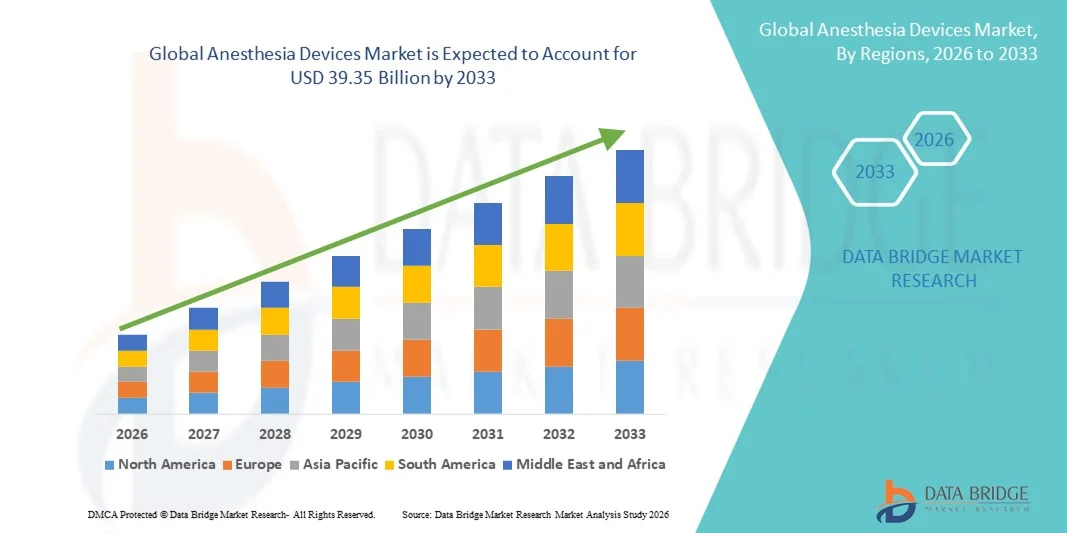
- The global anesthesia devices market size was valued at USD 19.04 billion in 2025 and is expected to reach USD 39.35 billion by 2033, at a CAGR of 9.50% during the forecast period
- The market growth is largely fueled by the increasing number of surgical procedures worldwide, rising prevalence of chronic diseases, and growing demand for advanced perioperative care solutions, leading to greater adoption of anesthesia devices across hospitals, ambulatory surgical centers, and specialty clinics. Continuous technological advancements in anesthesia delivery systems, patient monitoring, and automated ventilators are further driving integration and improving procedural safety in both developed and emerging healthcare markets
- Furthermore, the growing emphasis on patient safety, minimally invasive surgeries, and precision anesthesia management is establishing anesthesia devices as a critical component of modern surgical practice. Expanding healthcare infrastructure, rising geriatric population, and increasing investments in research and development are accelerating the uptake of innovative anesthesia devices, thereby significantly boosting overall industry growth
Anesthesia Devices Market Analysis
- Anesthesia devices, including anesthesia delivery systems, ventilators, and patient monitoring equipment, are increasingly vital components of modern surgical and critical care settings due to their ability to ensure precise, safe, and controlled administration of anesthesia during procedures. Continuous innovations in automated systems, integrated monitoring, and smart ventilators are further enhancing procedural efficiency and patient safety across hospitals and ambulatory surgical centers
- The escalating demand for anesthesia devices is primarily fueled by the rising number of surgical procedures, increasing prevalence of chronic and critical illnesses, growing geriatric population, and the focus on minimally invasive and precision surgeries. Technological advancements, such as AI-enabled monitoring, closed-loop anesthesia delivery, and portable anesthesia systems, are further driving adoption and expanding clinical applications globally
- North America dominated the Anesthesia Devices market with the largest revenue share of approximately 41.2% in 2025, driven by advanced healthcare infrastructure, high surgical volumes, strong reimbursement frameworks, and the presence of key medical device manufacturers. The U.S. continues to experience substantial growth in anesthesia device adoption, supported by innovations in smart ventilators, automated anesthesia delivery systems, and integrated monitoring solutions
- Asia-Pacific is expected to be the fastest-growing region in the Anesthesia Devices market during the forecast period, projected to register a CAGR of approximately 10.8%, fueled by rising healthcare expenditure, increasing hospital infrastructure, growing medical tourism, and expanding awareness of advanced anesthesia technologies in countries such as India, China, and Japan
- The Anesthesia Delivery Machines segment dominated the largest market revenue share of 48.2% in 2025, owing to its crucial role in controlled anesthesia administration across multiple surgical disciplines
Report Scope and Anesthesia Devices Market Segmentation
|
Attributes |
Anesthesia Devices Key Market Insights |
|
Segments Covered |
|
|
Countries Covered |
North America
Europe
Asia-Pacific
Middle East and Africa
South America
|
|
Key Market Players |
|
|
Market Opportunities |
|
|
Value Added Data Infosets |
In addition to the insights on market scenarios such as market value, growth rate, segmentation, geographical coverage, and major players, the market reports curated by the Data Bridge Market Research also include in-depth expert analysis, patient epidemiology, pipeline analysis, pricing analysis, and regulatory framework. |
Anesthesia Devices Market Trends
Technological Advancements and Integration of Modern Monitoring Systems
- A key trend in the global anesthesia devices market is the adoption of advanced anesthesia workstations that integrate real-time patient monitoring, precise gas delivery systems, and safety alarms into a single platform
- These innovations enhance clinical efficiency and enable anesthesiologists to monitor vital parameters continuously during surgical procedures
- For instance, GE Healthcare has introduced anesthesia machines with built-in advanced ventilators and monitoring modules, which allow for precise control of anesthetic gas flow and real-time respiratory monitoring. Such innovations are increasingly adopted in tertiary hospitals and high-volume surgical centers
- Portable and compact anesthesia devices are gaining prominence, especially in outpatient surgical centers and resource-limited hospitals, as they allow flexibility for minor surgeries, emergency interventions, and mobile surgical units
- In addition, the integration of anesthesia devices with electronic medical records facilitates automated data capture and improves post-operative analysis, aiding compliance with regulatory requirements
- There is also a strong focus on patient safety and ergonomics, with devices designed for low gas consumption, intuitive interfaces, and optimized dosing to reduce risks associated with anesthesia administration
- The rise of 3D-printed and customized anesthesia components, along with modular systems that support both open and minimally invasive surgeries, is further shaping the market and driving adoption globally
Anesthesia Devices Market Dynamics
Driver
Increasing Surgical Volumes and Demand for Advanced Perioperative Care
- Rising global incidence of surgical procedures across elective, emergency, and minimally invasive operations is a primary driver for anesthesia device adoption. Aging populations and the prevalence of chronic diseases are increasing the overall surgical workload
- For instance, in countries such as the U.S. and Germany, hospital data indicate growing numbers of orthopedic, cardiac, and abdominal surgeries, which require reliable anesthesia delivery systems to ensure patient safety and efficient operation room management
- Expansion of healthcare infrastructure in emerging economies like India, Brazil, and China is supporting higher surgical capacities, driving demand for both advanced and mid-range anesthesia devices
- The increased adoption of minimally invasive and robotic surgeries also fuels market growth, as such procedures require precise anesthetic control and continuous patient monitoring, making sophisticated anesthesia machines essential
- Growing awareness among healthcare providers about the importance of perioperative patient safety, accurate dosing, and monitoring is further encouraging hospitals to invest in modern anesthesia workstations and supportive equipment like vaporizers, ventilators, and monitoring modules.
Restraint/Challenge
High Device Costs and Regulatory Barriers
- One major challenge is the high cost of advanced anesthesia devices, including full workstations, integrated monitoring modules, and ventilators, which can be prohibitive for small hospitals or clinics in low- and middle-income countries
- For instance, the procurement of state-of-the-art anesthesia machines from companies like Drägerwerk AG & Co. KGaA involves not only device costs but also recurring expenses for maintenance, calibration, and consumables, which may limit widespread adoption
- Stringent regulatory requirements for anesthesia devices, including compliance with ISO standards and national medical device regulations, extend approval timelines and increase development costs for manufacturers
- Technical complexity and need for trained personnel can slow market penetration. Anesthesia devices require skilled anesthesiologists and technicians for safe operation, and shortage of trained staff in certain regions may limit device utilization
- In addition, risk of device malfunction or calibration errors poses clinical and safety concerns. Hospitals must invest in regular maintenance, staff training, and backup systems, which increases operational costs and can hinder adoption in cost-sensitive settings
Anesthesia Devices Market Scope
The market is segmented on the basis of product, type, application, and end-user.
- By Type
On the basis of type, the Anesthesia Devices market is segmented into General Anesthesia and Local Anesthesia. The General Anesthesia segment dominated the largest market revenue share of 45.8% in 2025, driven by its extensive use in complex surgical procedures such as cardiology, neurology, and orthopedic surgeries. Hospitals and ambulatory service centers prioritize general anesthesia devices for their reliability and ability to manage critical cases. Integration with anesthesia monitors and patient safety systems ensures precise drug delivery. Rising surgical volumes due to aging populations boost demand. The segment benefits from advanced features in delivery machines that improve accuracy and patient outcomes. Regulatory approvals and reimbursement frameworks support market adoption. Continuous innovation in anesthesia delivery systems enhances efficiency. Medical professionals prefer general anesthesia for multi-step procedures. Growing awareness about patient safety strengthens adoption. Integration with hospital IT improves data tracking. Private and public hospitals invest in modern anesthesia systems. High clinical reliability maintains market dominance.
The Local Anesthesia segment is expected to witness the fastest CAGR of 21.5% from 2026 to 2033, driven by its growing adoption in outpatient, dental, and ophthalmology procedures. Its lower complication rate and shorter recovery time make it ideal for minor and minimally invasive surgeries. Clinics and small hospitals prefer local anesthesia devices due to cost-effectiveness and portability. Technological advancements in precision delivery and monitoring support widespread uptake. Expansion of dental and ophthalmology centers in emerging economies drives adoption. Integration with real-time monitoring systems enhances procedural safety. Government initiatives promoting modern surgical practices encourage use. Increasing awareness among clinicians about safe anesthesia administration fuels growth. Patients prefer local anesthesia for convenience and reduced risk. Portable and automated systems improve operational efficiency. High demand in cosmetic and pediatric procedures sustains growth. Continuous professional training ensures proper device utilization. Rising medical tourism in countries like India supports expansion.
- By Product
On the basis of product, the Anesthesia Devices market is segmented into Anesthesia Delivery Machines, Anesthesia Monitors, and Anesthesia Information Management Systems (AIMS). The Anesthesia Delivery Machines segment dominated the largest market revenue share of 48.2% in 2025, owing to its crucial role in controlled anesthesia administration across multiple surgical disciplines. Hospitals prioritize machines integrated with monitoring systems for real-time patient safety. High surgical volumes in cardiology, orthopedics, and neurology drive adoption. Advanced features, including automated drug delivery and closed-loop systems, enhance precision. Regulatory compliance and reimbursement frameworks support widespread use. Integration with AIMS and hospital IT systems improves workflow efficiency. Portable delivery machines enable outpatient usage. Increased awareness among clinicians about device accuracy ensures consistent adoption. Private and public healthcare infrastructure expansion contributes to growth. Continuous innovation in sensors and safety alarms strengthens market dominance.
The Anesthesia Information Management Systems (AIMS) segment is expected to witness the fastest CAGR of 20.9% from 2026 to 2033, fueled by the increasing digitization of surgical and patient data. Hospitals adopt AIMS to track anesthesia details, monitor drug usage, and ensure compliance. Integration with hospital EHRs and delivery machines enhances procedural safety and efficiency. Cloud-based platforms improve scalability and accessibility. Rising demand in cardiology, dental, and ophthalmology surgeries accelerates adoption. Real-time analytics enable clinicians to optimize anesthesia delivery. Training programs for staff improve system utilization. Government initiatives promoting digital healthcare support uptake. Reduction in administrative burden and improved documentation encourage adoption. Portable AIMS solutions cater to outpatient clinics. Enhanced reporting and automation strengthen clinical decision-making. Emerging economies with modern hospital networks contribute to market growth.
- By Application
On the basis of application, the Anesthesia Devices market is segmented into Cardiology, Neurology, Dental, Ophthalmology, Urology, Orthopedics, and Others. The Cardiology segment dominated the largest market revenue share of 36.5% in 2025, driven by increasing cardiac surgeries and minimally invasive interventions. Hospitals prioritize precise anesthesia delivery for critical procedures. Integration with monitoring systems ensures patient safety. High prevalence of cardiovascular diseases and growing geriatric populations contribute to market dominance. Regulatory approvals and reimbursement frameworks facilitate adoption. Advanced delivery machines with automated features improve clinical workflow. Expansion of private and public hospitals boosts market penetration. Real-time monitoring and safety alarms enhance clinician confidence. Surgical innovations and minimally invasive techniques increase demand. Rising awareness of anesthesia safety strengthens adoption. Portable solutions enable use in multiple hospital settings. Integration with hospital IT systems ensures proper documentation. Continuous investment in training programs promotes professional adoption.
The Dental and Ophthalmology segment is expected to witness the fastest CAGR of 22.7% from 2026 to 2033, driven by the rising number of outpatient and minimally invasive procedures. Dental and ophthalmology clinics increasingly prefer local anesthesia devices for patient comfort and safety. Technological advancements in precision delivery systems and portability improve adoption. Real-time monitoring integration ensures procedural accuracy. Cost-effectiveness and compact design favor small clinics. Awareness among clinicians about modern anesthesia practices supports growth. Expansion of clinic networks in emerging economies fuels demand. Government initiatives for safe anesthesia administration encourage adoption. Patient preference for reduced recovery time accelerates uptake. Professional training ensures proper device utilization. Cosmetic and pediatric procedure volumes contribute to growth. Integration with clinic management systems improves workflow efficiency. Rising disposable income and healthcare investment sustain market expansion.
Anesthesia Devices Market Regional Analysis
- North America dominated the anesthesia devices market with the largest revenue share of approximately 41.2% in 2025, driven by advanced healthcare infrastructure, high surgical volumes, strong reimbursement frameworks, and the presence of key medical device manufacturers
- Consumers and healthcare providers in the region are increasingly adopting smart ventilators, automated anesthesia delivery systems, and integrated monitoring solutions. Hospitals and ambulatory surgical centers prioritize technologically advanced anesthesia devices for improved patient safety, operational efficiency, and precision in drug delivery
- The high surgical procedure volume, combined with strong clinical awareness and continuous innovation in anesthesia technology, supports market dominance. North American providers also leverage digital anesthesia information management systems (AIMS) to integrate patient data, optimize workflows, and enhance perioperative care
U.S. Anesthesia Devices Market Insight
The U.S. anesthesia devices market captured the largest revenue share in 2025 within North America, fueled by the swift adoption of connected devices and the expanding trend of hospital automation. Hospitals increasingly prioritize devices with advanced monitoring capabilities, automated delivery, and smart integration features. The growing preference for digital anesthesia management, integration with electronic medical records (EMRs), and demand for minimally invasive surgeries further propel market growth. Continuous product innovation, robust healthcare spending, and government support for advanced surgical technologies strengthen adoption.
Europe Anesthesia Devices Market Insight
The Europe anesthesia devices market is projected to expand at a substantial CAGR throughout the forecast period, driven by stringent healthcare regulations, rising focus on patient safety, and growing demand for modern anesthesia delivery and monitoring systems. Countries such as Germany, France, and the U.K. are leading adoption due to advanced hospital infrastructure and high surgical procedure volumes. The integration of AIMS with EMRs, demand for real-time monitoring, and rising outpatient surgical procedures are key factors driving growth. Hospitals and surgical centers are investing in digital anesthesia solutions to enhance efficiency and reduce clinical errors.
U.K. Anesthesia Devices Market Insight
The U.K. anesthesia devices market is expected to grow at a noteworthy CAGR during the forecast period, fueled by increasing hospital modernization, adoption of advanced anesthesia monitoring systems, and government healthcare initiatives. Hospitals and clinics are investing in smart ventilators and automated delivery systems for improved perioperative safety and workflow efficiency.
Germany Anesthesia Devices Market Insight
The Germany anesthesia devices market is expected to expand at a considerable CAGR, supported by high surgical volumes, advanced healthcare infrastructure, and strong emphasis on digital and eco-conscious medical technologies. Hospitals are increasingly adopting automated anesthesia systems integrated with patient monitoring solutions.
Asia-Pacific Anesthesia Devices Market Insight
The Asia-Pacific anesthesia devices market is poised to grow at the fastest CAGR of 10.8% during the forecast period, driven by rising healthcare expenditure, expansion of hospital infrastructure, growing medical tourism, and increasing awareness of advanced anesthesia technologies in countries such as India, China, and Japan. Rapid urbanization, government healthcare initiatives, and investments in modern surgical centers are further supporting market growth. Hospitals and clinics are adopting smart ventilators, automated anesthesia delivery systems, and anesthesia information management systems (AIMS) to enhance operational efficiency and patient safety.
Japan Anesthesia Devices Market Insight
The Japan anesthesia devices market is gaining momentum due to the country’s high-tech healthcare ecosystem, aging population, and high surgical procedure volumes. Hospitals and clinics are increasingly investing in automated anesthesia systems, smart ventilators, and integrated monitoring solutions. Advanced perioperative management practices and technology integration drive adoption.
China Anesthesia Devices Market Insight
The China anesthesia devices market accounted for the largest market revenue share in Asia-Pacific in 2025, driven by expanding hospital infrastructure, rising healthcare expenditure, rapid urbanization, and strong domestic manufacturing capabilities. Hospitals are adopting automated anesthesia delivery machines, advanced monitors, and AIMS solutions to meet increasing surgical procedure volumes. Government initiatives supporting modernization of medical facilities further propel market growth.
Anesthesia Devices Market Share
The Anesthesia Devices industry is primarily led by well-established companies, including:
- Medtronic plc (Ireland)
- GE Healthcare Technologies Inc. (U.S.)
- Drägerwerk AG & Co. KGaA (Germany)
- Philips Healthcare (Netherlands)
- Mindray Medical International Limited (China)
- Smiths Medical (U.K.)
- Getinge AB (Sweden)
- Masimo Corporation (U.S.)
- B. Braun Melsungen AG (Germany)
- Nihon Kohden Corporation (Japan)
- ConvaTec Group PLC (U.K.)
- Fresenius Kabi AG (Germany)
- Nihon Kohden America, Inc. (U.S.)
- Penlon Ltd. (U.K.)
- Spacelabs Healthcare (U.S.)
- ZOLL Medical Corporation (U.S.)
- Respironics, Inc. (U.S.)
- CareFusion Corporation (U.S.)
- Analogic Corporation (U.S.)
- Dräger Medical Inc. (U.S.)
Latest Developments in Global Anesthesia Devices Market
- In September 2023, Drägerwerk AG & Co. KGaA launched the Atlan anesthesia workstation family in the United States, offering versatile configurations designed to support patients ranging from neonates to adults, with advanced ventilation capabilities and integrated safety systems to optimize care across surgical procedures
- In March 2023, Smiths Medical announced the launch of the CADD® Solis Wireless Anesthesia Infusion System, a wireless‑enabled infusion pump for anesthetic drugs, enabling clinicians to deliver anesthetic agents more precisely and with enhanced workflow efficiency in operating room and critical care environments
- In March 2024, Medtronic plc received U.S. FDA clearance for the BIS Advance monitor, a brain monitoring system that assesses the depth of anesthesia to help healthcare professionals tailor anesthetic dosing in real time, thus aiming to reduce risks of over‑ or under‑ sedation
- In January 2025, Dräger’s Atlan A350/A350XL anesthesia machines received an Innovative Technology designation from Vizient for their clinical impact, advanced ventilation technology, and sustainability‑focused design that reduces anesthetic agent usage and environmental footprint in operating rooms
- In April 2025, Drägerwerk AG & Co. KGaA introduced the Atlan® A100 anesthesia workstation in India, designed with advanced lung‑protective ventilation, low‑flow anesthesia, improved infection control features, and digital connectivity to enhance workflow efficiency and patient safety in perioperative care settings
- In October 2025, GE HealthCare unveiled the Carestation 850 anesthesia delivery system at the ANESTHESIOLOGY 2025 conference in San Antonio, Texas, featuring enhanced clinical tools, customizable applications, smart vaporization control, and an intuitive interface to support perioperative precision and operational efficiency across diverse patient groups, from neonates to adults
- In August 2025, Drägerwerk AG & Co. KGaA announced that its Atlan A350/A350 XL anesthesia workstations received Authority to Operate (ATO) certification under the U.S. Department of Defense’s cybersecurity Risk Management Framework, enhancing device data protection and patient security in networked clinical environments

- Interactive Data Analysis Dashboard
- Company Analysis Dashboard for high growth potential opportunities
- Research Analyst Access for customization & queries
- Competitor Analysis with Interactive dashboard
- Latest News, Updates & Trend analysis
- Harness the Power of Benchmark Analysis for Comprehensive Competitor Tracking
Data collection and base year analysis are done using data collection modules with large sample sizes. The stage includes obtaining market information or related data through various sources and strategies. It includes examining and planning all the data acquired from the past in advance. It likewise envelops the examination of information inconsistencies seen across different information sources. The market data is analysed and estimated using market statistical and coherent models. Also, market share analysis and key trend analysis are the major success factors in the market report. To know more, please request an analyst call or drop down your inquiry.
The key research methodology used by DBMR research team is data triangulation which involves data mining, analysis of the impact of data variables on the market and primary (industry expert) validation. Data models include Vendor Positioning Grid, Market Time Line Analysis, Market Overview and Guide, Company Positioning Grid, Patent Analysis, Pricing Analysis, Company Market Share Analysis, Standards of Measurement, Global versus Regional and Vendor Share Analysis. To know more about the research methodology, drop in an inquiry to speak to our industry experts.
Data Bridge Market Research is a leader in advanced formative research. We take pride in servicing our existing and new customers with data and analysis that match and suits their goal. The report can be customized to include price trend analysis of target brands understanding the market for additional countries (ask for the list of countries), clinical trial results data, literature review, refurbished market and product base analysis. Market analysis of target competitors can be analyzed from technology-based analysis to market portfolio strategies. We can add as many competitors that you require data about in the format and data style you are looking for. Our team of analysts can also provide you data in crude raw excel files pivot tables (Fact book) or can assist you in creating presentations from the data sets available in the report.













