Global Ammonia Fertilizer Market
Market Size in USD Billion

 USD
65.50 Billion
USD
107.18 Billion
2025
2033
USD
65.50 Billion
USD
107.18 Billion
2025
2033
 Forecast Period Forecast Period |
2026 - 2033 |
 Market Size (Base Year) Market Size (Base Year) |
USD 65.50 Billion |
 Market Size (Forecast Year) Market Size (Forecast Year) |
USD 107.18 Billion |
 CAGR CAGR |
% |
| Major Markets Players |
|
Ammonia Fertilizer Market Overview
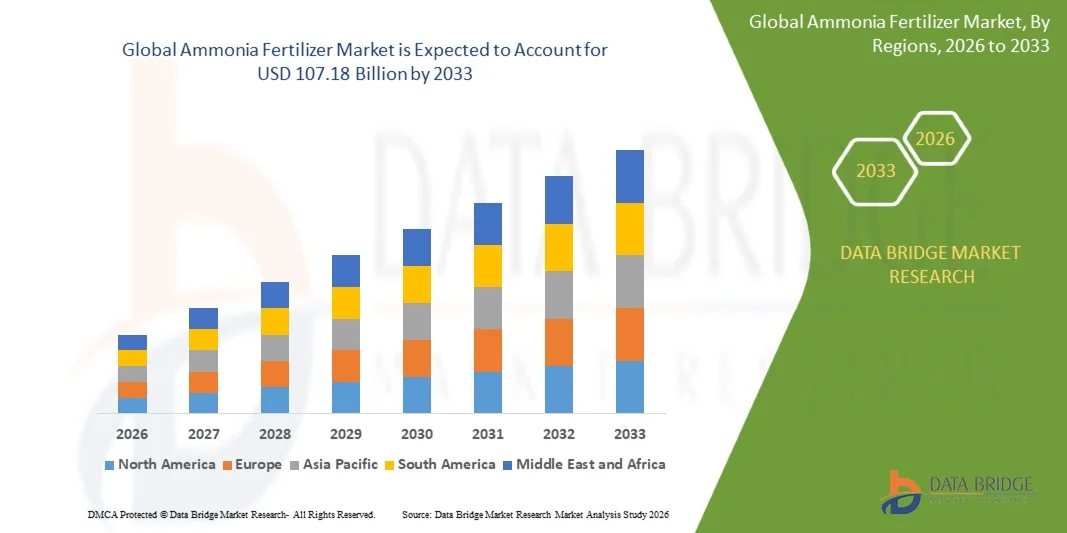
As per Data Bridge Market Research Analysis the ammonia fertilizer market was valued at USD 65.50 billion in 2025 and is projected to reach USD 107.18 billion by 2033, growing at a CAGR of 6.35 % from 2026 to 2033. Market growth is primarily driven by the increasing g demand for food production, rising consumption of nitrogen-based fertilizers, and the growing need to improve agricultural productivity and crop yields. Increasing adoption of ammonia fertilizers to enhance soil fertility, optimize nutrient utilization, and support sustainable farming practices is further contributing to market expansion.
Growing cultivation of cereals, grains, oilseeds, fruits, and vegetables is creating sustained demand for ammonia fertilizers across major agricultural economies. Increasing emphasis on precision agriculture, balanced nutrient management, and efficient fertilizer application is encouraging the use of ammonia fertilizers to maximize farm productivity while minimizing nutrient losses. Furthermore, supportive government initiatives for agricultural development, expansion of fertilizer production capacities, technological advancements in ammonia manufacturing, and increasing investments in low-carbon and green ammonia projects are expected to strengthen market growth throughout the forecast period.
Market Size & Forecast
- Market Value (2025): USD 65.50 Billion
- Expected Market Value (2033): USD 107.18 Billion
- Forecast CAGR (2026–2033): 4.55%
- Leading Region in 2025: North America
- Fastest Growing Region: Asia-Pacific
Key Market Trends & Insights
- North America dominated the ammonia fertilizer market with the largest revenue in 2025 supported by its advanced agricultural sector, high adoption of nitrogen-based fertilizers, and substantial ammonia production capacity.
- Asia-Pacific is expected to witness significant growth during the forecast period from 2026 to 2023, driven by its vast agricultural sector, high ammonia production capacity, and strong demand for nitrogen-based fertilizers across China, India, and other major agricultural economies.
- The liquid segment held the largest market revenue share in 2025 driven by its extensive use in anhydrous ammonia fertilizers, high nitrogen concentration, cost-effective bulk transportation, and efficient field application. Rising demand for nitrogen-based fertilizers to improve crop productivity and support global food production continues to strengthen the segment's market leadership.
- The gas segment is expected to witness the fastest growth during the forecast period from 2026 to 2033 driven by increasing investments in green and blue ammonia production technologies, renewable hydrogen-based ammonia synthesis, and growing demand for low-carbon ammonia in sustainable fertilizer manufacturing.
- The fertilizers segment held the largest market revenue share in 2025 driven by the widespread use of ammonia as a key feedstock for manufacturing nitrogen-based fertilizers such as urea, ammonium nitrate, and ammonium sulfate. Increasing global food demand, the need to improve crop yields, and government initiatives supporting agricultural productivity continue to drive segment growth.
- The pharmaceuticals segment is expected to witness the fastest growth during the forecast period from 2026 to 2033 driven by increasing use of ammonia in the production of pharmaceutical intermediates, active pharmaceutical ingredients (APIs), and specialty chemicals.
Report Scope and Ammonia Fertilizer Market Segmentation
|
Attributes |
Ammonia Fertilizer Key Market Segments |
|
Segments Covered |
|
|
Countries Covered |
North America
Europe
Asia-Pacific
Middle East and Africa
South America
|
|
Key Market Players |
|
|
Market Opportunities |
|
|
Value Added Data Infosets |
In addition to the insights on market scenarios such as market value, growth rate, segmentation, geographical coverage, and major players, the market reports curated by the Data Bridge Market Research also include import export analysis, production capacity overview, production consumption analysis, price trend analysis, climate change scenario, supply chain analysis, value chain analysis, raw material/consumables overview, vendor selection criteria, PESTLE Analysis, Porter Analysis, and regulatory framework. |
Ammonia Fertilizer Market Trends
Trend: Rising Adoption of Low-Carbon Ammonia Production and Precision Nutrient Management
The ammonia fertilizer market is witnessing a significant shift toward low-carbon ammonia production and precision nutrient management as governments and manufacturers focus on reducing greenhouse gas emissions while improving agricultural productivity. Increasing demand for sustainable fertilizers, renewable hydrogen integration, carbon capture technologies, and precision agriculture is accelerating investments in green and blue ammonia production while improving nitrogen use efficiency.
For instance, June 2024, Yara International ASA is expanding its low-carbon ammonia initiatives through investments in green ammonia production and renewable hydrogen projects. The company is also advancing digital farming solutions to optimize fertilizer application, improve nitrogen use efficiency, and support sustainable agricultural practices.
The growing adoption of low-carbon ammonia production and precision nutrient management is expected to accelerate sustainable fertilizer manufacturing and drive long-term market growth.
Ammonia Fertilizer Market Dynamics
Key Market Driver: Rising Demand for Low-Carbon Ammonia in Sustainable Fertilizer Production
The increasing demand for low-carbon ammonia in sustainable fertilizer production is driving the growth of the ammonia fertilizer market. Governments and fertilizer manufacturers are investing in clean ammonia technologies, renewable hydrogen, and carbon reduction initiatives to lower greenhouse gas emissions while maintaining agricultural productivity. Rising demand for nitrogen fertilizers and growing emphasis on improving nitrogen use efficiency are further supporting market expansion.
For instance, in April 2024, OCI Global entered into a long-term agreement with COMPO EXPERT to supply lower-carbon ammonia for the production of lower-carbon NPK fertilizers. The initiative demonstrates the increasing adoption of low-carbon ammonia to reduce emissions associated with fertilizer manufacturing.
The rising demand for low-carbon ammonia in sustainable fertilizer production is expected to remain a key driver of the ammonia fertilizer market.
Key Restraint/Challenge: Fluctuations in Natural Gas Supply and Rising Production Costs
Fluctuations in natural gas supply and rising production costs remain major challenges for the ammonia fertilizer market. As natural gas is the primary feedstock for conventional ammonia production, volatility in gas availability and pricing directly affects production costs, fertilizer prices, and manufacturing capacity. Increasing environmental compliance requirements and investments in low-carbon technologies further add to production costs.
For instance, in October 2025, Nutrien Ltd. commenced a controlled shutdown of its Trinidad nitrogen operations due to unreliable and uneconomic natural gas supply and port access restrictions, directly impacting ammonia and urea production.
Natural gas supply volatility and rising production costs are expected to remain significant challenges for ammonia fertilizer manufacturers.
Key Market Opportunity: Expansion of Low-Carbon and Green Ammonia Production for Sustainable Fertilizer Manufacturing
The expansion of low-carbon and green ammonia production is creating significant growth opportunities for the ammonia fertilizer market. Increasing investments in renewable hydrogen, decarbonization technologies, and sustainable fertilizer manufacturing are encouraging producers to transition from conventional ammonia production to environmentally friendly alternatives. Supportive government policies and rising demand for sustainable nitrogen fertilizers are expected to further accelerate market growth.
For instance, in November 2021 Borealis AG partnered with Hynamics to develop a low-carbon ammonia production project at its fertilizer production facility in Ottmarsheim, France, incorporating a 30 MW electrolysis plant to produce renewable hydrogen for manufacturing approximately 24,000 tonnes of low-carbon ammonia annually.
The expansion of low-carbon and green ammonia production is expected to create substantial long-term growth opportunities for the ammonia fertilizer market.
Ammonia Fertilizer Market Scope
The ammonia fertilizer market is segmented based on product form, application, type, crop type, grade, and usage.
- • By Product Form
On the basis of product form, the market is segmented into liquid, gas, and powder. The liquid segment held the largest market revenue share in 2025 driven by its extensive use in anhydrous ammonia fertilizers, high nitrogen concentration, cost-effective bulk transportation, and efficient field application. Rising demand for nitrogen-based fertilizers to improve crop productivity and support global food production continues to strengthen the segment's market leadership.
The gas segment is expected to witness the fastest growth during the forecast period from 2026 to 2033 driven by increasing investments in green and blue ammonia production technologies, renewable hydrogen-based ammonia synthesis, and growing demand for low-carbon ammonia in sustainable fertilizer manufacturing. Advancements in ammonia storage and transportation technologies are further supporting segment growth.
- By Application
On the basis of application, the market is segmented into fertilizers, pharmaceuticals, textile, refrigerants, and others. The fertilizers segment held the largest market revenue share in 2025 driven by the widespread use of ammonia as a key feedstock for manufacturing nitrogen-based fertilizers such as urea, ammonium nitrate, and ammonium sulfate. Increasing global food demand, the need to improve crop yields, and government initiatives supporting agricultural productivity continue to drive segment growth.
The pharmaceuticals segment is expected to witness the fastest growth during the forecast period from 2026 to 2033 driven by increasing use of ammonia in the production of pharmaceutical intermediates, active pharmaceutical ingredients (APIs), and specialty chemicals. Rising healthcare expenditure, expanding pharmaceutical manufacturing, and growing demand for high-purity chemicals are expected to accelerate segment growth.
- By Type
On the basis of type, the ammonia fertilizer market is segmented into anhydrous ammonia, aqua ammonia, urea, and ammonium phosphate. The anhydrous ammonia segment held the largest market revenue share in 2025, driven by its high nitrogen concentration, cost efficiency, and widespread adoption across large-scale agricultural operations. Farmers prefer anhydrous ammonia for corn and cereal crop cultivation due to its effectiveness in improving crop yields and soil fertility.
The urea segment is projected to register the fastest growth at a CAGR from 2026 to 2033, driven by its ease of handling, lower transportation costs, high nutrient efficiency, and growing demand across developing agricultural economies. Increasing adoption in precision farming and sustainable nutrient management practices is further supporting segment growth.
- By Crop Type
On the basis of crop type, the ammonia fertilizer market is segmented into corn, soybean, wheat, and rice. The corn segment accounted for the largest market revenue share in 2025, supported by extensive global corn cultivation and the crop's high nitrogen requirements. Ammonia fertilizers remain essential for maximizing corn productivity, particularly in North America, China, and Brazil.
The soybean segment is expected to witness the fastest growth at a CAGR from 2026 to 2033, driven by rising demand for plant-based protein products, expanding soybean acreage, and increasing focus on sustainable agricultural practices. Growing global consumption of soy products is accelerating fertilizer demand across soybean-producing regions.
- By Grade
On the basis of grade, the ammonia fertilizer market is segmented into technical grade and food grade. The technical grade segment dominated the market with a revenue share in 2025, owing to its extensive use in agricultural fertilizer manufacturing and large-scale crop production. Its cost-effectiveness and widespread availability continue to support strong market demand.
The food grade segment is anticipated to register the fastest growth at a CAGR from 2026 to 2033, driven by increasing applications in food processing, refrigeration systems, and specialty agricultural products. Growing regulatory emphasis on product purity and quality standards is further contributing to segment expansion.
- By Usage
On the basis of usage, the ammonia fertilizer market is segmented into bulk and packaged. The bulk segment held the largest market revenue share in 2025, driven by strong demand from commercial farms and large agricultural enterprises that require high-volume fertilizer procurement. Bulk fertilizers offer lower logistics costs and improved operational efficiency for large-scale farming operations.
The packaged segment is projected to register the fastest growth at a CAGR from 2026 to 2033, supported by rising demand from small and medium-sized farms, horticulture applications, and retail agricultural markets. Convenience, easier storage, and increasing adoption among independent growers are contributing to segment growth.
Ammonia Fertilizer Market Analysis
North America Ammonia Fertilizer Market Insight
North America dominated the ammonia fertilizer market with the largest revenue in 2025 supported by its advanced agricultural sector, high adoption of nitrogen-based fertilizers, and substantial ammonia production capacity. Strong availability of natural gas, continuous investments in modern fertilizer manufacturing facilities, and increasing demand for higher crop yields continue to support market expansion. Furthermore, growing investments in low-carbon ammonia production, carbon capture and storage (CCS) technologies, and precision nutrient management are expected to strengthen the regional market while supporting sustainable agricultural practices.
U.S. Ammonia Fertilizer Market Insight
The U.S. dominated the ammonia fertilizer market with the largest revenue in 2025, driven by abundant natural gas resources, advanced fertilizer manufacturing infrastructure, and strong demand for nitrogen fertilizers across commercial agriculture. Increasing investments in clean ammonia production, carbon capture technologies, renewable hydrogen integration, and sustainable farming practices continue to support market growth. In addition, rising adoption of precision agriculture and government initiatives promoting efficient fertilizer utilization are expected to further strengthen the country's market position throughout the forecast period.
Asia-Pacific Ammonia Fertilizer Market Insight
Asia-Pacific is expected to witness significant growth during the forecast period from 2026 to 2023, driven by its vast agricultural sector, high ammonia production capacity, and strong demand for nitrogen-based fertilizers across China, India, and other major agricultural economies. Rising food demand, expanding cultivation of cereals, rice, wheat, and other staple crops, along with supportive government initiatives promoting balanced fertilizer application and sustainable farming practices, continue to strengthen regional demand. In addition, increasing investments in green ammonia production, renewable hydrogen integration, and precision agriculture technologies are expected to reinforce Asia-Pacific's leading position throughout the forecast period.
China Ammonia Fertilizer Market Insight
China accounted for the largest share of the Asia-Pacific ammonia fertilizer market in 2025, supported by its extensive agricultural sector, large-scale fertilizer manufacturing capacity, and strong domestic demand for nitrogen-based fertilizers. The country continues to invest in modern ammonia production technologies, low-carbon manufacturing initiatives, and energy-efficient production facilities to ensure fertilizer security while reducing carbon emissions. Furthermore, increasing adoption of precision agriculture, government policies promoting efficient nutrient management, and expanding green ammonia projects are expected to strengthen China's leadership in the regional market.
Japan Ammonia Fertilizer Market Insight
Japan is expected to witness significant growth during the forecast period from 2026 to 2033, driven by increasing investments in low-carbon ammonia production, renewable hydrogen technologies, and sustainable agricultural practices. The country is actively promoting clean ammonia as part of its decarbonization strategy while encouraging efficient fertilizer use through precision farming technologies. In addition, growing collaboration between fertilizer manufacturers, energy companies, and research institutions to develop green ammonia production is expected to accelerate the adoption of sustainable ammonia fertilizers across the country.
Europe Ammonia Fertilizer Market Insight
Europe is expected to witness steady growth during the forecast period from 2026 to 2023, driven by increasing demand for sustainable fertilizers, stringent environmental regulations, and rising investments in low-carbon ammonia production. Countries including Germany, Norway, the Netherlands, France, and the U.K. are investing in renewable hydrogen, carbon capture and storage (CCS), and green ammonia technologies to reduce emissions associated with conventional ammonia manufacturing. Furthermore, increasing adoption of precision farming, supportive policies under the European Green Deal, and collaborations between fertilizer manufacturers and clean energy companies continue to strengthen regional market growth.
Germany Ammonia Fertilizer Market Insight
Germany is expected to witness steady growth during the forecast period from 2026 to 2023, supported by increasing investments in renewable hydrogen, green ammonia projects, and sustainable fertilizer manufacturing. The country's strong industrial base, focus on decarbonization, and continuous investments in energy-efficient ammonia production technologies are accelerating the transition toward low-carbon fertilizer production. In addition, government support for climate-neutral industrial processes and precision nutrient management is expected to further drive market growth.
U.K. Ammonia Fertilizer Market Insight
The U.K. ammonia fertilizer market is expected to witness notable growth during the forecast period from 2026 to 2033, driven by increasing investments in green ammonia production, renewable energy integration, and sustainable agriculture initiatives. Government policies supporting net-zero emissions, expanding hydrogen infrastructure, and growing adoption of precision farming technologies are encouraging fertilizer manufacturers to adopt lower-carbon production methods. Furthermore, collaborations between industry participants and clean energy developers to establish low-carbon ammonia projects are expected to accelerate market growth across the country.
Ammonia Fertilizer Market Share
The ammonia fertilizer market Analysis is primarily led by well-established companies, including:
- Yara International ASA (Norway)
- CF Industries Holdings, Inc. (U.S.)
- Nutrien Ltd. (Canada)
- EuroChem Group AG (Switzerland)
- Koch Fertilizer, LLC (U.S.)
- Saudi Basic Industries Corporation (SABIC) (Saudi Arabia)
- Acron Group (Russia)
- Qatar Fertiliser Company (QAFCO) (Qatar)
- Fertiglobe plc (U.A.E.)
- TogliattiAzot (TOAZ) (Russia)
- OCI Global (Netherlands)
- Gujarat State Fertilizers & Chemicals Limited (GSFC) (India)
- Coromandel International Limited (India)
- Chambal Fertilisers and Chemicals Limited (India)
- Indian Farmers Fertiliser Cooperative Limited (IFFCO) (India)
Latest Developments in Ammonia Fertilizer Market
- In January 2026, AM Green signed a long-term offtake agreement with Uniper to supply more than 500,000 tonnes of green ammonia annually, with the first deliveries expected in 2028. The agreement supports Europe's industrial decarbonization goals and strengthens the emerging green hydrogen and ammonia supply corridor between India and Europe.
- In December 2025, OCI Global commenced ammonia production at its Beaumont New Ammonia facility in Texas, U.S., ahead of the planned implementation of carbon capture and storage (CCS) technology and the transfer of operations to Woodside Energy. The facility is designed to produce up to 1.1 million tonnes of blue ammonia annually in its initial phase, supporting fertilizer production, power generation, and marine fuel applications. This development strengthens global low-carbon ammonia supply and supports the transition toward more sustainable fertilizer manufacturing.
- In January 2025, Samsung E&A advanced the Wabash Low-Carbon Ammonia Project in Indiana, U.S., for a facility capable of producing 500,000 tonnes of low-carbon ammonia annually while capturing approximately 1.67 million tonnes of CO₂ each year. The project is expected to improve sustainable fertilizer production, reduce emissions associated with conventional ammonia manufacturing, and strengthen the North American low-carbon ammonia supply chain.
SKU-

- Interactive Data Analysis Dashboard
- Company Analysis Dashboard for high growth potential opportunities
- Research Analyst Access for customization & queries
- Competitor Analysis with Interactive dashboard
- Latest News, Updates & Trend analysis
- Harness the Power of Benchmark Analysis for Comprehensive Competitor Tracking
Data collection and base year analysis are done using data collection modules with large sample sizes. The stage includes obtaining market information or related data through various sources and strategies. It includes examining and planning all the data acquired from the past in advance. It likewise envelops the examination of information inconsistencies seen across different information sources. The market data is analysed and estimated using market statistical and coherent models. Also, market share analysis and key trend analysis are the major success factors in the market report. To know more, please request an analyst call or drop down your inquiry.
The key research methodology used by DBMR research team is data triangulation which involves data mining, analysis of the impact of data variables on the market and primary (industry expert) validation. Data models include Vendor Positioning Grid, Market Time Line Analysis, Market Overview and Guide, Company Positioning Grid, Patent Analysis, Pricing Analysis, Company Market Share Analysis, Standards of Measurement, Global versus Regional and Vendor Share Analysis. To know more about the research methodology, drop in an inquiry to speak to our industry experts.
Data Bridge Market Research is a leader in advanced formative research. We take pride in servicing our existing and new customers with data and analysis that match and suits their goal. The report can be customized to include price trend analysis of target brands understanding the market for additional countries (ask for the list of countries), clinical trial results data, literature review, refurbished market and product base analysis. Market analysis of target competitors can be analyzed from technology-based analysis to market portfolio strategies. We can add as many competitors that you require data about in the format and data style you are looking for. Our team of analysts can also provide you data in crude raw excel files pivot tables (Fact book) or can assist you in creating presentations from the data sets available in the report.