


What is the Airport Access Control Market Size and Growth Rate?
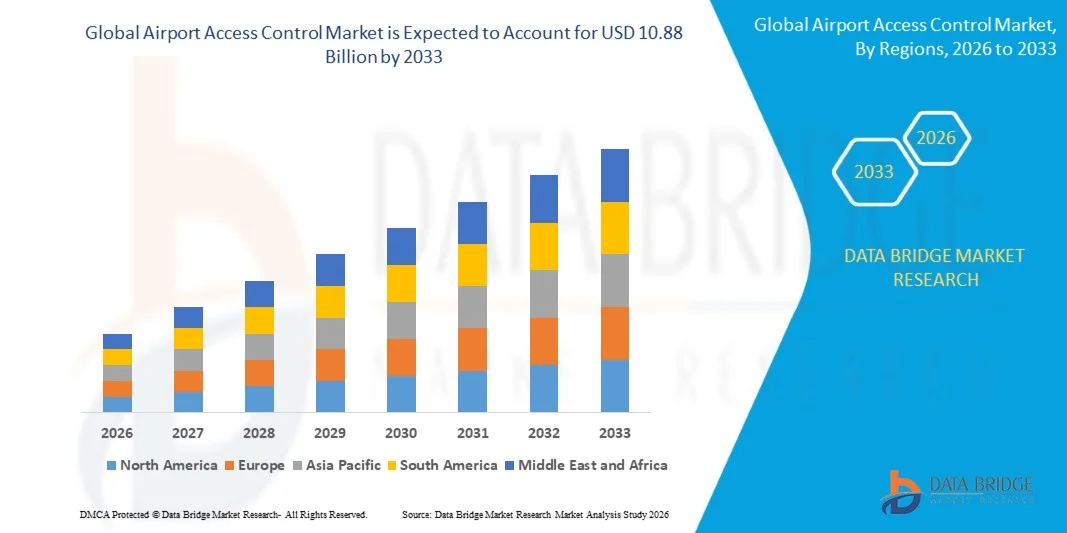
As per Data Bridge Market Research analysis the Airport Access Control Market was valued at USD 6.73 billion in 2025 and is projected to reach USD 10.88 billion by 2033, growing at a CAGR of 6.20% from 2026 to 2033. The market is experiencing steady growth driven by increasing security concerns at airports, rising passenger traffic, expanding airport infrastructure projects, and growing adoption of biometric authentication, smart card, and mobile credential technologies.
The increasing need to prevent unauthorized access to restricted airport zones, including terminals, runways, baggage handling areas, cargo facilities, and airside operations, is encouraging airport authorities to deploy advanced access control systems. Biometric readers, facial recognition platforms, RFID-enabled identification cards, and integrated security management solutions are replacing conventional manual verification processes, providing improved identity validation, real-time monitoring, and faster passenger and employee movement across airport facilities.
Market Size & Forecast
- Global Market Value (2025): USD 6.73 Billion
- Expected Market Value (2033): USD 10.88 Billion
- Forecast CAGR (2026–2033): 6.20%
- Leading Region in 2025: North America
- Fastest Growing Region: Asia-Pacific
Key Market Trends & Insights
- North America dominated the airport access control market with the largest revenue share in 2025, supported by stringent aviation security regulations, high passenger traffic, extensive deployment of biometric screening systems, and continued investment in airport infrastructure modernization and homeland security technologies.
- Asia-Pacific is expected to be the fastest-growing region, recording a CAGR of 7.10% from 2026 to 2033. Growth is driven by rapid airport construction, increasing air passenger traffic, rising investment in smart airport infrastructure, and expanding adoption of biometric identity verification, surveillance, and integrated security management systems across China, India, Japan, and South Korea.
- The screening segment held the largest market revenue share of approximately 31.8% in 2025 driven by the growing need for passenger, baggage, cargo, and employee screening across airport terminals. Screening technologies are widely deployed to identify prohibited items, verify identities, and support aviation security compliance across high-traffic airport facilities.
- The cyber security segment is projected to register the fastest growth at a CAGR of 7.4% from 2026 to 2033, driven by the increasing digitization of airport operations, growing adoption of cloud-based access control platforms, and rising risks of cyberattacks targeting airport networks. Increasing integration of biometric systems, connected surveillance devices, and digital identity platforms is accelerating demand for advanced cyber security solutions.
- The hardware segment held the largest market revenue share of approximately 48.5% in 2025 driven by widespread deployment of biometric readers, smart card scanners, RFID devices, access gates, surveillance cameras, and physical barriers. Hardware systems remain essential for controlling entry into restricted airport areas and supporting identity verification across passenger and employee access points.
- The software segment is projected to register the fastest growth at a CAGR of 7.1% from 2026 to 2033, driven by increasing adoption of cloud-based access management, identity verification platforms, video analytics, and centralized security monitoring solutions. Airport operators are increasingly using software platforms to integrate access control systems with surveillance networks, passenger processing systems, and emergency response operations.
Report Scope and Airport Access Control Market Segmentation
|
Attributes |
Airport Access Control Key Market Insights |
|
Segments Covered |
|
|
Countries Covered |
North America
Europe
Asia-Pacific
Middle East and Africa
South America
|
|
Key Market Players |
|
|
Market Opportunities |
|
|
Value Added Data Infosets |
|
What is the Key Trend in the Airport Access Control Market?
Trend: Increasing Adoption Of Biometric And Contactless Airport Access Control Systems
The growing focus on passenger safety, operational efficiency, and seamless airport movement is increasing the adoption of biometric and contactless access control technologies across global airports. Conventional manual identity verification and physical access procedures can create long queues, operational delays, and security vulnerabilities, encouraging airport authorities to implement facial recognition, fingerprint authentication, iris recognition, RFID credentials, and mobile-based access systems.
Major airports are increasingly integrating biometric systems into passenger processing, employee access, baggage handling, and restricted-area entry points. For instance, the U.S. Customs and Border Protection biometric facial comparison program has processed more than 300 million travelers since its introduction and has prevented more than 2,000 impostors from entering the country using fraudulent travel documents. These systems enable automated identity verification at boarding gates, immigration counters, and airport security checkpoints while reducing dependence on physical passports and boarding passes.
The rapid expansion of smart airport infrastructure is also supporting the deployment of integrated access control platforms connected with video surveillance, visitor management, and security operations centers. In addition, the International Air Transport Association has reported that 46% of passengers used biometrics at some point during their airport journey in 2024, reflecting growing passenger acceptance of contactless travel technologies. Airports are increasingly adopting cloud-based access management and AI-enabled monitoring systems to improve real-time threat detection, reduce waiting times, and support efficient airport operations.
Airport Access Control Market Dynamics
Key Market Driver: Rising Security Requirements And Airport Infrastructure Modernization
Airports worldwide are facing increasing pressure to strengthen security across terminals, airside facilities, baggage handling zones, cargo operations, and employee-only areas. The need to prevent unauthorized entry, improve identity verification, and maintain compliance with aviation security regulations is creating strong demand for advanced airport access control systems. Rising passenger volumes and expanding airport capacity are further increasing the number of access points requiring continuous monitoring and authentication.
Airport operators are increasingly deploying biometric readers, smart card systems, RFID badges, and integrated security management platforms to control access to sensitive areas. For instance, the U.S. Transportation Security Administration screened more than 904 million passengers in 2024, highlighting the large-scale security and passenger processing requirements across airport infrastructure. Automated access control systems support faster credential validation, real-time audit trails, and centralized monitoring, improving operational control across high-traffic airport environments.
Similarly, airport expansion projects across Asia-Pacific, the Middle East, and Europe are incorporating digital access control technologies into new terminals and modernization programs. The Airports Council International reported that global passenger traffic reached approximately 9.5 billion passengers in 2024, increasing demand for scalable security infrastructure. The integration of access control systems with CCTV, intrusion detection, and emergency response platforms is further supporting market growth by enabling coordinated security management and faster incident response.
Key Restraint/Challenge: High Implementation Cost And Data Privacy Concerns
Advanced airport access control systems require significant investment in biometric sensors, cameras, software platforms, network infrastructure, cybersecurity tools, and system integration services. Large airports may need to deploy thousands of access control devices across terminals, runways, cargo areas, staff entrances, and restricted zones, increasing initial implementation and maintenance costs. These expenses can create adoption challenges for smaller regional airports and airports operating under constrained infrastructure budgets.
In addition, the collection and processing of biometric data, including facial images, fingerprints, and iris scans, can create data privacy and cybersecurity concerns. Airport operators must comply with data protection regulations and establish secure storage, encryption, consent, and data retention practices to reduce the risk of unauthorized access or misuse. For instance, the European Union General Data Protection Regulation can impose administrative fines of up to EUR 20 million or 4% of global annual turnover for serious data protection violations, increasing compliance requirements for biometric access control deployments.
Interoperability challenges can also affect system deployment, as airports often operate legacy security infrastructure from multiple vendors. Integrating new biometric access systems with existing CCTV networks, identity management databases, airline systems, and border control platforms can increase project complexity and implementation timelines. Maintaining system availability during upgrades is particularly important, as airport access disruptions can affect flight operations, passenger movement, and security procedures.
Key Market Opportunity: Expansion Of Digital Identity And Smart Airport Ecosystems
The growing adoption of digital travel credentials, mobile identity platforms, and smart airport ecosystems is creating significant opportunities for airport access control providers. Airports are increasingly seeking interoperable systems that enable passengers, employees, contractors, and visitors to use secure digital credentials across multiple airport touchpoints. These technologies can improve airport throughput, reduce physical document handling, and support personalized passenger services while maintaining strict security controls.
Airports and airlines are increasingly testing biometric boarding, self-service bag drop, and digital identity verification solutions to improve passenger experience. For instance, the International Air Transport Association One ID initiative is promoting the use of digital identity and biometric recognition to enable contactless airport processing, while the International Civil Aviation Organization Digital Travel Credential framework supports secure digital representations of travel documents. These initiatives are expected to expand the use of integrated access control platforms across check-in, security, border control, lounges, and boarding gates.
In addition, artificial intelligence and analytics are improving the value of airport access control data by enabling anomaly detection, crowd management, and predictive security monitoring. The Airports Council International forecasts that global passenger traffic could reach approximately 19.3 billion passengers by 2042, creating long-term demand for scalable and automated airport security infrastructure. Growing investment in airport digitalization, cloud-based security management, and biometric identity verification is expected to create opportunities for access control providers across major international airports and emerging regional aviation hubs.
How is the Airport Access Control Market Segmented?
The market is segmented on the basis of technology and component.
- By Technology
On the basis of technology, the airport access control market is segmented into cyber security, perimeter security, screening, surveillance, and others. The screening segment held the largest market revenue share of approximately 31.8% in 2025 driven by the growing need for passenger, baggage, cargo, and employee screening across airport terminals. Screening technologies are widely deployed to identify prohibited items, verify identities, and support aviation security compliance across high-traffic airport facilities.
The cyber security segment is projected to register the fastest growth at a CAGR of 7.4% from 2026 to 2033, driven by the increasing digitization of airport operations, growing adoption of cloud-based access control platforms, and rising risks of cyberattacks targeting airport networks. Increasing integration of biometric systems, connected surveillance devices, and digital identity platforms is accelerating demand for advanced cyber security solutions.
- By Component
On the basis of component, the airport access control market is segmented into hardware, software, and services. The hardware segment held the largest market revenue share of approximately 48.5% in 2025 driven by widespread deployment of biometric readers, smart card scanners, RFID devices, access gates, surveillance cameras, and physical barriers. Hardware systems remain essential for controlling entry into restricted airport areas and supporting identity verification across passenger and employee access points.
The software segment is projected to register the fastest growth at a CAGR of 7.1% from 2026 to 2033, driven by increasing adoption of cloud-based access management, identity verification platforms, video analytics, and centralized security monitoring solutions. Airport operators are increasingly using software platforms to integrate access control systems with surveillance networks, passenger processing systems, and emergency response operations.
Which Region Holds the Largest Share of the Airport Access Control Market?
North America Airport Access Control Market Insight
North America dominated the airport access control market with the largest revenue share in 2025, supported by stringent aviation security requirements, high passenger traffic, and continued investment in airport modernization programs. Airport authorities across the region are increasingly deploying biometric authentication, smart card systems, RFID credentials, video surveillance, and integrated security management platforms to secure restricted areas. The widespread presence of major international airports, advanced technology infrastructure, and strong focus on homeland security are further supporting the adoption of airport access control solutions across passenger terminals, cargo facilities, and airside operations.
U.S. Airport Access Control Market Insight
The U.S. airport access control market captured the largest revenue share in 2025 within North America, fueled by growing deployment of biometric passenger processing, advanced screening technologies, and integrated access management systems. Rising emphasis on protecting critical aviation infrastructure and preventing unauthorized access to secure airport zones is encouraging airport operators to adopt facial recognition, mobile credentials, and AI-enabled surveillance platforms. Moreover, increasing airport renovation projects and the expansion of digital identity verification programs are significantly contributing to market growth across major domestic and international airports.
Europe Airport Access Control Market Insight
The Europe airport access control market is expected to witness the fastest growth rate from 2026 to 2033, primarily driven by stringent aviation safety regulations, increasing airport modernization activities, and growing demand for contactless passenger processing technologies. European airports are increasingly integrating biometric authentication, automated border control gates, and centralized security platforms to improve passenger throughput and operational security. The region is experiencing significant growth across commercial airports, cargo terminals, and regional aviation facilities, with access control technologies being incorporated into both new terminal construction and airport renovation projects.
U.K. Airport Access Control Market Insight
The U.K. airport access control market is expected to witness the fastest growth rate from 2026 to 2033, driven by rising investment in airport security upgrades, growing adoption of biometric identity verification, and increasing demand for efficient passenger movement. Concerns regarding aviation security, unauthorized access, and cyber threats are encouraging airport operators to deploy advanced access control systems across terminals and restricted operational areas. The U.K.’s strong aviation network, digital technology ecosystem, and ongoing airport infrastructure development are expected to continue stimulating market growth.
Germany Airport Access Control Market Insight
The Germany airport access control market is expected to witness the fastest growth rate from 2026 to 2033, fueled by increasing investment in smart airport technologies and demand for secure, automated passenger processing solutions. Germany’s well-developed aviation infrastructure, combined with its strong focus on digitalization, cybersecurity, and operational efficiency, is promoting the adoption of biometric access control and integrated surveillance systems. The integration of airport access control technologies with automated border management, baggage handling, and security monitoring platforms is also becoming increasingly prevalent across the country.
Asia-Pacific Airport Access Control Market Insight
The Asia-Pacific airport access control market is expected to witness the fastest growth rate from 2026 to 2033, supported by rapid growth in air passenger traffic, expanding airport infrastructure, and rising investment in smart airport development across countries such as China, Japan, and India. The region’s increasing focus on aviation security, digital identity verification, and automated passenger processing is driving adoption of biometric systems, surveillance platforms, and integrated access management technologies. Furthermore, the development of new airports and terminal expansion projects is increasing the demand for scalable access control solutions across the region.
Japan Airport Access Control Market Insight
The Japan airport access control market is expected to witness the fastest growth rate from 2026 to 2033 due to the country’s advanced technology ecosystem, high focus on passenger safety, and increasing adoption of automated airport operations. Japanese airports are increasingly deploying facial recognition, contactless access systems, and smart surveillance platforms to improve security and reduce passenger processing times. The integration of access control technologies with automated immigration gates, baggage systems, and airport operational platforms is fueling market growth, while the country’s emphasis on efficient and secure travel infrastructure is expected to support continued adoption.
China Airport Access Control Market Insight
The China airport access control market accounted for the largest market revenue share in Asia-Pacific in 2025, attributed to rapid airport construction, increasing domestic and international air traffic, and strong government investment in smart aviation infrastructure. China is expanding its airport network and adopting biometric authentication, facial recognition, surveillance systems, and digital identity platforms to improve airport security and passenger processing efficiency. The country’s focus on smart cities, large-scale transportation modernization, and the presence of domestic security technology providers are key factors propelling the airport access control market in China.
Which are the Top Companies in Airport Access Control Market?
The Airport Access Control industry is primarily led by well-established companies, including:
• American Science and Engineering, Inc. (U.S.)
• Axis Communications AB (Sweden)
• Teledyne FLIR LLC (U.S.)
• Bosch Sicherheitssysteme GmbH (Germany)
• Honeywell International Inc. (U.S.)
• Dahua Technology Co., Ltd. (China)
• Avigilon Corporation (Canada)
• Hangzhou Hikvision Digital Technology Co. Ltd. (China)
• Pelco (U.S.)
• Thales (France)
• Johnson Controls (Ireland)
• Fiber Sensys Inc. (U.S.)
• Arthur J. Gallagher & Co. (U.S.)
• Senstar Corporation (Canada)
• Ingersoll Rand (U.S.)
• The Infinova Group (China)
• Southwest Microwave, Inc. (U.S.)
• PureTech Systems (U.S.).)
What are Latest Developments in Airport Access Control Market?
- In October 2026, Honeywell International Inc. (U.S.) unveiled an integrated airport access control suite featuring advanced identity verification and centralized security management capabilities. The solution is designed to strengthen restricted-area security, improve operational coordination, and support faster passenger and employee processing, reinforcing demand for integrated aviation security platforms
- In September 2025, Thales Group (France) launched a cloud-based airport access control platform incorporating artificial intelligence for real-time security data analysis. The platform enables airport operators to identify potential threats faster, streamline security workflows, and improve response capabilities, supporting the growing adoption of AI-enabled and cloud-based access control systems
- In August 2024, Siemens AG (Germany) announced a strategic partnership with a technology company to develop next-generation biometric access control systems for airport applications. The collaboration is intended to improve identity verification, enhance airport security efficiency, and enable smoother integration with existing airport infrastructure, strengthening the shift toward biometric-enabled smart airport ecosystems

- Interactive Data Analysis Dashboard
- Company Analysis Dashboard for high growth potential opportunities
- Research Analyst Access for customization & queries
- Competitor Analysis with Interactive dashboard
- Latest News, Updates & Trend analysis
- Harness the Power of Benchmark Analysis for Comprehensive Competitor Tracking
Global Airport Access Control Market, Supply Chain Analysis and Ecosystem Framework
To support market growth and help clients navigate the impact of geopolitical shifts, DBMR has integrated in-depth supply chain analysis into its Global Airport Access Control Market research reports. This addition empowers clients to respond effectively to global changes affecting their industries. The supply chain analysis section includes detailed insights such as Global Airport Access Control Market consumption and production by country, price trend analysis, the impact of tariffs and geopolitical developments, and import and export trends by country and HSN code. It also highlights major suppliers with data on production capacity and company profiles, as well as key importers and exporters. In addition to research, DBMR offers specialized supply chain consulting services backed by over a decade of experience, providing solutions like supplier discovery, supplier risk assessment, price trend analysis, impact evaluation of inflation and trade route changes, and comprehensive market trend analysis.
Data collection and base year analysis are done using data collection modules with large sample sizes. The stage includes obtaining market information or related data through various sources and strategies. It includes examining and planning all the data acquired from the past in advance. It likewise envelops the examination of information inconsistencies seen across different information sources. The market data is analysed and estimated using market statistical and coherent models. Also, market share analysis and key trend analysis are the major success factors in the market report. To know more, please request an analyst call or drop down your inquiry.
The key research methodology used by DBMR research team is data triangulation which involves data mining, analysis of the impact of data variables on the market and primary (industry expert) validation. Data models include Vendor Positioning Grid, Market Time Line Analysis, Market Overview and Guide, Company Positioning Grid, Patent Analysis, Pricing Analysis, Company Market Share Analysis, Standards of Measurement, Global versus Regional and Vendor Share Analysis. To know more about the research methodology, drop in an inquiry to speak to our industry experts.
Data Bridge Market Research is a leader in advanced formative research. We take pride in servicing our existing and new customers with data and analysis that match and suits their goal. The report can be customized to include price trend analysis of target brands understanding the market for additional countries (ask for the list of countries), clinical trial results data, literature review, refurbished market and product base analysis. Market analysis of target competitors can be analyzed from technology-based analysis to market portfolio strategies. We can add as many competitors that you require data about in the format and data style you are looking for. Our team of analysts can also provide you data in crude raw excel files pivot tables (Fact book) or can assist you in creating presentations from the data sets available in the report.













