


What is the Agricultural Fumigant Market Size and Growth Rate?
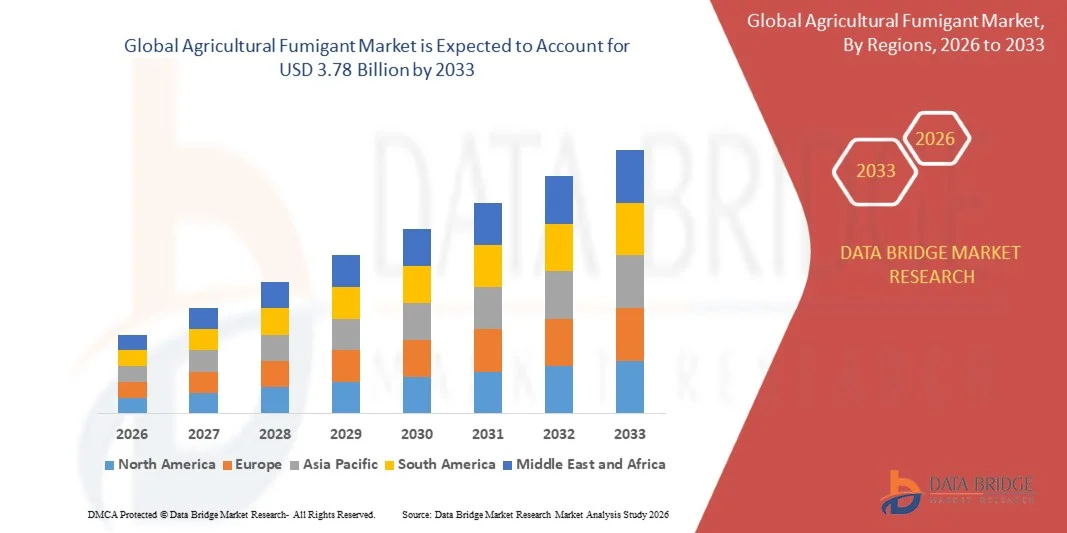
- As per Data Bridge Market Research analysis, the agricultural fumigant market was valued at USD 2.63 billion in 2025 and is projected to reach USD 3.78 billion by 2033, growing at a CAGR of 4.65% from 2026 to 2033.
- The market is expected to witness steady growth driven by a progressing global population, rising incomes, and increasing food demand, all of which are boosting the need for higher agricultural productivity and effective crop protection.
- Increasing awareness among farmers regarding pest management and the rising need to safeguard grain and produce quality is compelling agrochemical companies, warehouse operators, and cooperatives to adopt fumigation-based pest control. At the same time, the phase-out of certain legacy fumigants under evolving regulatory frameworks is reshaping product adoption in favor of newer, more compliant formulations.
Market Size & Forecast
- Global Market Value (2021): USD 2.63 Billion
- Expected Market Value (2033): USD 3.78 Billion
- Forecast CAGR (2026–2033): 4.65%
- Leading Region: Asia-Pacific
- Fastest Growing Region: North America
What are the Major Takeaways of the Agricultural Fumigant Market?
- Asia-Pacific dominates the agricultural fumigant market in terms of revenue, supported by wide availability and rising awareness of fumigation-based crop protection techniques across major farming economies.
- North America is anticipated to be the fastest-developing region during the forecast period, owing to its early adoption of advanced storage and farming methods and strong grain-export infrastructure.
- Phosphine-based fumigants continue to gain share within the product-type category, supported by broad-spectrum efficacy against insects, mites, and rodents, ease of application, and relatively low cost compared with alternative fumigants.
- Methyl bromide remains widely used in structural and quarantine fumigation owing to its strong penetrative properties, although its long-term use is being reshaped by phase-out commitments under international agreements such as the Montreal Protocol.
- Soil-based application continues to account for a substantial share of overall demand, reflecting the widespread use of fumigants for pre-plant soil treatment against nematodes, weeds, and fungal pathogens.
- Rising post-harvest loss-reduction initiatives and advancements in storage technology are expected to further boost demand for warehouse fumigation across the forecast period.
Report Scope and Agricultural Fumigant Market Segmentation
|
Attributes |
Agricultural Fumigant Key Market Insights |
|
Segments Covered |
|
|
Countries Covered |
North America
Europe
Asia-Pacific
Middle East and Africa
South America
|
|
Key Market Players |
|
|
Market Opportunities |
|
|
Value Added Data Infosets |
In addition to the insights on market scenarios such as market value, growth rate, segmentation, geographical coverage, and major players, the market reports curated by the Data Bridge Market Research also include in-depth expert analysis, geographically represented company-wise production and capacity, network layouts of distributors and partners, detailed and updated price trend analysis and deficit analysis of supply chain and demand. |
What is the Key Trend in the Agricultural Fumigant Market?
- A growing trend within the agricultural fumigant market is the shift toward safer, lower-residue formulations that align with tightening regulatory and consumer expectations for food safety.
- Manufacturers are increasingly investing in advanced fumigant delivery technologies, including controlled-release systems and improved sealed-storage infrastructure, to enhance efficacy while minimizing chemical exposure and environmental impact.
- The rising adoption of IoT-enabled gas monitoring and sensor-based application systems is improving safety compliance and dosage precision during fumigation, particularly in large-scale grain storage and export-oriented operations.
- Companies such as BASF, Syngenta, and Solvay continue to expand their crop-protection and fumigant portfolios to address both regulatory compliance and evolving pest-resistance challenges.
- As global food security priorities intensify, the trend toward safer, technology-enabled fumigation solutions is expected to reshape demand patterns across both developed and emerging agricultural markets.
What are the Key Drivers of the Agricultural Fumigant Market?
- Rising demand for agricultural fumigants from the broader agrochemical industry is a key growth driver, as fumigants play a critical role in protecting agricultural produce from pests both pre- and post-harvest.
- The growing focus on reducing post-harvest food losses is fueling fumigant adoption, as fumigation remains one of the most effective techniques for preserving the quality of freshly harvested and stored commodities.
- For instance, fumigation with ammonia has been used to control post-harvest deterioration in citrus, illustrating how targeted fumigation technology helps prevent losses and preserve commodity quality.
- Increasing use of fumigants for cereal storage and production, advancements in storage technology, and shifting farming practices are together reinforcing sustained market growth.
Which Factors are Challenging the Growth of the Agricultural Fumigant Market?
- Stringent regulations and growing concerns over chemical residue during fumigation are expected to restrain market growth, particularly as regulatory bodies tighten permissible exposure and residue limits.
- Side effects associated with exposure to fumigant chemical compounds, including loss of appetite, dizziness, headache, and respiratory irritation, are limiting broader adoption in certain agricultural applications.
- The phase-out of several legacy fumigants under international environmental agreements is requiring manufacturers to reformulate products, adding cost and complexity to compliance.
- Overcoming these challenges through safer formulations, improved application protocols, and regulatory alignment remains essential for sustained growth in the global agricultural fumigant market.
How is the Agricultural Fumigant Market Segmented?
The agricultural fumigant market is segmented on the basis of product type, application, crop type, and pest control method.
- By Product Type
On the basis of product type, the global soil fumigants market is segmented into methyl bromide, phosphine, chloropicrin, metam sodium, 1,3-dichloropropene, and others. The methyl bromide segment dominated the market in 2025, owing to its broad-spectrum efficacy, rapid action, and extensive use across soil and structural fumigation applications. Its effectiveness against a wide range of soil-borne pests, pathogens, and nematodes continues to support its use in specialized fumigation applications.
The phosphine segment is projected to register the fastest growth during the forecast period, driven by increasing adoption for warehouse and stored-grain fumigation. Its high penetration capability, cost-effectiveness, and effectiveness against a broad range of stored-product pests are accelerating segment expansion.
- By Application
On the basis of application, the global soil fumigants market is segmented into soil and warehouse. The soil segment dominated the market in 2025, owing to the increasing need to control soil-borne pests, nematodes, fungi, and pathogens that negatively affect crop productivity. Growing adoption of intensive farming practices and increasing focus on protecting crop yields are supporting the widespread use of fumigants for soil treatment.
The warehouse segment is projected to register the fastest growth during the forecast period, driven by rising demand for effective post-harvest pest management and protection of stored agricultural commodities. Increasing grain storage capacity and the need to minimize storage losses are accelerating the adoption of warehouse fumigation solutions.
- By Crop Type
On the basis of crop type, the global soil fumigants market is segmented into cereals and grains, oilseeds and pulses, fruits and vegetables, and others. The cereals and grains segment dominated the market in 2025, owing to the large-scale cultivation and storage of wheat, rice, maize, and other grains. The high susceptibility of stored grains to insects, fungi, and other pests, combined with the increasing need to minimize post-harvest losses, supports the extensive use of fumigation products in this segment.
The fruits and vegetables segment is projected to register the fastest growth during the forecast period, driven by increasing demand for high-quality produce and greater emphasis on controlling soil-borne pests and pathogens. Expansion of commercial horticulture and increasing adoption of intensive cultivation practices are accelerating segment growth.
- By Pest Control Method
On the basis of pest control method, the global soil fumigants market is segmented into tarpaulin fumigation, non-tarp fumigation by injection, structural fumigation, vacuum chamber fumigation, and others. The tarpaulin fumigation segment dominated the market in 2025, owing to its effectiveness in creating a controlled fumigation environment and its extensive use in soil treatment and commodity protection. The method helps maintain fumigant concentration within the treatment area, improving pest control efficiency across agricultural and storage applications.
The non-tarp fumigation by injection segment is projected to register the fastest growth during the forecast period, driven by increasing demand for efficient and targeted fumigation methods. The growing adoption of injection-based application techniques for soil treatment and their suitability for large-scale agricultural operations are accelerating segment expansion.
Which Region Holds the Largest Share of the Agricultural Fumigant Market?
- Asia-Pacific dominates the global agricultural fumigant market in terms of revenue, supported by strong macro-economic factors, wide product availability, and growing awareness regarding the use of fumigants as an effective crop protection technique.
- The region's large and diverse agricultural base, combined with rising government support for modernized farming and post-harvest infrastructure, continues to reinforce Asia-Pacific's leadership in the global market.
North America Agricultural Fumigant Market Insight
North America is anticipated to be the fastest-developing region in the agricultural fumigant market during the forecast period, driven by its position as a frontrunner in adopting advanced storage and farming methods. Strong grain-export infrastructure, high awareness of integrated pest management, and continued investment in post-harvest technology are supporting sustained regional growth.
U.S. Agricultural Fumigant Market Insight
The U.S. agricultural fumigant market is supported by large-scale grain storage operations, extensive export-oriented agriculture, and a strong regulatory framework governing pesticide and fumigant use. Increasing adoption of advanced application technologies and sensor-based safety monitoring is further strengthening market growth.
Europe Agricultural Fumigant Market Insight
The Europe agricultural fumigant market is shaped by stringent regulatory frameworks governing pesticide and fumigant residues, alongside rising consumer demand for high-quality, low-residue produce. Adoption is supported by strong agricultural research infrastructure and increasing emphasis on integrated pest management across commercial and greenhouse farming.
Asia-Pacific Agricultural Fumigant Market Insight
The Asia-Pacific agricultural fumigant market benefits from a large and diverse agricultural base, rising food security priorities, and growing awareness of fumigation as an effective crop protection technique. Expanding storage infrastructure and government initiatives supporting agricultural modernization across China, India, and Japan continue to drive regional demand.
China Agricultural Fumigant Market Insight
The China agricultural fumigant market is growing steadily, supported by large-scale grain production, expanding storage and warehousing infrastructure, and rising government focus on reducing post-harvest losses. The presence of established domestic agrochemical manufacturers further supports market expansion.
India Agricultural Fumigant Market Insight
The India agricultural fumigant market is expanding due to the country's large grain storage requirements, rising awareness of post-harvest pest management, and growing investment in modernized storage and warehousing facilities. Government initiatives promoting food security and reduced grain wastage continue to support demand.
Which are the Top Companies in the Agricultural Fumigant Market?
The agricultural fumigant industry is primarily led by well-established companies, including:
- LANXESS
- BASF SE
- DOW
- Arkema
- Syngenta
- ADAMA
- Trinity Manufacturing, Inc. (U.S.)
- Bayer AG (Germany)
- Solvay (Belgium)
- Merck KGaA (Germany)
- FMC Corporation (U.S.)
- Anhui Guangxin Agrochemical Co., Ltd. (China)
- UPL Limited (India)
- Rentokil Initial plc (U.K.)
- Chemtura Corporation (U.S.)
- DAI (U.S.)
- AMVAC Chemical Corporation (U.S.)
- Reddick Equipment Company of NC (U.S.)
- Nippon Chemical Industrial Co., Ltd. (Japan)
- Arysta LifeScience Limited (India)
What are the Latest Developments in the Agricultural Fumigant Market?
- In March 2025, Agmatix, an AI-powered agronomic solutions provider, partnered with BASF to develop a digital solution for detecting and predicting soybean cyst nematode (SCN) infestations. Launched through BASF’s AgroStart platform, the collaboration aims to provide soybean growers with real-time, scalable insights to identify SCN presence and minimize yield losses caused by one of the most damaging pests in soybean cultivation.
- In November 2024, Orbia Netafim and Bayer expanded their collaboration to strengthen digital farming solutions for fruit and vegetable growers. As part of the expanded partnership, the companies introduced HortiView, a platform designed to simplify data collection and provide tailored recommendations for crop management and irrigation, supporting more efficient and data-driven agricultural practices.
- In April 2024, Draslovka a.s. established INTRESO as a standalone business to consolidate and expand its agricultural solutions portfolio. The new entity focuses on the commercialization of next-generation fumigants and biocides, including Ethanedinitrile (EDN), BLUEFUME, and eFUME, which are positioned as more environmentally sustainable alternatives. Through partnerships with industry stakeholders, INTRESO aims to accelerate the adoption of fumigation solutions while supporting efforts to reduce emissions associated with fumigation.

- Interactive Data Analysis Dashboard
- Company Analysis Dashboard for high growth potential opportunities
- Research Analyst Access for customization & queries
- Competitor Analysis with Interactive dashboard
- Latest News, Updates & Trend analysis
- Harness the Power of Benchmark Analysis for Comprehensive Competitor Tracking
Global Agricultural Fumigants Market, Supply Chain Analysis and Ecosystem Framework
To support market growth and help clients navigate the impact of geopolitical shifts, DBMR has integrated in-depth supply chain analysis into its Global Agricultural Fumigants Market research reports. This addition empowers clients to respond effectively to global changes affecting their industries. The supply chain analysis section includes detailed insights such as Global Agricultural Fumigants Market consumption and production by country, price trend analysis, the impact of tariffs and geopolitical developments, and import and export trends by country and HSN code. It also highlights major suppliers with data on production capacity and company profiles, as well as key importers and exporters. In addition to research, DBMR offers specialized supply chain consulting services backed by over a decade of experience, providing solutions like supplier discovery, supplier risk assessment, price trend analysis, impact evaluation of inflation and trade route changes, and comprehensive market trend analysis.
Data collection and base year analysis are done using data collection modules with large sample sizes. The stage includes obtaining market information or related data through various sources and strategies. It includes examining and planning all the data acquired from the past in advance. It likewise envelops the examination of information inconsistencies seen across different information sources. The market data is analysed and estimated using market statistical and coherent models. Also, market share analysis and key trend analysis are the major success factors in the market report. To know more, please request an analyst call or drop down your inquiry.
The key research methodology used by DBMR research team is data triangulation which involves data mining, analysis of the impact of data variables on the market and primary (industry expert) validation. Data models include Vendor Positioning Grid, Market Time Line Analysis, Market Overview and Guide, Company Positioning Grid, Patent Analysis, Pricing Analysis, Company Market Share Analysis, Standards of Measurement, Global versus Regional and Vendor Share Analysis. To know more about the research methodology, drop in an inquiry to speak to our industry experts.
Data Bridge Market Research is a leader in advanced formative research. We take pride in servicing our existing and new customers with data and analysis that match and suits their goal. The report can be customized to include price trend analysis of target brands understanding the market for additional countries (ask for the list of countries), clinical trial results data, literature review, refurbished market and product base analysis. Market analysis of target competitors can be analyzed from technology-based analysis to market portfolio strategies. We can add as many competitors that you require data about in the format and data style you are looking for. Our team of analysts can also provide you data in crude raw excel files pivot tables (Fact book) or can assist you in creating presentations from the data sets available in the report.













