Europe Inorganic Scintillators Market
Market Size in USD Million
CAGR :
% 
 USD
118.20 Million
USD
186.97 Million
2025
2033
USD
118.20 Million
USD
186.97 Million
2025
2033
 Forecast Period Forecast Period |
2026 –2033 |
 Market Size (Base Year) Market Size (Base Year) |
USD 118.20 Million |
 Market Size (Forecast Year) Market Size (Forecast Year) |
USD 186.97 Million |
 CAGR CAGR |
% |
| Major Markets Players |
|
Europe Inorganic Scintillators Market Size
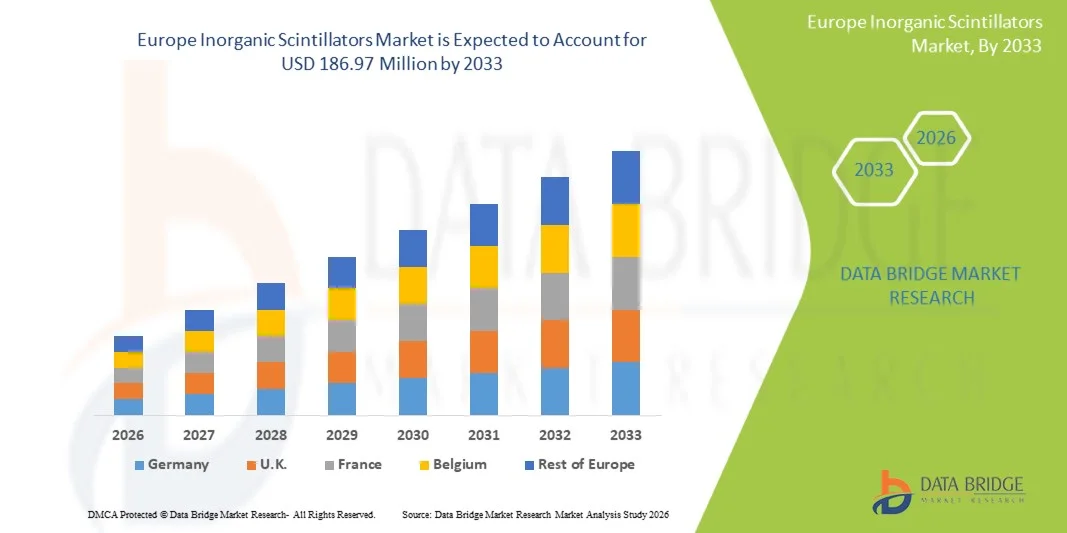
- The Europe inorganic scintillators market size was valued at USD 118.20 million in 2025 and is expected to reach USD 186.97 million by 2033, at a CAGR of 5.9% during the forecast period
- The market growth is largely driven by rising adoption of inorganic scintillators in medical imaging, nuclear medicine, homeland security, and high-energy physics research, supported by technological advancements in crystal growth and detector performance across Europe
- Furthermore, increasing demand for high-resolution radiation detection, improved diagnostic accuracy, and enhanced security screening systems is positioning inorganic scintillators as a critical component in advanced detection technologies, thereby significantly supporting the market’s expansion
Europe Inorganic Scintillators Market Analysis
- Inorganic scintillators, which convert high-energy radiation into visible light for detection and measurement, are increasingly critical components of medical imaging, nuclear medicine, industrial inspection, homeland security, and high-energy physics research across Germany, France, the U.K., and Italy, driven by their high density, strong light yield, and reliable energy resolution
- The growing demand for inorganic scintillators is primarily fueled by rising cancer incidence, increasing PET and SPECT imaging volumes, expanding nuclear medicine adoption, and stricter radiation safety regulations at the country level across Europe
- Germany dominated the Europe inorganic scintillators market with an estimated share of 28.5% in 2025, supported by its advanced healthcare infrastructure, strong base of medical imaging manufacturers, and sustained investments in nuclear research and radiation detection systems
- France is expected to be one of the fastest-growing countries during the forecast period, driven by expanding nuclear medicine procedures, government-supported research initiatives, and upgrades in diagnostic imaging and security infrastructure
- The alkali halide scintillators segment dominated the market with a share of 46.8% in 2025, owing to their established clinical usage, high detection efficiency, and cost-effectiveness, particularly in medical imaging and radiation monitoring applications
Report Scope and Europe Inorganic Scintillators Market Segmentation
|
Attributes |
Europe Inorganic Scintillators Key Market Insights |
|
Segments Covered |
|
|
Countries Covered |
Europe
|
|
Key Market Players |
|
|
Market Opportunities |
|
|
Value Added Data Infosets |
In addition to the insights on market scenarios such as market value, growth rate, segmentation, geographical coverage, and major players, the market reports curated by the Data Bridge Market Research also include in-depth expert analysis, patient epidemiology, pipeline analysis, pricing analysis, and regulatory framework |
Europe Inorganic Scintillators Market Trends
“Advancements in High-Performance Scintillator Materials and Detector Integration”
- A significant and accelerating trend in the Europe inorganic scintillators market is the continuous advancement in high-performance scintillator materials such as cerium-doped crystals and improved crystal growth techniques, enhancing detection efficiency, energy resolution, and durability across medical, security, and research applications
- For instance, cerium-doped lutetium-based scintillators are increasingly adopted in PET imaging systems across European hospitals due to their faster decay times and higher light output, improving image clarity and diagnostic accuracy
- Technological integration of inorganic scintillators with advanced photodetectors and digital signal processing systems enables faster data acquisition, reduced noise, and more precise radiation measurements. For instance, newer detector assemblies used in European research facilities leverage optimized scintillator–sensor coupling to enhance performance in high-energy physics experiments
- The seamless integration of inorganic scintillators into compact, high-resolution imaging and detection platforms supports centralized and automated radiation monitoring across healthcare, industrial inspection, and border security environments, improving operational efficiency and reliability
- This trend toward more efficient, durable, and application-specific scintillator systems is reshaping performance expectations in radiation detection. Consequently, manufacturers such as Saint-Gobain and CRYTUR are focusing on advanced inorganic scintillator materials optimized for medical imaging and scientific research applications
- The demand for next-generation inorganic scintillators with higher sensitivity, longer operational lifetimes, and compatibility with modern detector systems is steadily increasing across Europe’s healthcare, security, and research sectors
- Increasing collaboration between European research institutes and material science companies is accelerating innovation in scintillator compositions, supporting faster commercialization of advanced inorganic scintillator technologies
Europe Inorganic Scintillators Market Dynamics
Driver
“Rising Demand from Medical Imaging and Nuclear Medicine Applications”
- The increasing prevalence of chronic diseases, particularly cancer, combined with the expanding adoption of PET and SPECT imaging technologies, is a major driver for the growing demand for inorganic scintillators across Europe
- For instance, in June 2024, several European hospitals expanded PET imaging capacity as part of national cancer diagnostic programs, increasing demand for high-performance scintillator crystals used in imaging detectors. Such initiatives are expected to drive market growth during the forecast period
- As healthcare providers focus on early and accurate diagnosis, inorganic scintillators offer high detection efficiency, superior image resolution, and reliable performance, making them essential components in advanced diagnostic imaging systems
- Furthermore, increased public and private investments in nuclear medicine infrastructure and research facilities across countries such as Germany, France, and the U.K. are reinforcing demand for inorganic scintillators
- The growing need for accurate radiation detection, faster imaging workflows, and improved patient outcomes is accelerating adoption in hospitals, diagnostic centers, and research institutions, thereby strongly supporting market expansion
- Rising demand from homeland security and border control agencies for radiation detection systems is further driving inorganic scintillator adoption across European countries
- Expansion of particle physics research programs and nuclear research facilities across Europe is generating sustained long-term demand for high-performance inorganic scintillators
Restraint/Challenge
“High Production Costs and Regulatory Compliance Requirements”
- The complex manufacturing processes and high material costs associated with inorganic scintillators, particularly rare-earth-based crystals, present a significant challenge to wider market adoption across Europe
- For instance, fluctuations in the supply and pricing of lutetium and other rare earth elements have increased production costs for certain high-end scintillator materials, impacting pricing strategies and profit margins
- Meeting stringent European regulatory standards for medical devices and radiation detection equipment requires extensive testing, certification, and quality assurance, increasing time-to-market and overall development costs for manufacturers
- In addition, the relatively high upfront cost of advanced scintillator-based detection systems compared to alternative technologies can limit adoption among smaller hospitals, laboratories, and industrial users, particularly in cost-sensitive environments
- Overcoming these challenges through manufacturing process optimization, material innovation, and regulatory harmonization, along with increased funding support for healthcare and research infrastructure, will be critical for sustained market growth
- Limited availability of skilled personnel for crystal growth and scintillator fabrication can constrain production scalability and technology deployment
- Dependence on specialized supply chains for raw materials and processing equipment increases vulnerability to disruptions, posing additional challenges for consistent market growth
Europe Inorganic Scintillators Market Scope
The market is segmented on the basis of scintillation material, type, application, and end user.
- By Scintillation Material
On the basis of scintillation material, the Europe inorganic scintillators market is segmented into Sodium Iodide (NaI), Cesium Iodide (CsI), Lutetium Oxyorthosilicate (LSO) and Lutetium–Yttrium Oxyorthosilicate (LYSO), Bismuth Germanate (BGO), Barium Fluoride, Lead Tungstate (PbWO₄), Cadmium Tungstate (CdWO₄), Cerium Bromide (CeBr₃), Lanthanum Bromide (LaBr₃), Gadolinium Orthosilicate (GSO), Yttrium Aluminum Garnet (YAG:Ce), Gadolinium Oxysulfide (GOS), and other scintillation materials. The Sodium Iodide (NaI) segment dominated the market in 2025, driven by its long-standing and widespread use in gamma-ray spectroscopy, nuclear medicine imaging, and radiation monitoring systems across Europe. NaI scintillators are favored due to their high light output, cost-effectiveness, and established compatibility with photomultiplier tubes. European hospitals, research laboratories, and nuclear facilities continue to rely on NaI-based detectors for routine diagnostic and monitoring applications. The extensive installed base and proven performance of NaI crystals strongly support their dominant position. In addition, ease of manufacturing and availability further reinforce their leadership in the market.
The LYSO and LSO segment is expected to witness the fastest growth from 2026 to 2033, fueled by rising adoption in advanced PET imaging systems across European healthcare facilities. These materials offer superior energy resolution, faster decay times, and higher detection efficiency compared to traditional scintillators. Growing demand for high-resolution cancer diagnostics and quantitative imaging is accelerating their uptake. Increasing investments in next-generation PET scanners and hybrid imaging systems further support growth. Moreover, expanding nuclear medicine procedures and research applications are positioning LYSO and LSO as high-growth scintillator materials in Europe.
- By Type
On the basis of type, the Europe inorganic scintillators market is segmented into alkali halides, oxide compounds, and rare earth metals. The alkali halides segment dominated the market in 2025 with market share of 46.8%, driven by extensive use of materials such as NaI and CsI in medical imaging, radiation detection, and nuclear monitoring applications. Alkali halide scintillators provide high light yield and reliable detection performance, making them suitable for a wide range of established applications. Their relatively lower cost compared to advanced oxide and rare earth scintillators supports broad adoption across healthcare and industrial sectors. Strong demand from hospitals, research institutes, and safety agencies further strengthens this segment’s dominance. Long-standing regulatory approvals and user familiarity also contribute to sustained market leadership.
The rare earth metals segment is anticipated to register the fastest growth during the forecast period, supported by increasing demand for high-performance scintillators such as LYSO, LaBr₃, and CeBr₃. These materials offer superior timing resolution, faster signal processing, and enhanced accuracy, making them ideal for advanced medical imaging and scientific research. Growing investments in PET imaging and particle physics research across Europe are driving adoption. In addition, continuous material innovation and performance improvements are expanding their application scope. This trend positions rare earth-based scintillators as the fastest-growing type segment.
- By Application
On the basis of application, the market is segmented into medical imaging, nuclear medicine, radioprotection, oil exploration, process industry, life sciences, and others. The medical imaging segment dominated the market in 2025, driven by the extensive use of inorganic scintillators in CT, PET, and SPECT imaging systems across Europe. Rising cancer prevalence and increasing emphasis on early and accurate diagnosis are fueling sustained demand. Hospitals and diagnostic centers rely heavily on scintillator-based detectors for high-resolution imaging and reliable performance. Continuous upgrades of imaging infrastructure in countries such as Germany, France, and the U.K. further reinforce dominance. The critical role of scintillators in diagnostic accuracy ensures steady market leadership.
The nuclear medicine segment is expected to grow at the fastest rate from 2026 to 2033, supported by increasing adoption of PET and SPECT procedures for oncology, cardiology, and neurology applications. Growing investments in radiopharmaceuticals and personalized medicine are boosting demand for advanced scintillator materials. Expansion of nuclear medicine facilities across Europe is further accelerating growth. Improved reimbursement frameworks and technological advancements in imaging systems also contribute to rapid expansion. This positions nuclear medicine as the fastest-growing application segment.
- By End User
On the basis of end user, the Europe inorganic scintillators market is segmented into healthcare, homeland security and defense, nuclear power plants, industrial applications, and others. The healthcare segment dominated the market in 2025, driven by high utilization of scintillator-based imaging systems in hospitals, diagnostic centers, and research institutions. Increasing diagnostic imaging volumes and expanding nuclear medicine procedures strongly support demand. Continuous modernization of healthcare infrastructure across Europe further reinforces dominance. The essential role of scintillators in medical diagnostics and patient care ensures consistent adoption. Strong public healthcare funding and private investments also contribute to this segment’s leading position.
The homeland security and defense segment is projected to be the fastest-growing end user during the forecast period, driven by increasing investments in radiation detection and border security systems across European countries. Rising concerns related to nuclear threats, illicit material trafficking, and public safety are accelerating deployment of scintillator-based detectors. Governments are strengthening surveillance and monitoring infrastructure at ports, borders, and public facilities. Technological advancements in compact and high-sensitivity detection systems further boost adoption. These factors collectively position homeland security and defense as the fastest-growing end-user segment.
Europe Inorganic Scintillators Market Regional Analysis
- Germany dominated the Europe inorganic scintillators market with an estimated share of 28.5% in 2025, supported by its advanced healthcare infrastructure, strong base of medical imaging manufacturers, and sustained investments in nuclear research and radiation detection systems
- End users in Germany place high value on the high detection accuracy, superior energy resolution, and long-term reliability of inorganic scintillators, particularly for PET imaging systems, radiation monitoring equipment, and security screening solutions used in hospitals, research institutes, and public safety facilities
- This widespread adoption is further supported by robust public healthcare spending, significant investments in nuclear and particle physics research, and strict national radiation safety and regulatory standards, establishing inorganic scintillators as a core technology across healthcare, security, and industrial applications in Germany
The Germany Inorganic Scintillators Market Insight
Germany dominated the Europe inorganic scintillators market in 2025, driven by its advanced healthcare infrastructure, strong manufacturing base, and leadership in scientific and nuclear research. The country has a high concentration of PET imaging systems and nuclear medicine facilities, supporting consistent demand for high-performance scintillator materials. Significant investments in particle physics research, radiation monitoring, and homeland security applications further contribute to growth. Germany’s emphasis on precision engineering, quality standards, and regulatory compliance strongly aligns with the adoption of advanced inorganic scintillators.
U.K. Inorganic Scintillators Market Insight
The U.K. inorganic scintillators market is expected to grow at a notable CAGR during the forecast period, supported by increasing nuclear medicine procedures and expanding life sciences research. Rising emphasis on early disease diagnosis and cancer screening is driving demand for scintillator-based imaging technologies. The country’s strong academic and research ecosystem also fuels usage in scientific instrumentation and radiation monitoring. Continued upgrades to healthcare imaging infrastructure are expected to sustain market momentum.
France Inorganic Scintillators Market Insight
The France inorganic scintillators market is experiencing steady growth, driven by a well-developed nuclear medicine ecosystem and government-supported research programs. Increasing utilization of PET imaging and radiation detection systems in hospitals and research institutions is supporting demand. France’s active involvement in nuclear energy and radiation safety initiatives further contributes to the adoption of inorganic scintillators. Ongoing investments in healthcare modernization and scientific research are expected to maintain stable market growth.
Italy Inorganic Scintillators Market Insight
The Italy inorganic scintillators market is witnessing moderate but consistent growth, supported by rising adoption of advanced diagnostic imaging technologies in oncology and cardiology. Expansion of PET and SPECT imaging facilities across public and private hospitals is driving demand. Increasing awareness of radiological safety and modernization of healthcare infrastructure further support market expansion. Industrial inspection and research applications also contribute to steady adoption of scintillator-based detection systems.
Europe Inorganic Scintillators Market Share
The Europe Inorganic Scintillators industry is primarily led by well-established companies, including:
- Hamamatsu Photonics K.K. (Japan)
- Hitachi High Tech Corporation (Japan)
- Mirion Technologies, Inc. (U.S.)
- Dynasil Corporation (U.S.)
- Scintacor (U.K.)
- Epic Crystal Co.,Ltd (China)
- Alpha Spectra, Inc. (U.S.)
- Radiation Monitoring Devices, Inc. (U.S.)
- Kromek Group plc (U.K.)
- Toshiba Materials Co., Ltd. (Japan)
- Scionix Holland B.V. (Netherlands)
- Hitachi Metals, Ltd. (Japan)
- Saint Gobain S.A. (France)
- Crytur a.s. (Czech Republic)
- Detec Electronic (Germany)
- Rexon Components, Inc. (U.S.)
- Eljen Technology (U.S.)
- Photonic Materials Ltd. (U.K.)
- Hilger Crystals Ltd. (U.K.)
What are the Recent Developments in Europe Inorganic Scintillators Market?
- In July 2025, the 26th Workshop on Radiation Imaging Detectors (IWORID 2025) took place with contributions from European institutions discussing detector developments and enhancements that include scintillator technologies for medical and scientific applications, reinforcing active industry and research engagement in scintillator advancement within Europe
- In April 2025, a comprehensive review article detailing the latest innovations in scintillator materials for X-ray detection was published in Inorganic Chemistry Frontiers, covering new high-performance scintillator material classes and performance enhancements relevant to medical imaging and detection technologies
- In November 2024, Saint-Gobain completed a €45 million expansion of its Nemours, France crystal manufacturing facility, increasing LSO and LYSO scintillator production capacity by 60 % to meet rising global demand from medical imaging equipment manufacturers
- In October 2024, a peer-reviewed research preprint demonstrated the fabrication of nanophotonic scintillators with enhanced emission properties and significantly improved light yield an advancement relevant to next-generation scintillator detector design across Europe and beyond
- In May 2023, researchers developed a new generation of organic–inorganic hybrid scintillator materials that significantly improve image quality in X-ray and CT imaging by achieving faster response times and enhanced radioluminescence advancements applicable to both medical and security imaging technologies
SKU-
Get online access to the report on the World's First Market Intelligence Cloud
- Interactive Data Analysis Dashboard
- Company Analysis Dashboard for high growth potential opportunities
- Research Analyst Access for customization & queries
- Competitor Analysis with Interactive dashboard
- Latest News, Updates & Trend analysis
- Harness the Power of Benchmark Analysis for Comprehensive Competitor Tracking
Research Methodology
Data collection and base year analysis are done using data collection modules with large sample sizes. The stage includes obtaining market information or related data through various sources and strategies. It includes examining and planning all the data acquired from the past in advance. It likewise envelops the examination of information inconsistencies seen across different information sources. The market data is analysed and estimated using market statistical and coherent models. Also, market share analysis and key trend analysis are the major success factors in the market report. To know more, please request an analyst call or drop down your inquiry.
The key research methodology used by DBMR research team is data triangulation which involves data mining, analysis of the impact of data variables on the market and primary (industry expert) validation. Data models include Vendor Positioning Grid, Market Time Line Analysis, Market Overview and Guide, Company Positioning Grid, Patent Analysis, Pricing Analysis, Company Market Share Analysis, Standards of Measurement, Global versus Regional and Vendor Share Analysis. To know more about the research methodology, drop in an inquiry to speak to our industry experts.
Customization Available
Data Bridge Market Research is a leader in advanced formative research. We take pride in servicing our existing and new customers with data and analysis that match and suits their goal. The report can be customized to include price trend analysis of target brands understanding the market for additional countries (ask for the list of countries), clinical trial results data, literature review, refurbished market and product base analysis. Market analysis of target competitors can be analyzed from technology-based analysis to market portfolio strategies. We can add as many competitors that you require data about in the format and data style you are looking for. Our team of analysts can also provide you data in crude raw excel files pivot tables (Fact book) or can assist you in creating presentations from the data sets available in the report.