Europe Digital Holographic Microscopy In Medical Market
Market Size in USD Million
CAGR :
% 
 USD
115.14 Million
USD
1,048.47 Million
2025
2033
USD
115.14 Million
USD
1,048.47 Million
2025
2033
 Forecast Period Forecast Period |
2026 –2033 |
 Market Size (Base Year) Market Size (Base Year) |
USD 115.14 Million |
 Market Size (Forecast Year) Market Size (Forecast Year) |
USD 1,048.47 Million |
 CAGR CAGR |
% |
| Major Markets Players |
|
Europe Digital Holographic Microscopy in Medical Market Size
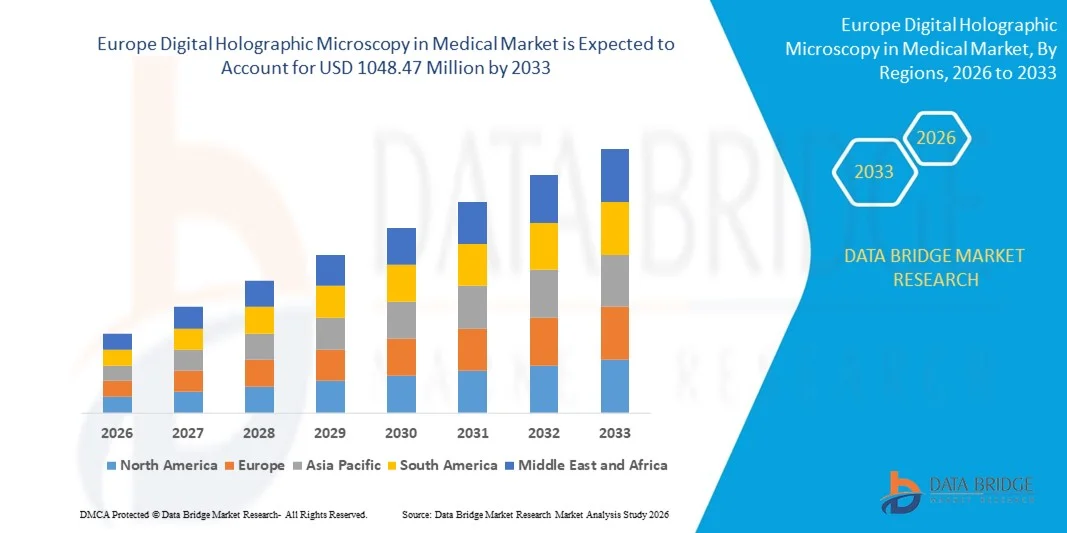
- The Europe digital holographic microscopy in medical market size was valued at USD 115.14 million in 2025 and is expected to reach USD 1048.47 million by 2033, at a CAGR of 31.80% during the forecast period
- The market growth is largely fuelled by the increasing adoption of advanced imaging technologies for rapid and label-free diagnostics
- Growing demand for real-time, non-invasive cellular analysis in clinical research and personalized medicine
Europe Digital Holographic Microscopy in Medical Market Analysis
- The market is driven by technological advancements in holographic microscopy systems that offer enhanced resolution, automation, and integration with AI-based analytics
- Increasing focus on early disease detection and monitoring has propelled the utilization of digital holographic microscopy in medical diagnostics and therapeutic research
- Germany dominated the digital holographic microscopy in medical market with the largest revenue share in 2025, driven by its strong healthcare infrastructure, advanced medical research ecosystem, and early adoption of high-precision imaging technologies
- U.K. is expected to witness the highest compound annual growth rate (CAGR) in the Europe digital holographic microscopy in medical market due to increasing investments in life sciences, rapid expansion of precision medicine initiatives, rising adoption of advanced non-invasive imaging technologies, and strong government support for medical research and innovation
- The Label-Free Interferometric Technique segment held the largest market revenue share in 2025 driven by its ability to provide non-invasive, real-time analysis of live cells without the need for dyes or markers. This technique is widely adopted in medical research and diagnostics due to its high sensitivity, accuracy, and suitability for continuous cell monitoring in applications such as oncology and regenerative medicine
Report Scope and Europe Digital Holographic Microscopy in Medical Market Segmentation
|
Attributes |
Europe Digital Holographic Microscopy in Medical Key Market Insights |
|
Segments Covered |
|
|
Countries Covered |
Europe
|
|
Key Market Players |
|
|
Market Opportunities |
|
|
Value Added Data Infosets |
In addition to the insights on market scenarios such as market value, growth rate, segmentation, geographical coverage, and major players, the market reports curated by the Data Bridge Market Research also include in-depth expert analysis, geographically represented company-wise production and capacity, network layouts of distributors and partners, detailed and updated price trend analysis and deficit analysis of supply chain and demand. |
Europe Digital Holographic Microscopy in Medical Market Trends
Rising Adoption Of Advanced Label-Free Imaging Technologies
- The increasing emphasis on non-invasive, real-time, and label-free diagnostic techniques is significantly shaping the Europe digital holographic microscopy in medical market, as healthcare providers and researchers seek precise cellular analysis without altering biological samples. Digital holographic microscopy is gaining traction due to its ability to deliver quantitative phase imaging, improved resolution, and continuous monitoring of live cells, supporting accurate diagnostics and research outcomes
- Growing focus on early disease detection, personalized medicine, and advanced clinical research has accelerated the adoption of digital holographic microscopy across hospitals, diagnostic laboratories, and research institutes. Medical professionals are increasingly utilizing this technology for cell biology studies, oncology research, and drug development, encouraging manufacturers to enhance system performance and analytical capabilities
- Technological advancements such as integration of artificial intelligence, automation, and advanced data analytics are influencing purchasing decisions, with manufacturers emphasizing higher throughput, user-friendly interfaces, and seamless data interpretation. These factors are enabling healthcare institutions to improve diagnostic efficiency while reducing manual intervention and operational complexity
- For instance, in 2024, several European research hospitals and biotechnology firms expanded the use of digital holographic microscopy systems for live-cell imaging and drug screening applications. These deployments were driven by the need for high-precision, real-time analysis in oncology and regenerative medicine research, with systems integrated into existing laboratory workflows
- While demand for digital holographic microscopy is rising, sustained market growth depends on continuous technological innovation, cost optimization, and improved system accessibility. Manufacturers are focusing on enhancing scalability, reducing equipment complexity, and improving analytical software to support wider clinical and research adoption
Europe Digital Holographic Microscopy in Medical Market Dynamics
Driver
Growing Demand For Non-Invasive And High-Precision Medical Imaging
- Rising demand for advanced, non-invasive imaging solutions is a major driver for the Europe digital holographic microscopy in medical market. Healthcare providers are increasingly adopting this technology to achieve accurate cellular and tissue analysis without the need for dyes or markers, supporting faster diagnostics and improved patient outcomes
- Expanding applications in oncology, neurology, infectious disease research, and drug discovery are contributing to market growth. Digital holographic microscopy enables continuous monitoring of cellular behavior and morphology, allowing researchers and clinicians to gain deeper insights into disease progression and treatment efficacy
- Medical device manufacturers and research institutions are actively promoting digital holographic microscopy through product innovation, clinical collaborations, and integration with digital health platforms. These initiatives are supported by growing investments in medical research and the increasing focus on precision medicine across Europe
- For instance, in 2023, multiple European universities and pharmaceutical companies increased their adoption of digital holographic microscopy for preclinical research and therapeutic development. This expansion was driven by the need for high-resolution, quantitative imaging to support advanced biomedical research and reduce reliance on conventional microscopy techniques
- Although strong demand supports market growth, broader adoption relies on continued investment in technology development, training of skilled professionals, and alignment with evolving clinical and research requirements
Restraint/Challenge
High Equipment Costs And Limited Technical Expertise
- The high initial cost of digital holographic microscopy systems compared to conventional optical microscopes remains a key challenge, limiting adoption among smaller laboratories and healthcare facilities. Advanced hardware components, specialized software, and maintenance requirements contribute to elevated investment costs
- Limited availability of trained professionals and technical expertise also restricts market expansion, as operating and interpreting digital holographic microscopy systems requires specialized knowledge. This can slow adoption in clinical environments where training resources are constrained
- Infrastructure and integration challenges further impact growth, as healthcare facilities must ensure compatibility with existing laboratory systems, data management platforms, and regulatory requirements. These factors can increase implementation time and operational complexity
- For instance, in 2024, smaller diagnostic laboratories and research centers in parts of Europe reported slower adoption of digital holographic microscopy due to budget constraints and limited access to skilled personnel. Integration challenges with legacy systems were also cited as barriers to implementation
- Addressing these challenges will require cost-effective system development, expanded training programs, and stronger collaboration between manufacturers, healthcare providers, and research institutions. Improving accessibility, usability, and technical support will be critical for unlocking the long-term growth potential of the Europe digital holographic microscopy in medical market
Europe Digital Holographic Microscopy in Medical Market Scope
The market is segmented on the basis of type, process type, offering, and end users.
- By Type
On the basis of type, the Europe digital holographic microscopy in medical market is segmented into Label-Free Interferometric Technique and Quantitative Phase Image. The Label-Free Interferometric Technique segment held the largest market revenue share in 2025 driven by its ability to provide non-invasive, real-time analysis of live cells without the need for dyes or markers. This technique is widely adopted in medical research and diagnostics due to its high sensitivity, accuracy, and suitability for continuous cell monitoring in applications such as oncology and regenerative medicine.
The Quantitative Phase Image segment is expected to witness the fastest growth rate from 2026 to 2033 driven by the increasing demand for precise measurement of cellular morphology and dynamics. Quantitative phase imaging enables detailed visualization of cell structure and behavior, supporting advanced disease research, drug discovery, and personalized medicine applications.
- By Process Type
On the basis of process type, the market is segmented into Digital Recording and Reconstruction. The Digital Recording segment accounted for the largest revenue share in 2025 due to its critical role in capturing high-resolution holographic data with improved accuracy and repeatability. Digital recording techniques support efficient data acquisition and storage, making them essential for medical research laboratories and diagnostic facilities.
The Reconstruction segment is expected to witness the fastest growth rate from 2026 to 2033 supported by advancements in computational algorithms and image processing software. Improved reconstruction techniques enhance image clarity, analytical precision, and real-time visualization, driving adoption in clinical and research settings.
- By Offering
On the basis of offering, the Europe digital holographic microscopy in medical market is segmented into Hardware and Software. The Hardware segment dominated the market in 2025 driven by strong demand for advanced microscopy systems, sensors, and optical components required for high-performance imaging. Continuous upgrades in hardware capabilities are supporting wider adoption across medical and research institutions.
The Software segment is expected to register the fastest growth from 2026 to 2033 due to increasing integration of AI, automation, and advanced analytics for image processing and data interpretation. Software solutions enhance usability, improve diagnostic accuracy, and support seamless workflow integration, making them increasingly critical to end users.
- By End Users
On the basis of end users, the market is segmented into Medical, Commercial, Aerospace and Defense, Automotive, Consumer, and Others. The Medical segment held the largest market share in 2025 driven by extensive use of digital holographic microscopy in diagnostics, clinical research, drug development, and disease monitoring. Growing emphasis on precision medicine and early diagnosis continues to support this dominance.
The Commercial segment is expected to witness the fastest growth rate from 2026 to 2033 supported by rising adoption in biotechnology companies, research organizations, and diagnostic service providers. Other end-user segments such as aerospace and defense, automotive, and consumer applications are also witnessing gradual adoption due to increasing use of holographic imaging for inspection, quality control, and advanced research purposes.
Europe Digital Holographic Microscopy in Medical Market Regional Analysis
- Germany dominated the digital holographic microscopy in medical market with the largest revenue share in 2025, driven by its strong healthcare infrastructure, advanced medical research ecosystem, and early adoption of high-precision imaging technologies
- Medical research institutes, universities, and hospitals in the country highly value the accuracy, label-free imaging capability, and real-time cellular analysis offered by digital holographic microscopy for diagnostics and biomedical research
- This widespread adoption is further supported by high healthcare expenditure, strong government funding for medical research, and close collaboration between academia, biotechnology firms, and medical device manufacturers, establishing Germany as a leading market within Europe
U.K. Digital Holographic Microscopy in Medical Market Insight
The U.K. digital holographic microscopy in medical market is expected to witness the fastest growth rate from 2026 to 2033, fueled by increasing investments in life sciences research and the rapid expansion of precision medicine initiatives. Healthcare providers and research organizations are increasingly focusing on advanced, non-invasive imaging techniques to support early disease detection and drug development. The growing emphasis on digital healthcare transformation, coupled with rising adoption of AI-enabled imaging solutions and strong support from government-backed research programs, is further accelerating market growth across the country.
Europe Digital Holographic Microscopy in Medical Market Share
The Europe digital holographic microscopy in medical industry is primarily led by well-established companies, including:
- Lyncee Tec SA (Switzerland)
- Ovizio Imaging Systems SA (Belgium)
- Phase Holographic Imaging PHI AB (Sweden)
- TESCAN ORSAY HOLDING, a.s. (Czech Republic)
- Holmarc Opto-Mechatronics Europe Ltd. (Germany)
- Nanolive SA (Switzerland)
- Lyncée Tec GmbH (Germany)
- HOLOEYE Photonics AG (Germany)
- Leica Microsystems GmbH (Germany)
- ZEISS Group (Germany)
- Opto GmbH (Germany)
- Holographix LLC Europe Operations (U.K.)
- Oxford Instruments plc (U.K.)
- Andor Technology Ltd. (U.K.)
- HORIBA Europe GmbH (Germany)
SKU-
Get online access to the report on the World's First Market Intelligence Cloud
- Interactive Data Analysis Dashboard
- Company Analysis Dashboard for high growth potential opportunities
- Research Analyst Access for customization & queries
- Competitor Analysis with Interactive dashboard
- Latest News, Updates & Trend analysis
- Harness the Power of Benchmark Analysis for Comprehensive Competitor Tracking
Europe Digital Holographic Microscopy In Medical Market, Supply Chain Analysis and Ecosystem Framework
To support market growth and help clients navigate the impact of geopolitical shifts, DBMR has integrated in-depth supply chain analysis into its Europe Digital Holographic Microscopy In Medical Market research reports. This addition empowers clients to respond effectively to global changes affecting their industries. The supply chain analysis section includes detailed insights such as Europe Digital Holographic Microscopy In Medical Market consumption and production by country, price trend analysis, the impact of tariffs and geopolitical developments, and import and export trends by country and HSN code. It also highlights major suppliers with data on production capacity and company profiles, as well as key importers and exporters. In addition to research, DBMR offers specialized supply chain consulting services backed by over a decade of experience, providing solutions like supplier discovery, supplier risk assessment, price trend analysis, impact evaluation of inflation and trade route changes, and comprehensive market trend analysis.
Research Methodology
Data collection and base year analysis are done using data collection modules with large sample sizes. The stage includes obtaining market information or related data through various sources and strategies. It includes examining and planning all the data acquired from the past in advance. It likewise envelops the examination of information inconsistencies seen across different information sources. The market data is analysed and estimated using market statistical and coherent models. Also, market share analysis and key trend analysis are the major success factors in the market report. To know more, please request an analyst call or drop down your inquiry.
The key research methodology used by DBMR research team is data triangulation which involves data mining, analysis of the impact of data variables on the market and primary (industry expert) validation. Data models include Vendor Positioning Grid, Market Time Line Analysis, Market Overview and Guide, Company Positioning Grid, Patent Analysis, Pricing Analysis, Company Market Share Analysis, Standards of Measurement, Global versus Regional and Vendor Share Analysis. To know more about the research methodology, drop in an inquiry to speak to our industry experts.
Customization Available
Data Bridge Market Research is a leader in advanced formative research. We take pride in servicing our existing and new customers with data and analysis that match and suits their goal. The report can be customized to include price trend analysis of target brands understanding the market for additional countries (ask for the list of countries), clinical trial results data, literature review, refurbished market and product base analysis. Market analysis of target competitors can be analyzed from technology-based analysis to market portfolio strategies. We can add as many competitors that you require data about in the format and data style you are looking for. Our team of analysts can also provide you data in crude raw excel files pivot tables (Fact book) or can assist you in creating presentations from the data sets available in the report.