


What is the Europe Arthroscopy Devices Market Size and Growth Rate?
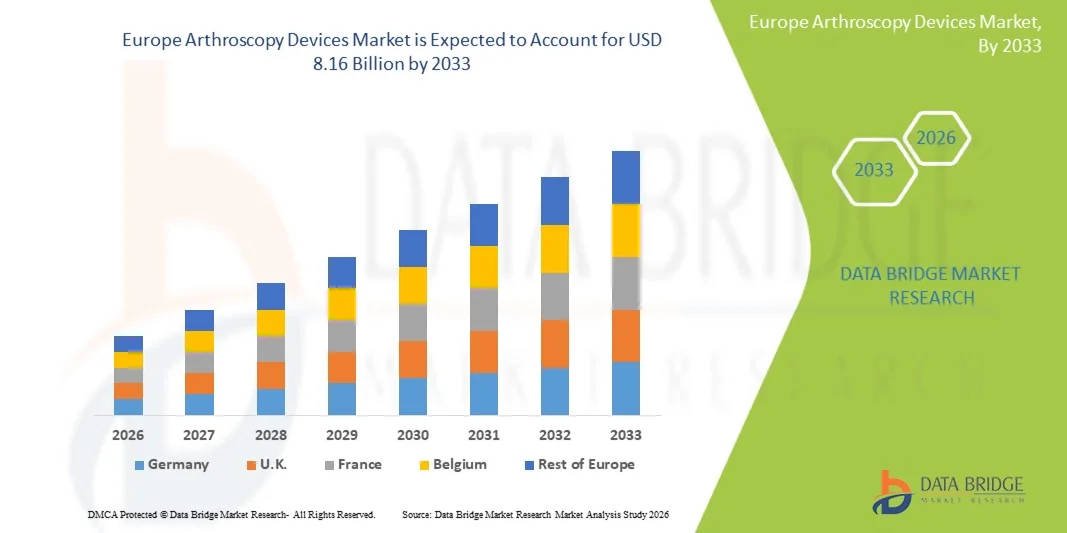
- As per Data Bridge Market Research Analysis the Europe Arthroscopy Devices Market size was valued at USD 5.00 Billion in 2025 and is expected to reach USD 8.16 Billion by 2033, at a CAGR of 6.32% during the forecast period
- The market growth is largely fueled by the increasing prevalence of musculoskeletal disorders, rising sports and recreational activities, and technological advancements in minimally invasive orthopedic procedures, leading to enhanced adoption of arthroscopy procedures in both hospitals and outpatient surgical centers
- Furthermore, growing demand for faster patient recovery, reduced post-operative complications, and advanced imaging and surgical visualization systems is establishing arthroscopy devices as essential tools in modern orthopedic and sports medicine. These converging factors are accelerating the uptake of arthroscopy devices solutions, thereby significantly boosting the industry's growth
Market Size and Forecast:
- Global Market Value (2025): USD 5.00 Billion
- Expected Market Value (2033): USD 8.16 Billion
- Forecast CAGR (2026–2033): 6.32%
How Europe Arthroscopy Devices Market Analysed?
- Arthroscopy devices, including advanced visualization systems, surgical instruments, and implants, are increasingly vital components of modern orthopedic and sports medicine procedures in both hospitals and outpatient surgical centers due to their ability to enable minimally invasive surgeries, reduce recovery times, and improve procedural accuracy
- The escalating demand for arthroscopy devices is primarily fueled by the rising prevalence of musculoskeletal disorders, growing sports and recreational activities, and increasing patient preference for minimally invasive procedure
- The U.K. dominated the Europe Arthroscopy Devices Market with the largest revenue share of approximately 39.7% in 2025, supported by advanced healthcare infrastructure, increasing adoption of minimally invasive orthopedic surgical technologies, and a strong presence of key industry players. Hospitals, ambulatory surgical centers, and specialized orthopedic clinics are driving substantial growth in arthroscopy device adoption, particularly in knee, shoulder, and hip procedures
- Germany is expected to be the fastest-growing region in the Europe Arthroscopy Devices Market during the forecast period, registering a CAGR of approximately 8.4%, driven by rising healthcare expenditure, increasing prevalence of musculoskeletal disorders, growing awareness of minimally invasive orthopedic procedures, and expanding access to specialized surgical centers across the country
- The Arthroscopy Implants segment dominated the largest market revenue share of 44.8% in 2025, driven by its critical role in joint repair and reconstruction procedures
Report Scope and Europe Arthroscopy Devices Market Segmentation
|
Attributes |
Arthroscopy Devices Key Market Insights |
|
Segments Covered |
|
|
Countries Covered |
Europe
|
|
Key Market Players |
|
|
Market Opportunities |
|
|
Value Added Data Infosets |
In addition to the insights on market scenarios such as market value, growth rate, segmentation, geographical coverage, and major players, the market reports curated by the Data Bridge Market Research also include in-depth expert analysis, patient epidemiology, pipeline analysis, pricing analysis, and regulatory framework. |
What are the Europe Arthroscopy Devices Market Trends?
“Rising Adoption of Minimally Invasive Orthopedic Procedures”
- A significant and accelerating trend in the global Europe Arthroscopy Devices Market is the growing preference for minimally invasive procedures across orthopedic and sports medicine surgeries. Surgeons and healthcare providers are increasingly adopting arthroscopy techniques due to their ability to reduce tissue damage, minimize postoperative complications, shorten hospital stays, and promote faster rehabilitation
- These devices provide high-precision visualization and access to joints such as knees, shoulders, hips, and ankles, improving overall patient outcomes and satisfaction
- For instance, in 2025, the Cleveland Clinic in the U.S. reported a 15% increase in arthroscopic knee surgeries compared to traditional open surgeries, highlighting the shift toward minimally invasive treatment methods. Similarly, Germany’s Charité Hospital incorporated 4K imaging and 3D-assisted arthroscopy into its orthopedic programs, enabling surgeons to perform complex procedures with higher accuracy and lower risk of infection. In India, specialized orthopedic centers in Mumbai and Bengaluru have started adopting flexible arthroscopes to expand access to arthroscopic surgeries in remote regions
- Technological advancements such as disposable arthroscopes, ultra-high-definition imaging systems, LED light sources, and improved fluid management devices are enhancing surgical efficiency, enabling hospitals to handle higher patient volumes with reduced procedural risks. Combined with improved suturing devices, motorized shavers, and joint-specific instruments, these innovations are shaping a new standard for orthopedic care globally
- The growing awareness among patients about less invasive treatment options, coupled with the rising demand for faster recovery from sports injuries or degenerative joint disorders, is fueling adoption in both developed and emerging economies. Moreover, training programs and certification courses for orthopedic surgeons are expanding, ensuring higher competency in using advanced arthroscopy devices
Europe Arthroscopy Devices Market Dynamics
Driver
“Increasing Prevalence of Orthopedic Disorders and Sports-Related Injuries”
- The rising global incidence of musculoskeletal disorders, sports injuries, osteoarthritis, and ligament tears is a major factor driving the adoption of arthroscopy devices
- Both hospitals and specialty clinics are investing in advanced arthroscopic equipment to meet the growing clinical demand and deliver more efficient patient care
- For instance, in the U.S., anterior cruciate ligament (ACL) reconstructions performed arthroscopically increased significantly in 2025, reflecting a preference for minimally invasive solutions. In Japan, the growing popularity of professional and recreational sports has driven the demand for arthroscopic knee, shoulder, and wrist surgeries in urban medical centers. In China, the increasing prevalence of age-related joint disorders among an aging population has accelerated hospital investments in arthroscopy technologies
- The availability of government reimbursements for minimally invasive orthopedic surgeries, combined with increased healthcare spending, is boosting adoption in developed regions such as North America and Western Europe
- Expanding orthopedic centers and sports medicine facilities in Asia-Pacific and Latin America are also acting as key enablers, increasing the availability of advanced arthroscopy devices for patients in emerging economies
Restraint/Challenge
“High Cost of Devices, Training Requirements, and Limited Accessibility”
- One of the major challenges limiting the broader adoption of arthroscopy devices globally is the high cost of advanced systems. Hospitals, particularly in developing regions, may struggle to invest in high-end HD imaging scopes, navigation systems, and motorized instruments
- For instance, in parts of Africa and Southeast Asia, limited funding for healthcare infrastructure restricts the availability of modern arthroscopy technologies despite rising orthopedic disorder prevalence. Similarly, smaller hospitals in Latin America face budgetary constraints that hinder access to high-precision arthroscopic devices
- In addition, the need for specialized surgical training and ongoing skill development for orthopedic surgeons poses a challenge. Complex arthroscopic procedures require precision and expertise, limiting adoption to hospitals and centers with adequately trained personnel
- Concerns over device maintenance, sterilization requirements, and replacement costs for disposable components also act as a restraint, particularly in regions with underdeveloped healthcare systems
- Overcoming these challenges through the development of cost-effective devices, government subsidies, healthcare infrastructure expansion, and international collaborations for training programs is essential to ensure sustained growth and accessibility in emerging markets
Europe Arthroscopy Devices Market Scope
The market is segmented on the basis of product type, procedure type, and end user.
• By Product Type
On the basis of product type, the Europe Arthroscopy Devices Market is segmented into Arthroscopy Fluid Management Systems, Arthroscopy Visualization Systems, Arthroscopy Implants, Arthroscopy Shavers, Arthroscopy RF Ablation Systems, and Arthroscopy RF Wands. The Arthroscopy Implants segment dominated the largest market revenue share of 44.8% in 2025, driven by its critical role in joint repair and reconstruction procedures. Hospitals and orthopedic clinics prefer implants due to their proven clinical efficacy, biocompatibility, and long-term durability. High prevalence of osteoarthritis, sports injuries, and age-related joint degeneration fuels demand. Continuous innovations in implant materials and designs enhance patient outcomes and reduce complication rates. Strategic partnerships between manufacturers and hospitals accelerate adoption. Rising awareness among surgeons regarding minimally invasive implant procedures further drives uptake. Regulatory approvals and standardized protocols ensure reliability and safety. Strong reimbursement frameworks in key markets support adoption. Investments in advanced sterilization and packaging technologies maintain product quality. Growing number of arthroscopic procedures globally reinforces the revenue dominance of implants. Clinical success stories and endorsements by orthopedic societies increase market trust. Overall, Arthroscopy Implants remain the most dominant product type due to efficacy, adoption, and clinical validation.
The Arthroscopy Visualization Systems segment is expected to witness the fastest CAGR of 19.3% from 2026 to 2033, fueled by growing demand for high-definition imaging during minimally invasive surgeries. Surgeons increasingly rely on advanced visualization tools for precision, reduced operative time, and better patient outcomes. Integration with 3D and 4K imaging technology enhances diagnostic capabilities. Rising investments in arthroscopy training centers accelerate adoption. Hospitals and ambulatory surgical centers are upgrading to next-generation systems to improve surgical efficiency. Technological advancements, such as augmented reality overlays, are expanding the utility of visualization systems. Demand is also supported by growing sports medicine and orthopedic procedure volumes. Enhanced ergonomics and compact designs make these systems more user-friendly. Expansion into emerging markets drives additional growth. Collaboration with medical device startups and research institutes accelerates innovation. Clinician preference for minimally invasive approaches further boosts adoption. Overall, visualization systems are the fastest-growing product segment due to technological innovation and increasing procedure volumes.
• By Procedure Type
On the basis of procedure type, the market is segmented into Shoulder Arthroscopic Procedures, Hip Arthroscopic Procedures, Knee Arthroscopic Procedures, and Others. Knee Arthroscopic Procedures dominated the largest market revenue share of 42.7% in 2025, driven by high prevalence of knee injuries, osteoarthritis, and sports-related trauma. Hospitals and orthopedic centers widely adopt knee arthroscopy due to its minimally invasive nature and faster recovery times. Availability of advanced surgical instruments and implants further supports dominance. Increasing participation in sports and active lifestyles contributes to procedure volume growth. Rising awareness about joint preservation among patients fuels adoption. Government healthcare initiatives in orthopedic care enhance accessibility. Reimbursement support and clinical guidelines favor minimally invasive approaches. Surgeons’ preference for knee arthroscopy for ligament and meniscus repair drives procedural adoption. Technological advancements in arthroscopy shavers and visualization systems support the knee segment. Training programs and clinical workshops strengthen surgeon proficiency. High patient satisfaction rates contribute to market leadership. Overall, knee arthroscopy procedures remain the most dominant due to procedure frequency, clinical efficacy, and patient outcomes.
Shoulder Arthroscopic Procedures are expected to witness the fastest CAGR of 17.8% from 2026 to 2033, fueled by rising incidence of rotator cuff injuries and shoulder instability. Sports medicine growth and increasing orthopedic awareness drive procedure adoption. Integration of advanced shavers, implants, and visualization systems enhances surgical precision. Outpatient surgery centers are increasingly performing shoulder arthroscopies due to minimally invasive techniques. Surgeons’ adoption of novel instrumentation and navigation tools accelerates growth. Aging populations with degenerative shoulder conditions contribute to increased demand. Technological innovations reduce operative time and improve patient recovery. Orthopedic clinics are expanding their service offerings to include shoulder procedures. Patient preference for less invasive surgeries boosts uptake. Training programs focused on shoulder arthroscopy support surgeon expertise. Growing insurance coverage for shoulder repairs facilitates market penetration. Overall, shoulder arthroscopic procedures are the fastest-growing segment due to rising clinical demand and technological adoption.
• By End User
On the basis of end user, the market is segmented into Hospitals, Ambulatory Surgical Centers, Orthopedic Clinics, and Community Hospitals. Hospitals dominated the largest market revenue share of 46.1% in 2025, driven by access to advanced surgical infrastructure, skilled surgeons, and high patient volumes. Hospitals perform a wide range of arthroscopic procedures, benefiting from economies of scale and established clinical protocols. Strong purchasing power enables procurement of high-end devices and implants. Collaboration with device manufacturers accelerates adoption. Awareness programs and surgeon training enhance procedural efficiency. Hospitals also benefit from integrated arthroscopy suites combining visualization, shavers, and implants. Reimbursement policies and government healthcare support reinforce hospital dominance. Multi-specialty hospital setups allow broader procedure adoption. Continuous R&D and clinical trial participation further support hospital leadership. Patient trust and institutional reputation contribute to market share. Partnerships with research centers drive innovation and adoption.
Ambulatory Surgical Centers are expected to witness the fastest CAGR of 18.5% from 2026 to 2033, fueled by the increasing preference for outpatient minimally invasive surgeries due to lower costs and faster recovery. Rising patient demand for convenient, quick-access orthopedic care drives growth. Centers are upgrading with advanced arthroscopy visualization systems and fluid management tools. Integration with telemedicine and post-operative monitoring enhances patient experience. Surgeons’ preference for ASCs for elective procedures boosts adoption. Expansion into suburban and urban markets supports growth. Technological advancements reduce procedure time and improve throughput. Insurance coverage for outpatient surgeries encourages patient uptake. Collaboration with orthopedic device companies accelerates equipment deployment. Rising awareness of minimally invasive options fuels demand. Overall, ASCs are the fastest-growing end user segment due to convenience, efficiency, and expanding procedure volumes.
Europe Arthroscopy Devices Market Regional Analysis
- Europe dominated the Europe Arthroscopy Devices Market with the largest revenue share in 2025, supported by the presence of advanced healthcare infrastructure, a high volume of orthopedic surgical procedures, and strong adoption of minimally invasive surgical technologies across hospitals and specialty care centers. The region benefits from a well-established network of hospitals, ambulatory surgical centers, orthopedic clinics, and community hospitals that actively utilize advanced arthroscopy product types such as arthroscopy visualization systems, arthroscopy fluid management systems, arthroscopy shavers, RF ablation systems, RF wands, and arthroscopy implants to enhance surgical precision and patient recovery outcomes
- For instance, leading hospitals and ambulatory surgical centers across the United Kingdom and Germany have significantly increased the adoption of high-definition arthroscopy visualization systems and fluid management technologies for knee and shoulder arthroscopic procedures, enabling surgeons to perform ligament repairs, cartilage restoration, and joint reconstruction procedures with improved visualization and reduced operative time. This growing integration of advanced arthroscopy systems across healthcare facilities is strengthening the adoption of minimally invasive orthopedic procedures across the region
- This widespread adoption is further supported by the rising prevalence of sports-related injuries, osteoarthritis, and musculoskeletal disorders, particularly among aging populations and active athletes. In addition, the increasing preference for minimally invasive joint repair procedures, which offer shorter recovery times and reduced hospital stays, is encouraging hospitals and orthopedic clinics to expand their arthroscopy capabilities. Continuous technological advancements in arthroscopy shavers, implants, and RF ablation systems are also contributing to the strong growth of the market in Europe
U.K. Europe Arthroscopy Devices Market Insight
The U.K. Europe Arthroscopy Devices Market dominated the Europe Arthroscopy Devices Market with the largest revenue share of approximately 39.7% in 2025, supported by advanced healthcare infrastructure, increasing adoption of minimally invasive orthopedic surgical technologies, and the strong presence of major industry players developing innovative arthroscopy devices. Hospitals, ambulatory surgical centers, and specialized orthopedic clinics are driving substantial growth in the adoption of arthroscopy devices, particularly for knee, shoulder, and hip arthroscopic procedures. The country’s well-developed healthcare ecosystem and growing focus on minimally invasive orthopedic treatments continue to accelerate demand for advanced arthroscopy visualization systems, fluid management devices, shavers, and arthroscopy implants. For instance, several large orthopedic hospitals and sports medicine centers across cities such as London, Manchester, and Birmingham have expanded their arthroscopy surgical programs to address the rising number of knee ligament injuries, rotator cuff tears, and cartilage repair procedures among both athletes and aging populations. The increasing availability of technologically advanced arthroscopy RF ablation systems and precision surgical instruments in ambulatory surgical centers is further improving surgical efficiency and patient outcomes. Moreover, the growing trend of performing arthroscopic procedures in outpatient settings is encouraging healthcare providers to adopt compact and efficient arthroscopy device systems, further strengthening the market expansion across the United Kingdom.
Germany Europe Arthroscopy Devices Market Insight
Germany Europe Arthroscopy Devices Market is expected to be the fastest-growing region in the Europe Arthroscopy Devices Market during the forecast period, registering a CAGR of approximately 8.4%, driven by rising healthcare expenditure, increasing prevalence of musculoskeletal disorders, growing awareness of minimally invasive orthopedic procedures, and expanding access to specialized surgical centers across the country. Healthcare providers in Germany are increasingly adopting arthroscopy technologies to improve treatment outcomes for joint injuries and degenerative orthopedic conditions. For instance, hospitals and orthopedic centers across cities such as Berlin, Munich, and Hamburg have been investing in advanced arthroscopy visualization systems, fluid management systems, and RF ablation technologies to support the growing demand for knee and shoulder arthroscopic surgeries. The increasing number of sports injuries, combined with the aging population experiencing joint disorders such as osteoarthritis, is driving demand for arthroscopy implants and precision surgical instruments across hospitals and ambulatory surgical centers. Furthermore, ongoing investments in healthcare infrastructure and surgical training programs are enabling German healthcare providers to expand minimally invasive orthopedic services, thereby supporting the continued growth of the Europe Arthroscopy Devices Market in the country.
Which are the Top Companies in Europe Arthroscopy Devices Market?
The Arthroscopy Devices industry is primarily led by well-established companies, including:
- Stryker (U.S.)
- Smith & Nephew (U.K.)
- Arthrex (U.S.)
- Medtronic (Ireland)
- ConMed (U.S.)
- DePuy Synthes (U.S.)
- J&J Vision (U.S.)
- B. Braun (Germany)
- Tornier (U.S.)
- NOVADAQ (Canada)
- Holonex (South Korea)
- Tornier/Wright Medical (U.S.)
- OrthoSpace (Israel)
- Mitek Sports Medicine (U.S.)
- Paragon 28 (U.S.)
- Invivo (U.S.)
- Flexion Therapeutics (U.S.)
- Medacta (Switzerland)
- Hanamkore (South Korea)
- Aesculap (Germany)
What are the Latest Developments in Europe Arthroscopy Devices Market?
- In September 2024, CONMED Corporation launched the Argo Knotless Suture Anchor System, offering surgeons a reliable and efficient solution for soft tissue fixation during arthroscopic shoulder and knee repair procedures, improving surgical workflow and reducing operative time
- In November 2024, Stryker Corporation showcased its 1688 AIM 4K Platform with SPY fluorescence imaging at the American Academy of Orthopaedic Surgeons (AAOS) conference, a next‑generation visualization system that enhances intraoperative imaging clarity and enables real‑time tissue perfusion assessment in joint surgeries
- In January 2025, Arthrex, Inc. introduced the NanoNeedle Scope System, a miniaturized arthroscopy platform designed for in‑office joint assessments using a needle‑sized incision, enhancing patient comfort and supporting minimally invasive diagnostics outside a traditional operating room setting
- In March 2025, Smith+Nephew launched the Werewolf Fastseal 6.0 Hemostasis Wand, engineered to improve soft‑tissue management and bleeding control during shoulder and knee arthroscopic procedures, enhancing visibility and surgical efficiency
- In January 2025, Auxein Medical unveiled the Asterius 4K Arthroscopy Imaging System at Arab Health 2025 in Dubai, featuring ultra‑high‑definition imaging, ergonomic design, and integrated fluid management technologies to support precise, minimally invasive orthopedic surgeries
- In June 2025, Arthrex launched the Synergy Power System, a battery‑powered advanced arthroscopy platform with a versatile range of attachments and blades designed to enhance procedural flexibility, efficiency, and precision in a wide range of orthopedic applications

- Interactive Data Analysis Dashboard
- Company Analysis Dashboard for high growth potential opportunities
- Research Analyst Access for customization & queries
- Competitor Analysis with Interactive dashboard
- Latest News, Updates & Trend analysis
- Harness the Power of Benchmark Analysis for Comprehensive Competitor Tracking
Data collection and base year analysis are done using data collection modules with large sample sizes. The stage includes obtaining market information or related data through various sources and strategies. It includes examining and planning all the data acquired from the past in advance. It likewise envelops the examination of information inconsistencies seen across different information sources. The market data is analysed and estimated using market statistical and coherent models. Also, market share analysis and key trend analysis are the major success factors in the market report. To know more, please request an analyst call or drop down your inquiry.
The key research methodology used by DBMR research team is data triangulation which involves data mining, analysis of the impact of data variables on the market and primary (industry expert) validation. Data models include Vendor Positioning Grid, Market Time Line Analysis, Market Overview and Guide, Company Positioning Grid, Patent Analysis, Pricing Analysis, Company Market Share Analysis, Standards of Measurement, Global versus Regional and Vendor Share Analysis. To know more about the research methodology, drop in an inquiry to speak to our industry experts.
Data Bridge Market Research is a leader in advanced formative research. We take pride in servicing our existing and new customers with data and analysis that match and suits their goal. The report can be customized to include price trend analysis of target brands understanding the market for additional countries (ask for the list of countries), clinical trial results data, literature review, refurbished market and product base analysis. Market analysis of target competitors can be analyzed from technology-based analysis to market portfolio strategies. We can add as many competitors that you require data about in the format and data style you are looking for. Our team of analysts can also provide you data in crude raw excel files pivot tables (Fact book) or can assist you in creating presentations from the data sets available in the report.













