Asia Pacific Vegetables And Fruits Market
Market Size in USD Billion
CAGR :
% 
 USD
1,061.16 Billion
USD
2,684.23 Billion
2025
2033
USD
1,061.16 Billion
USD
2,684.23 Billion
2025
2033
 Forecast Period Forecast Period |
2026 –2033 |
 Market Size (Base Year) Market Size (Base Year) |
USD 1,061.16 Billion |
 Market Size (Forecast Year) Market Size (Forecast Year) |
USD 2,684.23 Billion |
 CAGR CAGR |
% |
| Major Markets Players |
|
Asia-Pacific Vegetables and Fruits Market Size
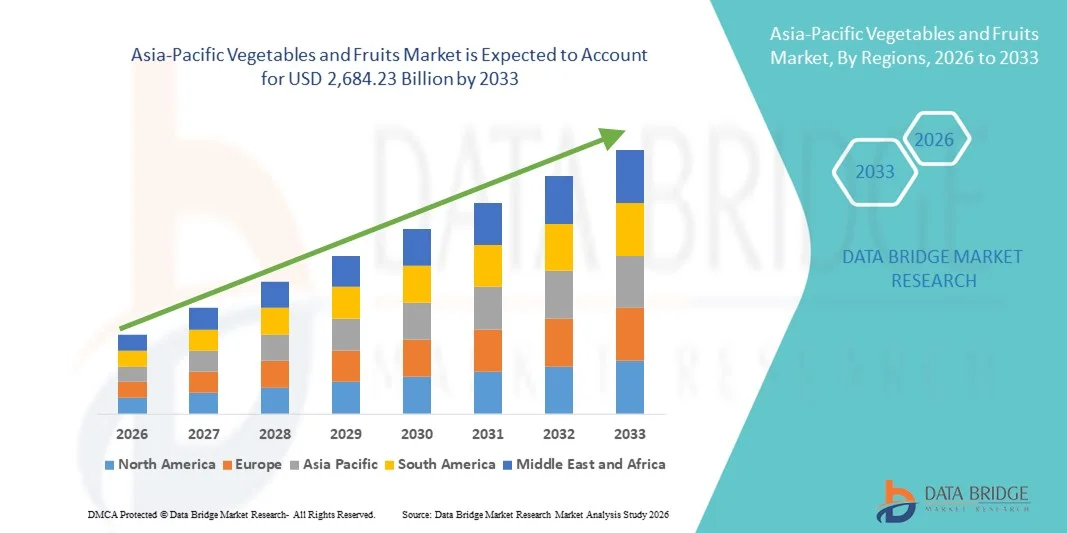
- The Asia-Pacific vegetables and fruits market size was valued at USD 1,061.16 billion in 2025 and is expected to reach USD 2,684.23 billion by 2033, at a CAGR of 12.30% during the forecast period
- The market growth is largely fuelled by rising consumer awareness regarding the health benefits of fresh fruits and vegetables, including improved immunity, digestion, and overall wellness
- Increasing adoption of plant-based diets and changing dietary preferences toward natural and minimally processed foods are significantly supporting market expansion
Asia-Pacific Vegetables and Fruits Market Analysis
- The market is witnessing steady expansion driven by strong demand across household, foodservice, and food processing applications, supported by consistent consumption patterns and daily dietary inclusion
- Growing emphasis on food quality, freshness, and traceability is encouraging producers and distributors to invest in improved farming practices, storage solutions, and supply chain optimisation
- The China vegetables and fruits market accounted for the largest revenue share in 2025, attributed to high agricultural output, rapid urbanization, and strong consumption across household and food service sectors. Vegetables and fruits form a core part of daily diets, supporting consistent demand
- Japan is expected to witness the highest compound annual growth rate (CAGR) in the Asia-Pacific vegetables and fruits market due to rising health awareness, growing demand for premium-quality and convenient produce, increasing adoption of ready-to-eat fruits and vegetables, and the nutritional needs of an aging population
- The vegetables segment accounted for the largest market revenue share in 2025 driven by high daily consumption, wide availability across retail channels, and strong demand from food service operators. Vegetables are extensively used in household cooking and commercial food preparation, supporting their consistent market dominance across countries
Report Scope and Asia-Pacific Vegetables and Fruits Market Segmentation
|
Attributes |
Asia-Pacific Vegetables and Fruits Key Market Insights |
|
Segments Covered |
|
|
Countries Covered |
Asia-Pacific
|
|
Key Market Players |
|
|
Market Opportunities |
|
|
Value Added Data Infosets |
In addition to the insights on market scenarios such as market value, growth rate, segmentation, geographical coverage, and major players, the market reports curated by the Data Bridge Market Research also include import export analysis, production capacity overview, production consumption analysis, price trend analysis, climate change scenario, supply chain analysis, value chain analysis, raw material/consumables overview, vendor selection criteria, PESTLE Analysis, Porter Analysis, and regulatory framework. |
Asia-Pacific Vegetables and Fruits Market Trends
Rising Demand For Fresh, Healthy, And Naturally Sourced Produce
- The increasing focus on health, nutrition, and preventive wellness is significantly shaping the vegetables and fruits market, as consumers actively prefer fresh, natural, and minimally processed food products. Vegetables and fruits are gaining strong traction due to their essential vitamins, minerals, and antioxidants, which support immunity, digestion, and overall well-being. This trend is strengthening their consumption across households, foodservice outlets, and food processing industries, encouraging producers to enhance quality, freshness, and supply consistency
- Growing awareness around balanced diets, clean eating, and plant-forward lifestyles has accelerated the demand for fresh vegetables and fruits across daily meals, snacks, and beverages. Health-conscious consumers are increasingly incorporating fresh produce into their diets, driving demand from retail, hospitality, and institutional food channels. This shift is also encouraging food brands to develop value-added products such as fresh-cut, ready-to-eat, and minimally processed fruit and vegetable offerings
- Sustainability and food transparency trends are influencing purchasing decisions, with consumers prioritizing responsibly sourced, residue-free, and sustainably grown produce. Producers and distributors are focusing on improved farming practices, reduced chemical usage, and transparent supply chains to meet these expectations. These factors are helping brands differentiate offerings, build consumer trust, and enhance long-term loyalty in a competitive market
- For instance, in recent years, leading food brands and fresh produce suppliers expanded their portfolios to include fresh, organic, and minimally processed vegetables and fruits to address rising consumer demand for nutritious and natural food options. These products were introduced across retail, foodservice, and online grocery platforms, with marketing efforts emphasizing freshness, health benefits, and sustainable sourcing to strengthen brand positioning
- While demand for vegetables and fruits continues to rise, sustained market growth depends on efficient supply chains, improved storage solutions, and reduced post-harvest losses. Market participants are increasingly investing in cold chain infrastructure, packaging innovations, and digital distribution platforms to maintain quality, extend shelf life, and ensure consistent availability across end-use channels
Asia-Pacific Vegetables and Fruits Market Dynamics
Driver
Growing Consumer Preference For Healthy And Nutrient-Rich Diets
- Rising consumer awareness regarding the health benefits of vegetables and fruits is a major driver for market growth. Consumers are increasingly prioritizing nutrient-dense foods rich in vitamins, minerals, and dietary fiber, encouraging higher daily consumption. This trend is driving producers and retailers to expand fresh produce offerings and improve product quality to meet evolving dietary preferences
- Expanding use of vegetables and fruits in home cooking, foodservice menus, and processed food applications is supporting market expansion. Fresh produce plays a critical role in salads, beverages, ready meals, and functional foods, enabling manufacturers and food operators to meet consumer demand for wholesome and balanced meals. The increasing adoption of plant-based and flexitarian diets further reinforces this growth driver
- Retailers, foodservice providers, and food brands are actively promoting vegetables and fruits through product innovations, awareness campaigns, and health-focused marketing strategies. These initiatives highlight nutritional value, freshness, and versatility, supporting increased consumption and encouraging collaboration across the agricultural and food supply ecosystem
- For instance, foodservice operators and packaged food brands have increased the inclusion of fresh and processed vegetables and fruits in meal kits, ready-to-eat products, and beverage formulations to meet rising consumer demand for healthy and convenient food choices. These initiatives have supported higher sales volumes and improved product differentiation in competitive food markets
- Despite strong demand drivers, sustained growth requires continuous investment in farming efficiency, logistics, and storage infrastructure. Strengthening supply chain resilience, improving yield consistency, and minimizing wastage will be essential to support long-term market expansion
Restraint/Challenge
Perishability And Supply Chain Inefficiencies
- The highly perishable nature of vegetables and fruits remains a key challenge, leading to significant post-harvest losses and increased operational costs. Inadequate storage, handling, and transportation infrastructure can result in quality degradation, reduced shelf life, and financial losses for producers and distributors, limiting overall market efficiency
- Price volatility caused by seasonal production cycles, climate variability, and fluctuating supply levels also restrains market stability. Sudden changes in availability can impact pricing, profit margins, and purchasing decisions, particularly for small-scale producers and price-sensitive consumers
- Supply chain complexities further challenge market growth, as vegetables and fruits require efficient cold storage, timely transportation, and careful handling to maintain freshness. Gaps in infrastructure and logistics capabilities increase costs and limit consistent availability across distribution channels
- For instance, disruptions in harvesting, storage, or transportation have led to quality losses and inconsistent supply for retailers and foodservice operators, affecting product availability and consumer satisfaction. These challenges have also prompted some sellers to limit product variety or increase prices to offset losses
- Addressing these challenges will require investment in cold chain development, advanced packaging solutions, and improved logistics management. Strengthening farmer-to-market connectivity, adopting modern storage technologies, and enhancing supply chain coordination will be critical to unlocking the long-term growth potential of the vegetables and fruits market
Asia-Pacific Vegetables and Fruits Market Scope
The market is segmented on the basis of product, type, category, packaging, end user, and distribution channel
- By Product
On the basis of product, the Asia-Pacific vegetables and fruits market is segmented into vegetables and fruits. The vegetables segment accounted for the largest market revenue share in 2025 driven by high daily consumption, wide availability across retail channels, and strong demand from food service operators. Vegetables are extensively used in household cooking and commercial food preparation, supporting their consistent market dominance across countries.
The fruits segment is expected to witness steady growth from 2026 to 2033 supported by rising consumer preference for healthy snacking options and increasing awareness of the nutritional benefits of fresh and processed fruits. In addition, growing demand for fruit-based beverages, desserts, and convenience products is supporting segment expansion.
- By Type
On the basis of type, the Asia-Pacific vegetables and fruits market is segmented into fresh, canned, frozen, dried & dehydrated, purees and paste, concentrates, and others. The fresh segment held the largest market share in 2025 owing to strong consumer preference for minimally processed food and the well-developed fresh produce supply chain in Asia-Pacific. Fresh vegetables and fruits are widely consumed due to their perceived quality, taste, and nutritional value.
The frozen segment is expected to grow steadily from 2026 to 2033 driven by extended shelf life, reduced food waste, and convenience for both households and food service providers. Frozen products are increasingly adopted due to advancements in freezing technology that help retain texture and nutrients.
- By Category
On the basis of category, the Asia-Pacific vegetables and fruits market is segmented into organic and conventional. The conventional segment dominated the market in 2025 supported by lower prices, higher availability, and established farming practices across Asia-Pacific. Conventional vegetables and fruits continue to be widely preferred due to affordability and consistent supply.
The organic segment is expected to register faster growth from 2026 to 2033 driven by increasing health consciousness and rising demand for chemical-free food products. In addition, supportive government initiatives and expanding organic retail offerings are accelerating segment growth.
- By Packaging
On the basis of packaging, the Asia-Pacific vegetables and fruits market is segmented into pouches, tray, bags, cans, jar, boxes, and others. Bags and trays accounted for a major revenue share in 2025 due to their extensive use for fresh produce packaging and ease of handling during transportation and retail display. These packaging formats are widely adopted by supermarkets and grocery stores.
Pouches and cans is expected to grow steadily from 2026 to 2033 driven by increasing demand for processed and ready-to-use vegetables and fruits. These packaging types offer improved shelf life and convenience, particularly for urban consumers.
- By End User
On the basis of end user, the Asia-Pacific vegetables and fruits market is segmented into retail/household and food service. The retail/household segment held the largest share in 2025 supported by high home consumption and frequent purchases through supermarkets and local stores. Changing dietary habits and preference for home-cooked meals continue to drive this segment.
The food service segment is expected to grow steadily from 2026 to 2033 driven by the expansion of restaurants, hotels, and catering services across Asia-Pacific. Increasing demand for consistent quality and bulk supply of vegetables and fruits is supporting segment growth.
- By Distribution Channel
On the basis of distribution channel, the Asia-Pacific vegetables and fruits market is segmented into store based retailers and non-store based retailers. Store based retailers dominated the market in 2025 driven by strong supermarket and hypermarket presence, wide product assortment, and consumer preference for physical inspection of fresh produce.
The non-store based retailers segment is expected to grow steadily from 2026 to 2033 supported by the rapid expansion of online grocery platforms and doorstep delivery services. In addition, increasing digital adoption and convenience are accelerating the shift toward online purchasing of vegetables and fruits.
Asia-Pacific Vegetables and Fruits Market Regional Analysis
- The China vegetables and fruits market accounted for the largest revenue share in 2025, attributed to high agricultural output, rapid urbanization, and strong consumption across household and food service sectors. Vegetables and fruits form a core part of daily diets, supporting consistent demand
- Moreover, improvements in cold chain logistics and large-scale retail distribution are strengthening China’s dominant market position
Japan Vegetables and Fruits Market Insight
The Japan vegetables and fruits market is expected to witness the fastest growth rate from 2026 to 2033, driven by increasing health awareness and strong demand for premium-quality, fresh, and convenient produce. Consumers place high importance on food safety, quality, and portion-controlled packaging. The rising popularity of ready-to-eat fruits and vegetables, along with nutritional needs of the aging population, is further fueling market growth.
Asia-Pacific Vegetables and Fruits Market Share
The Asia-Pacific vegetables and fruits industry is primarily led by well-established companies, including:
- Chaoda Modern Agriculture (Holdings) Limited (China)
- ShunDi Foods (China)
- Asia Pacific Produce Co., Ltd. (Japan)
- Kagome Co., Ltd. (Japan)
- Del Monte Pacific (Singapore)
- Saraf Foods Pvt Ltd (India)
- Chao Su Frozen Food Co., Ltd. (Taiwan)
- Metro Pacific Fresh Farms (Philippines)
- Famveg (India)
- Wholesalemandi.com (India)
- Totally Pure Fruits Pty Ltd (Australia)
- Bajaj Agro Foods India Ltd (India)
- Lianfu Food Co. Ltd (China)
- Paradise Fruits Solutions (China)
- Green Fields Fresh Produce (Australia)
SKU-
Get online access to the report on the World's First Market Intelligence Cloud
- Interactive Data Analysis Dashboard
- Company Analysis Dashboard for high growth potential opportunities
- Research Analyst Access for customization & queries
- Competitor Analysis with Interactive dashboard
- Latest News, Updates & Trend analysis
- Harness the Power of Benchmark Analysis for Comprehensive Competitor Tracking
Research Methodology
Data collection and base year analysis are done using data collection modules with large sample sizes. The stage includes obtaining market information or related data through various sources and strategies. It includes examining and planning all the data acquired from the past in advance. It likewise envelops the examination of information inconsistencies seen across different information sources. The market data is analysed and estimated using market statistical and coherent models. Also, market share analysis and key trend analysis are the major success factors in the market report. To know more, please request an analyst call or drop down your inquiry.
The key research methodology used by DBMR research team is data triangulation which involves data mining, analysis of the impact of data variables on the market and primary (industry expert) validation. Data models include Vendor Positioning Grid, Market Time Line Analysis, Market Overview and Guide, Company Positioning Grid, Patent Analysis, Pricing Analysis, Company Market Share Analysis, Standards of Measurement, Global versus Regional and Vendor Share Analysis. To know more about the research methodology, drop in an inquiry to speak to our industry experts.
Customization Available
Data Bridge Market Research is a leader in advanced formative research. We take pride in servicing our existing and new customers with data and analysis that match and suits their goal. The report can be customized to include price trend analysis of target brands understanding the market for additional countries (ask for the list of countries), clinical trial results data, literature review, refurbished market and product base analysis. Market analysis of target competitors can be analyzed from technology-based analysis to market portfolio strategies. We can add as many competitors that you require data about in the format and data style you are looking for. Our team of analysts can also provide you data in crude raw excel files pivot tables (Fact book) or can assist you in creating presentations from the data sets available in the report.