Asia Pacific Intraoperative Radiation Therapy Market
Market Size in USD Million
CAGR :
% 
 USD
73.39 Million
USD
126.09 Million
2025
2033
USD
73.39 Million
USD
126.09 Million
2025
2033
 Forecast Period Forecast Period |
2026 –2033 |
 Market Size (Base Year) Market Size (Base Year) |
USD 73.39 Million |
 Market Size (Forecast Year) Market Size (Forecast Year) |
USD 126.09 Million |
 CAGR CAGR |
% |
| Major Markets Players |
|
Asia-Pacific Intraoperative Radiation Therapy Market Size
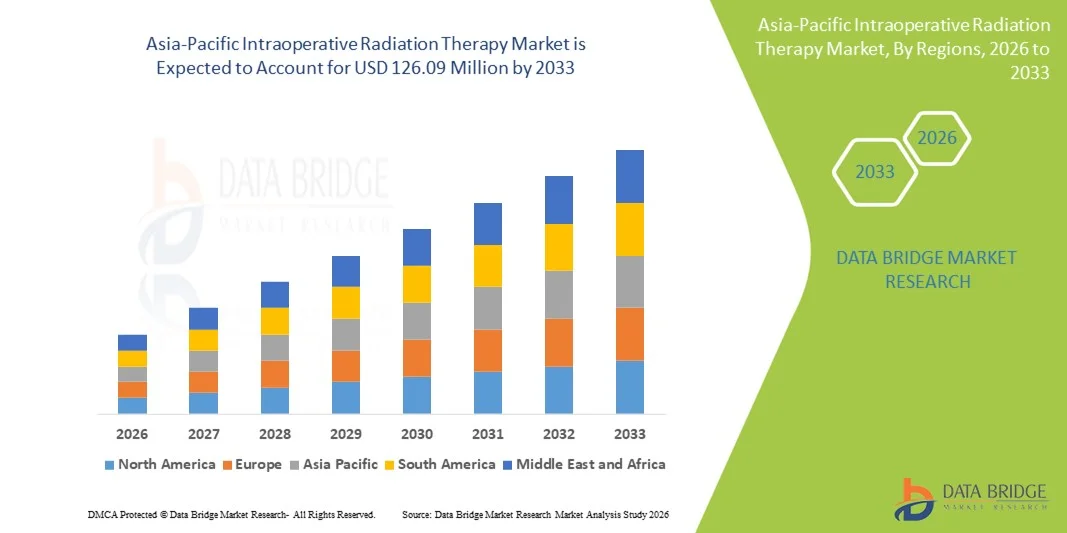
- The Asia-Pacific intraoperative radiation therapy market size was valued at USD 73.39 million in 2025 and is expected to reach USD 126.09 million by 2033, at a CAGR of 7.0% during the forecast period
- The market growth is mainly driven by the rising incidence of cancer across the region, expanding oncology care infrastructure, and growing adoption of advanced radiation technologies in surgical oncology settings. China, Japan, and India are key contributors as healthcare spending increases and awareness of targeted cancer treatments rises
- In addition, increasing demand for precise, single‑session radiation delivery during surgery, technological advancements in intraoperative systems, and supportive government initiatives for cancer care are establishing IORT as a preferred modality in both tertiary hospitals and specialty cancer centers. These combined factors are accelerating uptake and significantly boosting the industry’s expansion across Asia‑Pacific
Asia-Pacific Intraoperative Radiation Therapy Market Analysis
- The intraoperative radiation therapy market, delivering focused radiation during surgery, is increasingly recognized as a vital component of cancer care in hospitals and specialized oncology centers in Asia‑Pacific countries due to its precision, reduced treatment time, and ability to minimize exposure to surrounding healthy tissues
- The rising adoption of the intraoperative radiation therapy is primarily driven by increasing cancer incidence, expanding surgical oncology infrastructure, and growing awareness of targeted, single-session radiation treatments among healthcare providers and patients
- Japan dominated the Asia‑Pacific intraoperative radiation therapy market in 2025 with a revenue share of 25.6%, supported by advanced healthcare systems, early adoption of modern radiation technologies, and significant investment in cancer care facilities
- India is expected to be the fastest-growing country in the Asia‑Pacific intraoperative radiation therapy market during the forecast period driven by rising healthcare expenditure, increasing urbanization, and growing demand for advanced, minimally invasive cancer treatments
- Electron IORT segment dominated the Asia‑Pacific intraoperative radiation therapy market in 2025 with a share of 42.7%, driven by its proven clinical efficacy, compatibility with multiple tumor types, and increasing adoption in breast cancer and soft tissue sarcoma surgeries
Report Scope and Asia-Pacific Intraoperative Radiation Therapy Market Segmentation
|
Attributes |
Asia-Pacific Intraoperative Radiation Therapy Key Market Insights |
|
Segments Covered |
|
|
Countries Covered |
Asia-Pacific
|
|
Key Market Players |
|
|
Market Opportunities |
|
|
Value Added Data Infosets |
In addition to the insights on market scenarios such as market value, growth rate, segmentation, geographical coverage, and major players, the market reports curated by the Data Bridge Market Research also include in-depth expert analysis, patient epidemiology, pipeline analysis, pricing analysis, and regulatory framework |
Asia-Pacific Intraoperative Radiation Therapy Market Trends
Precision Oncology Adoption and Integration with Surgical Workflows
- A notable and accelerating trend in the Asia‑Pacific intraoperative radiation therapy market is the growing integration of IORT systems into minimally invasive surgical workflows, enhancing treatment precision, reducing post-operative complications, and shortening overall therapy duration
- For instance, hospitals in Japan and China are implementing portable electron IORT systems that allow surgeons to deliver targeted radiation during breast-conserving surgeries without moving patients to separate radiotherapy rooms
- Integration with surgical imaging and navigation tools enables real-time monitoring of tumor margins and surrounding healthy tissues, improving accuracy and patient outcomes. For instance, some advanced systems in South Korea utilize intraoperative imaging feedback to optimize radiation delivery during soft tissue sarcoma surgeries
- The seamless incorporation of IORT into surgical workflows facilitates multidisciplinary treatment planning, allowing surgeons, radiation oncologists, and medical physicists to coordinate procedures efficiently, improving overall treatment quality and patient throughput
- This trend toward precision-guided, workflow-integrated intraoperative radiation therapy is reshaping expectations for surgical oncology, with companies such as Carl Zeiss Meditec and Varian developing systems designed for real-time imaging and radiation delivery during surgery
- The demand for IORT systems integrated with surgical platforms is growing rapidly across hospitals and cancer centers in Asia-Pacific, as clinicians increasingly prioritize efficiency, treatment accuracy, and reduced hospital stays
Asia-Pacific Intraoperative Radiation Therapy Market Dynamics
Driver
Rising Cancer Incidence and Expansion of Oncology Infrastructure
- The increasing prevalence of cancers across Asia-Pacific countries, combined with expanding surgical oncology infrastructure, is a significant driver for the growing adoption of IORT systems
- For instance, in 2025, major hospitals in India upgraded their oncology departments with electron IORT units to manage increasing breast and gastrointestinal cancer cases
- As healthcare providers seek precise, single-session radiation treatments during surgery, IORT offers reduced treatment times, minimized damage to healthy tissue, and improved patient outcomes compared to conventional post-operative radiotherapy
- Furthermore, the growing number of specialized cancer centers and the modernization of hospitals in Japan, China, and South Korea are supporting higher IORT adoption rates, enabling integration with advanced surgical technologies
- The portable IORT units in urban Indian hospitals allow breast cancer patients to receive targeted radiation immediately after tumor removal, streamlining care pathways and enhancing patient convenience
- Increasing government initiatives and funding programs for advanced cancer treatment infrastructure in countries such as China and Japan are further driving IORT adoption
- For instance, grant programs in Japan subsidize IORT equipment for regional cancer hospitals, accelerating deployment across multiple surgical oncology centers
Restraint/Challenge
High Equipment Costs and Limited Awareness Among Clinicians
- The high initial cost of IORT devices and associated infrastructure poses a significant barrier to adoption, particularly for smaller hospitals and developing countries in Asia-Pacific
- For instance, some hospitals in Southeast Asia hesitate to purchase benchtop IORT systems due to budget constraints and competing capital priorities for oncology care
- Low awareness and training gaps among surgeons and radiation oncologists regarding the benefits and operation of IORT systems can slow adoption despite proven clinical efficacy. For instance, surveys in India and Vietnam highlighted the need for specialized training programs to ensure safe and effective use
- Addressing these challenges through cost-effective solutions, clinician education, and demonstration projects is critical for broader market penetration and sustained growth
- The initiatives by companies such as Carl Zeiss Meditec to provide training workshops and leasing options for IORT systems are helping overcome financial and knowledge barriers in emerging Asia-Pacific markets
- Limited availability of spare parts, maintenance services, and technical support in emerging countries may delay adoption or operational efficiency of IORT systems
- For instance, some hospitals in Indonesia report delayed installation or downtime due to lack of certified service personnel for electron IORT devices
Asia-Pacific Intraoperative Radiation Therapy Market Scope
The market is segmented on the basis of method, product, type, application, end user, and distribution channel.
- By Method
On the basis of method, the Asia‑Pacific intraoperative radiation therapy market is segmented into electron IORT, intraoperative brachytherapy, high dose-rate (HDR) IORT, X-ray IORT, and others. The electron IORT segment dominated the market in 2025 with the largest revenue share of 42.7%, due to its well-established clinical efficacy and versatility across multiple tumor types. Hospitals in Japan, China, and South Korea prefer electron IORT for breast, soft tissue sarcoma, and gastrointestinal cancers. Its ability to deliver precise single-session radiation during surgery reduces post-operative therapy needs and minimizes exposure to healthy tissues. Surgeons value its ease of integration with surgical workflows and imaging systems. The segment’s dominance is supported by robust clinical evidence, ongoing physician training programs, and strong hospital infrastructure. Widespread adoption in tertiary hospitals and oncology centers further reinforces its market leadership.
The HDR IORT segment is expected to witness the fastest growth from 2026 to 2033, driven by technological innovations in compact HDR systems and their rising adoption in specialty cancer centers. HDR IORT allows high-precision radiation delivery in complex tumor surgeries, including head and neck, gynecological, and pediatric tumors. Its adaptability for portable applications also supports rapid deployment in emerging markets such as India and Southeast Asia. Hospitals are increasingly adopting HDR systems to reduce treatment time and improve patient outcomes. Awareness campaigns and training initiatives for clinicians further accelerate adoption. The growing clinical preference for multi-tumor applicability strengthens the segment’s growth trajectory.
- By Product
On the basis of product, the market is segmented into IORT devices, IORT accessories, and software & services. The IORT devices segment dominated the market in 2025, accounting for 58% of revenue, due to increasing installations of advanced radiation devices in hospitals and cancer centers. Devices include electron accelerators, X-ray IORT units, and HDR systems, all enabling precise, intraoperative radiation. Hospitals prefer devices for their accuracy, real-time monitoring, and compatibility with multiple tumor types. Leading players such as Carl Zeiss Meditec, Varian, and IntraOp Medical provide training and support, enhancing adoption. Government funding and hospital investment programs further support the devices segment. Its proven clinical benefits, combined with established trust among clinicians, reinforce its dominance.
The software & services segment is expected to witness the fastest growth from 2026 to 2033, driven by demand for treatment planning software, real-time monitoring, and remote support services. Integration with surgical navigation platforms improves coordination between surgeons, radiation oncologists, and medical physicists. Hospitals increasingly use these solutions to optimize radiation doses, enhance safety, and predict patient outcomes. The growth is further supported by training, technical support, and subscription-based software models. Emerging markets in India, Indonesia, and Vietnam show strong adoption trends. Software-driven workflow enhancements contribute to faster, safer, and more effective IORT procedures.
- By Type
On the basis of type, the market is segmented into portable and benchtop IORT systems. The benchtop segment dominated the market in 2025 with a 62% share, primarily due to its suitability for large hospitals and cancer centers with dedicated oncology departments. Benchtop systems offer high precision, allow complex surgical procedures, and integrate seamlessly with imaging systems. Hospitals in Japan, China, and South Korea prefer these systems for breast, head and neck, and soft tissue sarcoma surgeries. Clinicians value their durability, long-term validation, and reliability. Government programs and clinical partnerships further support adoption. The segment’s ability to serve high patient volumes reinforces its dominance.
The portable segment is expected to register the fastest growth from 2026 to 2033, driven by adoption in smaller hospitals, ambulatory surgical centers, and emerging markets such as India, Vietnam, and Indonesia. Portable systems enable intraoperative radiation without major infrastructure modifications. They provide targeted, single-session treatment immediately post-surgery. Flexible deployment, lower installation costs, and accessibility in remote areas drive growth. Growing awareness and government support for expanding oncology access further strengthen adoption. Clinicians increasingly value the convenience and flexibility of portable systems for diverse surgical applications.
- By Application
On the basis of application, the market is segmented into breast cancer, brain tumor, head & neck cancer, soft tissue sarcoma, pediatric tumors, gynecological cancer, genitourinary cancers, upper gastro-intestinal tumors, and other cancers. The breast cancer segment dominated the market in 2025 with a 44% revenue share, driven by rising incidence in Asia-Pacific and the proven effectiveness of IORT in breast-conserving surgeries. Hospitals adopt IORT for single-session, targeted radiation immediately after tumor removal. Electron IORT ensures precision while reducing treatment duration. Patients benefit from shorter hospital stays and fewer side effects. Clinicians and hospitals prioritize this method due to workflow efficiency and improved patient satisfaction. Government programs promoting early breast cancer treatment further reinforce dominance.
The soft tissue sarcoma segment is expected to witness the fastest growth from 2026 to 2033, fueled by rising incidence in Japan, China, and India and adoption of advanced IORT systems. Surgeons use IORT for complex sarcoma resections to deliver precise radiation while protecting surrounding organs. Specialty cancer centers are increasingly incorporating IORT into multidisciplinary sarcoma treatment protocols. Awareness campaigns and training programs accelerate adoption. Technological advancements in IORT devices and workflow integration further support growth.
- By End User
On the basis of end user, the market is segmented into hospitals, ambulatory surgical centers, specialty centers, and others. The hospital segment dominated the market in 2025, with a 65% share, due to advanced oncology infrastructure and trained multidisciplinary teams. Hospitals in Japan, China, and South Korea are equipped with benchtop and portable IORT systems. They serve high patient volumes for breast, brain, and soft tissue sarcoma surgeries. Dedicated operating rooms and integration with imaging systems support precise radiation delivery. Clinical expertise, government funding, and partnerships with manufacturers reinforce dominance. Hospitals benefit from long-term service contracts, training, and technical support.
The ambulatory surgical centers segment is expected to register the fastest growth from 2026 to 2033, driven by demand for outpatient procedures in India, Indonesia, and Vietnam. Portable IORT systems allow radiation delivery without large infrastructure investments. Patients benefit from convenience, reduced hospital stays, and minimally invasive procedures. Adoption is supported by training programs, government awareness campaigns, and increasing cancer awareness. Centers integrate IORT with multidisciplinary surgical workflows. Growing preference for same-day surgery in emerging markets strengthens this segment’s growth trajectory.
- By Distribution Channel
On the basis of distribution channel, the market is segmented into direct tender and retail sales. The direct tender segment dominated the market in 2025, accounting for 72% of revenue, as hospitals and cancer centers prefer direct procurement for installation, training, and service agreements. Bulk purchases often include software, accessories, and maintenance packages. Hospitals in Japan, China, and South Korea rely on direct tenders to ensure regulatory compliance and long-term support. Manufacturers such as Carl Zeiss Meditec, Varian, and IntraOp Medical actively pursue tender contracts. Direct procurement ensures reliability, proper training, and strong technical support. Long-term service agreements and clinical support reinforce dominance.
The retail sales segment is expected to witness the fastest growth from 2026 to 2033, particularly for accessories, portable systems, and software packages in emerging markets. Hospitals, specialty centers, and ambulatory surgical facilities in India, Indonesia, and Vietnam increasingly procure via distributors or authorized resellers. Retail channels offer flexible financing, localized technical support, and training. Smaller facilities benefit from easier access to advanced systems. Rapid adoption is supported by awareness programs and demonstrations. The convenience and scalability of retail purchases drive segment growth.
Asia-Pacific Intraoperative Radiation Therapy Market Regional Analysis
- Japan dominated the Asia‑Pacific intraoperative radiation therapy market in 2025 with a revenue share of 25.6%, supported by advanced healthcare systems, early adoption of modern radiation technologies, and significant investment in cancer care facilities
- Healthcare providers in these countries highly value the precision, reduced treatment times, and improved patient outcomes offered by IORT systems during surgeries for breast, soft tissue sarcoma, and gastrointestinal cancers
- This widespread adoption is further supported by government initiatives for cancer care, availability of skilled multidisciplinary teams, and strong investment in hospitals and specialty cancer centers, establishing IORT as a preferred modality for intraoperative radiation therapy across the region
The China Intraoperative Radiation Therapy Market Insight
The China intraoperative radiation therapy market captured the revenue share of 28% in 2025, driven by the rapid expansion of hospital infrastructure, increasing cancer incidence, and growing awareness of precision oncology treatments. Hospitals and specialty cancer centers are increasingly adopting IORT systems for breast, soft tissue sarcoma, and gastrointestinal cancers due to their precision and reduced treatment times. The rising availability of advanced IORT devices and government funding for oncology programs further propels market growth. Integration of IORT with modern surgical workflows and imaging systems enhances clinical outcomes, supporting widespread adoption. The growing focus on minimally invasive procedures and single-session radiation therapy strengthens demand across both urban and semi-urban healthcare facilities.
Japan Intraoperative Radiation Therapy Market Insight
The Japan intraoperative radiation therapy market is captured largest revenue share, driven by high healthcare infrastructure standards, early adoption of advanced radiation technologies, and a strong focus on cancer treatment innovation. Hospitals increasingly integrate IORT into breast-conserving surgeries and soft tissue sarcoma procedures. The country’s advanced imaging and surgical systems complement IORT, improving precision and workflow efficiency. Japan’s aging population and high prevalence of cancer further support adoption in both hospitals and specialty centers. Clinicians value IORT for reducing post-operative radiotherapy sessions while maintaining clinical efficacy. Ongoing government initiatives and hospital investment programs encourage further expansion of IORT adoption.
India Intraoperative Radiation Therapy Market Insight
The India intraoperative radiation therapy market accounted for the largest revenue share in the region in 2025, attributed to rising cancer prevalence, rapid hospital modernization, and increasing investment in oncology infrastructure. Portable IORT systems are gaining traction in urban and semi-urban hospitals and ambulatory surgical centers, providing targeted radiation during surgeries without large infrastructure investments. Government support through health programs and cancer awareness campaigns is driving adoption in both public and private hospitals. The expanding middle-class patient base and growing awareness of advanced therapies contribute to rising demand. Training programs for clinicians and partnerships with IORT device manufacturers further facilitate growth. Availability of cost-effective IORT systems also accelerates adoption across emerging hospitals.
South Korea Intraoperative Radiation Therapy Market Insight
The South Korea intraoperative radiation therapy market is expected to grow at a notable CAGR during the forecast period, driven by technological advancement in surgical oncology and precision radiation therapies. Hospitals and specialty cancer centers are adopting IORT systems for breast, head & neck, and soft tissue sarcoma surgeries. The integration of IORT with robotic-assisted surgery and advanced imaging improves treatment accuracy. South Korea’s well-developed healthcare infrastructure and strong focus on research and clinical trials support rapid market adoption. Government funding for cancer treatment technologies further encourages hospitals to implement IORT systems. The market benefits from growing awareness among clinicians of the clinical advantages of intraoperative radiation.
Asia-Pacific Intraoperative Radiation Therapy Market Share
The Asia-Pacific Intraoperative Radiation Therapy industry is primarily led by well-established companies, including:
- Elekta AB (Sweden)
- IntraOp Medical, Inc. (U.S.)
- Carl Zeiss Meditec AG (Germany)
- Eckert & Ziegler AG (Germany)
- iCAD, Inc. (U.S.)
- Sensus Healthcare, Inc. (U.S.)
- Ariane Medical Systems Ltd (U.K.)
- GMV Innovating Solutions S.L. (Spain)
- Ion Beam Applications SA (Belgium)
- IsoRay, Inc. (U.S.)
- Brainlab AG (Germany)
- Mevion Medical Systems, Inc. (U.S.)
- Xoft, Inc. (U.S.)
- Panacea Medical Technologies Pvt. Ltd. (India)
- REMEDI Co., Ltd. (South Korea)
- RaySearch Laboratories AB (Sweden)
- Sordina IORT Technologies (Italy)
- Zap Surgical Systems Inc. (U.S.)
- Varian Medical Systems, Inc. (U.S.)
What are the Recent Developments in Asia-Pacific Intraoperative Radiation Therapy Market?
- In November 2025, Aster Whitefield Hospital achieved a milestone of completing more than 140+ IOeRT procedures, setting a national benchmark for intraoperative electron radiation therapy cancer care in India and demonstrating broad clinical adoption and treatment effectiveness for early‑stage breast cancers
- In March 2025, Aster Whitefield Hospital in Bengaluru, India, introduced India’s first Intra‑Operative Electron Radiation Therapy (IOeRT) service, marking a major institutional launch of targeted intraoperative radiation treatment designed to reduce post‑surgical radiation sessions and improve precision for complex cancers
- In May 2024, Ramaiah Memorial Hospital in Bangalore, India, launched a novel IORT X‑Ray device, successfully performing precision intraoperative radiation therapy during breast conservation surgeries, thus advancing treatment options and demonstrating the integration of IORT into routine surgical oncology
- In March 2022, Zeiss Medical Technology launched the INTRABEAM 600 device in India to provide intraoperative radiation therapy (IORT) for early‑stage breast cancer patients, marking a significant technology introduction in the region and making advanced IORT treatment available at the Fortis Cancer Institute in Bengaluru. This launch also included investment in an IORT Innovation Lab to boost cancer research and make IORT technology more accessible and effective in India
- In February 2022, Fortis Cancer Institute in Karnataka, India, announced the installation of intraoperative radiation therapy (IORT) equipment dedicated to breast cancer treatment, enhancing access to targeted, single‑session radiation therapy during surgery and improving treatment precision for patients in the region
SKU-
Get online access to the report on the World's First Market Intelligence Cloud
- Interactive Data Analysis Dashboard
- Company Analysis Dashboard for high growth potential opportunities
- Research Analyst Access for customization & queries
- Competitor Analysis with Interactive dashboard
- Latest News, Updates & Trend analysis
- Harness the Power of Benchmark Analysis for Comprehensive Competitor Tracking
Research Methodology
Data collection and base year analysis are done using data collection modules with large sample sizes. The stage includes obtaining market information or related data through various sources and strategies. It includes examining and planning all the data acquired from the past in advance. It likewise envelops the examination of information inconsistencies seen across different information sources. The market data is analysed and estimated using market statistical and coherent models. Also, market share analysis and key trend analysis are the major success factors in the market report. To know more, please request an analyst call or drop down your inquiry.
The key research methodology used by DBMR research team is data triangulation which involves data mining, analysis of the impact of data variables on the market and primary (industry expert) validation. Data models include Vendor Positioning Grid, Market Time Line Analysis, Market Overview and Guide, Company Positioning Grid, Patent Analysis, Pricing Analysis, Company Market Share Analysis, Standards of Measurement, Global versus Regional and Vendor Share Analysis. To know more about the research methodology, drop in an inquiry to speak to our industry experts.
Customization Available
Data Bridge Market Research is a leader in advanced formative research. We take pride in servicing our existing and new customers with data and analysis that match and suits their goal. The report can be customized to include price trend analysis of target brands understanding the market for additional countries (ask for the list of countries), clinical trial results data, literature review, refurbished market and product base analysis. Market analysis of target competitors can be analyzed from technology-based analysis to market portfolio strategies. We can add as many competitors that you require data about in the format and data style you are looking for. Our team of analysts can also provide you data in crude raw excel files pivot tables (Fact book) or can assist you in creating presentations from the data sets available in the report.