Asia Pacific Automated Liquid Handling Market
Market Size in USD Million
CAGR :
% 
 USD
258.69 Million
USD
515.45 Million
2025
2033
USD
258.69 Million
USD
515.45 Million
2025
2033
 Forecast Period Forecast Period |
2026 –2033 |
 Market Size (Base Year) Market Size (Base Year) |
USD 258.69 Million |
 Market Size (Forecast Year) Market Size (Forecast Year) |
USD 515.45 Million |
 CAGR CAGR |
% |
| Major Markets Players |
|
Asia-Pacific Automated Liquid Handling Market Size
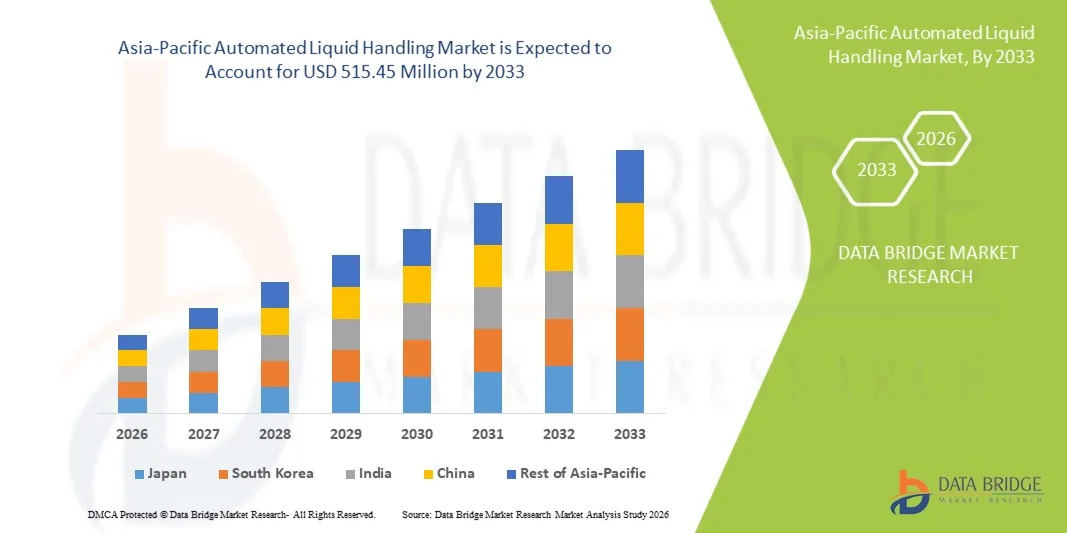
- The Asia-Pacific automated liquid handling market size was valued at USD 258.69 million in 2025 and is expected to reach USD 515.45 million by 2033, at a CAGR of 9.0% during the forecast period
- The market’s expansion is primarily driven by increasing investment in life sciences research and development, broader adoption of laboratory automation in pharmaceutical, biotechnology, clinical diagnostics, and genomics applications, and ongoing modernization of healthcare infrastructure across key countries such as China, India, Japan, and South Korea
- Furthermore, growing demand for high‑throughput screening, the shift from manual to automated workflows, and the integration of advanced robotics and software in liquid handling systems are positioning automated liquid handling solutions as essential tools in regional laboratories. These converging factors are accelerating uptake across academic, industrial, and healthcare settings, significantly bolstering market growth through the forecast period
Asia-Pacific Automated Liquid Handling Market Analysis
- Automated liquid handling systems, which provide precise, high-throughput sample processing and reagent management, are becoming increasingly critical in laboratories across Asia-Pacific, supporting applications in genomics, drug discovery, clinical diagnostics, and proteomics due to their efficiency, accuracy, and seamless integration with laboratory automation workflows
- The rising demand for automated liquid handling solutions is primarily fueled by growing investments in biotechnology and pharmaceutical R&D, increasing adoption of laboratory automation, the need for high-throughput and reproducible workflows, and the shift from manual to automated procedures in research and clinical laboratories
- China dominated the Asia-Pacific market, with the largest revenue share of 22.3% in 2025, supported by advanced research infrastructure, significant government funding for life sciences, and the presence of key industry players offering innovative automation platforms and consumables
- India is expected to be the fastest-growing country driven by expanding pharmaceutical and biotechnology sectors, rising clinical trials, and increasing laboratory modernization initiatives in both academic and industrial settings
- Automated liquid handling workstations segment dominated the market in 2025 with a share of 44.1%, reflecting their critical role in PCR setup, plate replication, serial dilution, and other laboratory procedures
Report Scope and Asia-Pacific Automated Liquid Handling Market Segmentation
|
Attributes |
Asia-Pacific Automated Liquid Handling Key Market Insights |
|
Segments Covered |
|
|
Countries Covered |
Asia-Pacific
|
|
Key Market Players |
|
|
Market Opportunities |
|
|
Value Added Data Infosets |
In addition to the insights on market scenarios such as market value, growth rate, segmentation, geographical coverage, and major players, the market reports curated by the Data Bridge Market Research also include in-depth expert analysis, patient epidemiology, pipeline analysis, pricing analysis, and regulatory framework |
Asia-Pacific Automated Liquid Handling Market Trends
“Automation and AI Integration in Laboratory Workflows”
- A key and rapidly growing trend in the Asia-Pacific automated liquid handling market is the increasing integration of artificial intelligence (AI) and robotic automation into liquid handling platforms, enhancing accuracy, efficiency, and workflow optimization across genomics, drug discovery, and clinical diagnostics
- For instance, Hamilton Microlab STAR platforms incorporate AI-assisted pipetting and scheduling algorithms to streamline sample processing and minimize human error, while Tecan Fluent systems optimize liquid dispensing through predictive analytics
- AI integration allows features such as adaptive pipetting based on sample viscosity, real-time error detection, and predictive maintenance notifications, while robotic automation reduces manual handling and improves reproducibility across high-throughput workflows
- The seamless integration of liquid handling systems with laboratory information management systems (LIMS) and broader lab automation platforms enables centralized control over multiple instruments, allowing researchers to monitor, schedule, and manage experiments from a single interface
- This trend toward more intelligent, automated, and interconnected liquid handling solutions is transforming expectations for laboratory efficiency and precision. Consequently, companies such as Beckman Coulter and Eppendorf are introducing AI-enabled systems capable of adaptive workflows and integration with robotic arms
- The demand for automated liquid handling platforms with AI and workflow integration is increasing rapidly across biotechnology, pharmaceutical, and clinical laboratories, as institutions prioritize speed, reproducibility, and operational efficiency
- The adoption of modular and flexible liquid handling platforms is also trending, allowing labs to scale automation according to experiment volume and complexity while optimizing resource utilization and cost efficiency
Asia-Pacific Automated Liquid Handling Market Dynamics
Driver
“Rising R&D Investments and Laboratory Automation Adoption”
- The growing investment in biotechnology, pharmaceuticals, and genomics research across Asia-Pacific, along with the adoption of laboratory automation, is a major driver for increased demand for automated liquid handling solutions
- For instance, in March 2025, Tecan announced expanded deployment of its Fluent liquid handling platforms across Asia-Pacific clinical and research laboratories to support high-throughput screening and genomics workflows
- As laboratories seek to improve efficiency, reproducibility, and throughput, automated liquid handling systems provide precise sample handling, minimize human error, and accelerate experimental timelines
- Furthermore, the expansion of pharmaceutical manufacturing, contract research organizations (CROs), and clinical diagnostics centers is making automated liquid handling essential for scaling experiments and ensuring consistent results
- The ability to integrate liquid handling systems with existing lab automation platforms, monitor workflows remotely, and manage high-volume experiments is propelling adoption in research institutes, hospitals, and biotechnology companies across the region
- Strong government initiatives and funding programs supporting biotechnology and genomics research in China, Japan, and India are further accelerating the uptake of automated liquid handling systems in public and private research labs
- The growing emphasis on high-throughput drug screening, precision medicine, and genomic sequencing projects is driving laboratories to implement automated liquid handling to meet throughput, accuracy, and reproducibility requirements efficiently
Restraint/Challenge
“High Costs and Technical Complexity”
- The relatively high capital investment required for advanced automated liquid handling platforms, along with the complexity of integrating them into existing laboratory workflows, presents a significant challenge for adoption, particularly in smaller research facilities
- For instance, start-up biotechnology labs and academic institutes may face budget constraints that limit procurement of full-featured liquid handling workstations, while semi-automated or modular systems may require technical expertise for operation
- Maintenance requirements, software updates, and potential calibration errors can create operational bottlenecks, raising concerns among laboratory managers about downtime and return on investment
- Furthermore, training staff to operate sophisticated automated liquid handling systems is essential, and lack of skilled personnel can hinder efficient implementation in some regions
- Overcoming these challenges through modular solutions, user-friendly interfaces, remote support, and affordable entry-level systems will be critical for sustained market growth across Asia-Pacific laboratories
- Inconsistent standards and regulatory requirements across Asia-Pacific countries can complicate implementation and cross-border adoption of automated liquid handling systems in multi-national research operations
- The potential risk of mechanical failures or errors during high-throughput operations poses operational concerns, necessitating robust preventive maintenance and real-time monitoring systems to ensure continuous productivity
Asia-Pacific Automated Liquid Handling Market Scope
The market is segmented on the basis of product, type, procedure, modality, application, end user, and distribution channel.
- By Product
On the basis of product, the market is segmented into automated liquid handling workstations, reagents & consumables, and others. The automated liquid handling workstations segment dominated the market with the largest revenue share of 44.1% in 2025, driven by their central role in high-throughput laboratory workflows. Workstations provide precise, reproducible liquid handling for critical procedures such as PCR setup, serial dilutions, and high-throughput screening. Laboratories favor these platforms for their ability to reduce human error, save time, and integrate with robotics and LIMS. Demand is further supported by increasing adoption in genomics, drug discovery, and clinical diagnostics, where precision and speed are essential. Workstations are also compatible with a variety of consumables and modular instruments, enhancing flexibility and scalability.
The reagents & consumables segment is expected to witness the fastest growth during 2026–2033, driven by the recurring need for disposable tips, plates, and reagents required for automated workflows. Rising volumes of genomics and high-throughput research increase consumption, while innovation in reagent kits tailored for specific applications, such as PCR and proteomics, supports growth. Laboratories often prioritize compatibility with automated workstations and reliability of reagents, further accelerating adoption. Additionally, expansion of biotechnology and pharmaceutical R&D in India, China, and Southeast Asia is fueling demand for consumables.
- By Type
On the basis of type, the market is segmented into automated liquid handling systems and semi-automated liquid handling. The automated liquid handling systems segment dominated the market in 2025, capturing 51% of the revenue share, as fully automated platforms allow high-throughput processing with minimal human intervention. These systems are preferred for complex workflows in genomics, drug discovery, and clinical diagnostics, where reproducibility, accuracy, and time efficiency are critical. Automation reduces pipetting errors, supports integration with robotics, and allows labs to handle larger sample volumes. Major players continue to enhance systems with AI, predictive analytics, and modularity, which drives adoption. Customers also value centralized control and remote monitoring features offered by automated systems.
The semi-automated liquid handling segment is expected to witness the fastest growth during 2026–2033, driven by cost-effective solutions for small- and medium-scale laboratories. Semi-automated systems provide flexibility for lower throughput workflows while offering automation benefits over manual pipetting. Growing adoption in academic institutes and research startups in Asia-Pacific, where budgets are constrained, is supporting market growth. Semi-automated platforms are also gaining traction due to their ease of setup, limited training requirements, and ability to integrate with existing laboratory infrastructure.
- By Procedure
On the basis of procedure, the market is segmented into PCR setup, plate replication, serial dilution, high-throughput screening, plate reformatting, cell culture, whole genome amplification, array printing, and others. The PCR setup segment dominated the market in 2025, reflecting its critical role in molecular diagnostics, genomics research, and infectious disease testing. Automation improves accuracy, reduces sample contamination, and ensures reproducibility in high-volume PCR workflows. Laboratories increasingly rely on automated systems to handle thousands of reactions simultaneously, saving time and labor. Integration with LIMS and robotic platforms further enhances efficiency and data tracking. PCR setup automation is also crucial for pandemic preparedness and large-scale testing initiatives in the region.
The high-throughput screening segment is expected to witness the fastest growth during 2026–2033, driven by increasing drug discovery and screening activities in pharmaceutical and biotechnology sectors. Automated liquid handling platforms allow rapid processing of thousands of compounds and assays, accelerating the drug development pipeline. Expansion of contract research organizations (CROs) and high-throughput genomic research in China, India, and Japan supports this growth. The segment benefits from demand for miniaturization, precision, and integration with AI-assisted data analytics to improve screening efficiency.
- By Modality
On the basis of modality, the market is segmented into disposable tips and fixed tips. The disposable tips segment dominated the market with a share of 61.5% in 2025, owing to their convenience, contamination prevention, and compatibility with various automated liquid handling systems. Laboratories prefer disposable tips for PCR, cell culture, and high-throughput workflows to ensure sample integrity. Growth is further driven by increasing lab automation adoption and the rise in genomics, proteomics, and diagnostic testing. Disposable tips also reduce maintenance needs and minimize cross-contamination risks, making them essential for regulated environments.
The fixed tips segment is expected to witness the fastest growth during 2026–2033, driven by cost-efficiency for repetitive and large-volume workflows. Fixed tips reduce consumable costs over time and are suitable for standardized protocols in high-volume labs. Expansion in clinical and industrial laboratories in Asia-Pacific, where cost optimization is critical, supports growth. Additionally, fixed tips are increasingly integrated with modular automation platforms to enhance performance in routine operations.
- By Application
On the basis of application, the market is segmented into genomics, drug discovery, clinical diagnostics, proteomics, and others. The genomics segment dominated the market in 2025, fueled by rising investments in genome sequencing, personalized medicine, and genetic research. Automation is critical to handle high sample volumes, reduce errors, and improve reproducibility. Genomics workflows rely heavily on precision liquid handling for PCR, library preparation, and sequencing. Growth is further supported by government initiatives, research grants, and increasing adoption of next-generation sequencing (NGS) in China, Japan, and India. Companies also offer integrated solutions for genomics research, driving segment revenue.
The drug discovery segment is expected to witness the fastest growth during 2026–2033, driven by increasing high-throughput screening and compound testing activities in pharmaceutical R&D. Automated liquid handling enables faster assay setup, reduces human error, and supports large-scale screening projects. The expansion of CROs, biotech startups, and research collaborations across Asia-Pacific further boosts adoption. Integration with AI and robotics accelerates efficiency and reproducibility in preclinical drug discovery workflows.
- By End User
On the basis of end user, the market is segmented into biotechnology and pharmaceutical industries, research institutes, hospitals and diagnostic laboratories, academic institutes, and others. The biotechnology and pharmaceutical industries segment dominated the market in 2025, accounting for 45% of revenue, due to high adoption of automated workflows in drug discovery, genomics research, and clinical testing. These industries require high-throughput, reproducible operations and benefit from the integration of liquid handling systems with robotic platforms. Increasing R&D investments and expansion of production pipelines in China, Japan, and India drive growth. Leading companies provide tailored solutions for industrial labs, further supporting the segment.
The academic institutes segment is expected to witness the fastest growth during 2026–2033, driven by increasing research funding, modern lab infrastructure, and the need to train students on automated liquid handling workflows. Rising adoption of affordable semi-automated systems enables educational and smaller research labs to implement advanced liquid handling platforms. Collaborative research programs and expansion of university laboratories in Asia-Pacific are also fueling growth. Academic institutes prioritize flexibility and modularity in liquid handling solutions to support diverse experimental protocols.
- By Distribution Channel
On the basis of distribution channel, the market is segmented into direct tender, retail sales, and third-party distributor. The direct tender segment dominated the market in 2025, as large research institutions, hospitals, and pharmaceutical companies prefer procuring automated liquid handling systems directly from manufacturers. Direct sales provide customized solutions, technical support, and integration services, ensuring optimal system performance. Contracts often include service agreements, installation, and training programs, which are critical for high-value automation systems. Leading vendors strengthen customer relationships through direct engagement, driving adoption.
The third-party distributor segment is expected to witness the fastest growth during 2026–2033, driven by small and medium-sized laboratories that rely on local distributors for access to equipment, consumables, and service support. Distributors offer convenience, regional support, and flexible payment options. Expansion of CROs, diagnostic centers, and biotech startups in Asia-Pacific is increasing reliance on third-party channels. Growth is further supported by distributors providing bundled solutions, consumables, and maintenance services alongside automation platforms.
Asia-Pacific Automated Liquid Handling Market Regional Analysis
- China dominated the Asia-Pacific market, with the largest revenue share of 22.3% in 2025, supported by advanced research infrastructure, significant government funding for life sciences, and the presence of key industry players offering innovative automation platforms and consumables
- Research institutions, hospitals, and pharmaceutical companies in China are increasingly prioritizing high-throughput, accurate, and reproducible workflows, making automated liquid handling systems essential for applications in genomics, drug discovery, clinical diagnostics, and proteomics
- This widespread adoption is further supported by strong government funding programs, growing clinical trials, rising adoption of laboratory automation, and an increasing number of biotechnology startups, establishing automated liquid handling platforms as the preferred solution for both industrial and academic laboratories in China
The China Automated Liquid Handling Market Insight
The China automated liquid handling market captured the largest revenue share of 22.3% in 2025 within Asia-Pacific, driven by substantial investments in biotechnology, pharmaceutical R&D, and genomics research. Laboratories increasingly prioritize high-throughput, precise, and reproducible workflows, making automated liquid handling systems essential for applications in drug discovery, clinical diagnostics, and proteomics. The strong government support for life sciences research, growing number of clinical trials, and modernized laboratory infrastructure further accelerate adoption. Moreover, China’s expanding biotech and pharmaceutical startup ecosystem is driving demand for advanced liquid handling platforms and consumables.
Japan Automated Liquid Handling Market Insight
The Japan market is witnessing robust growth due to its advanced research infrastructure, high technology adoption, and emphasis on laboratory automation in both industrial and academic sectors. Automated liquid handling systems are increasingly used in genomics, clinical diagnostics, and pharmaceutical research to improve throughput, reduce manual errors, and ensure reproducibility. Integration with robotic systems and laboratory information management systems (LIMS) is driving operational efficiency. Furthermore, aging laboratory workforce challenges are prompting adoption of automated solutions for safer and easier handling of reagents and samples.
India Automated Liquid Handling Market Insight
The India automated liquid handling market accounted for the largest market share within South Asia in 2025, fueled by rapid urbanization, growing biotechnology and pharmaceutical sectors, and increasing R&D investments. Rising clinical trials, expansion of contract research organizations (CROs), and demand for high-throughput and reproducible lab workflows are driving adoption. Affordable semi-automated and modular liquid handling platforms are helping smaller labs and academic institutions implement automation. Government initiatives promoting smart laboratories and biotechnology innovation are also contributing to market expansion.
South Korea Automated Liquid Handling Market Insight
The South Korea automated liquid handling market is growing steadily, fueled by strong investments in biotechnology, genomics, and pharmaceutical research. High adoption of laboratory automation and precision workflows in drug discovery and clinical diagnostics drives demand. The presence of major multinational biotech companies and government initiatives supporting advanced laboratory infrastructure further accelerate market expansion. Additionally, integration with robotics and AI-assisted analytics is enhancing workflow efficiency and throughput in research and clinical labs.
Asia-Pacific Automated Liquid Handling Market Share
The Asia-Pacific Automated Liquid Handling industry is primarily led by well-established companies, including:
- Agilent Technologies, Inc. (U.S.)
- Thermo Fisher Scientific Inc. (U.S.)
- Hamilton Company (U.S.)
- Tecan Group Ltd. (Switzerland)
- PerkinElmer (U.S.)
- Eppendorf SE (Germany)
- Beckman Coulter, Inc. (U.S.)
- Analytik Jena GmbH (Germany)
- BioTek Instruments (U.S.)
- Gilson, Inc. (U.S.)
- Hudson Robotics, Inc. (U.S.)
- INTEGRA Biosciences AG (Switzerland)
- Sartorius AG (Germany)
- Aurora Biomed Inc. (Canada)
- Labcyte, Inc. (U.S.)
- METTLER‑TOLEDO International Inc. (U.S.)
- Corning Incorporated (U.S.)
- QIAGEN (Netherlands)
- SPT Labtech Ltd. (U.K.)
- Diagenode Diagnostics (Belgium)
What are the Recent Developments in Asia-Pacific Automated Liquid Handling Market?
- In July 2025, PerkinElmer officially inaugurated its expanded manufacturing and R&D facility in Taicang, Suzhou, China, significantly boosting regional production capacity for automated laboratory and analytical instruments to support life sciences and biomedical research workflows across China and neighboring Asia‑Pacific markets
- In May 2025, CYTENA and DISPENDIX announced that their latest I.DOT LT non‑contact liquid handling system was selected as a New Product Award Finalist at SLAS Europe 2025, highlighting its precision and applicability for advanced laboratory automation tasks such as genomics, drug discovery, and proteomics workflows
- In January 2025, DISPENDIX confirmed its participation at SLAS 2025, where it showcased its latest liquid handling innovations, including the flagship I.DOT platform, the G.PURE NGS clean‑up device, and introduced the upcoming I.DOT LT model, demonstrating ongoing innovation in automated liquid dispensing technologies relevant to Asia‑Pacific research labs
- In March 2024, DISPENDIX’s I.DOT Liquid Handler received notable attention at LabAutomation 2024, where the system was highlighted for its precision, speed, and accessibility for laboratories seeking automated liquid handling solutions, reflecting growing adoption and industry recognition within Asia‑Pacific research and diagnostic environments
- In May 2023, Agilent Technologies Inc. unveiled an on‑deck thermal cycler (ODTC) accessory for its Agilent Bravo NGS automated liquid handling platform, enabling integrated thermal cycling for next‑generation sequencing (NGS), end‑point PCR, and cell‑based workflows within a single automated setup
SKU-
Get online access to the report on the World's First Market Intelligence Cloud
- Interactive Data Analysis Dashboard
- Company Analysis Dashboard for high growth potential opportunities
- Research Analyst Access for customization & queries
- Competitor Analysis with Interactive dashboard
- Latest News, Updates & Trend analysis
- Harness the Power of Benchmark Analysis for Comprehensive Competitor Tracking
Research Methodology
Data collection and base year analysis are done using data collection modules with large sample sizes. The stage includes obtaining market information or related data through various sources and strategies. It includes examining and planning all the data acquired from the past in advance. It likewise envelops the examination of information inconsistencies seen across different information sources. The market data is analysed and estimated using market statistical and coherent models. Also, market share analysis and key trend analysis are the major success factors in the market report. To know more, please request an analyst call or drop down your inquiry.
The key research methodology used by DBMR research team is data triangulation which involves data mining, analysis of the impact of data variables on the market and primary (industry expert) validation. Data models include Vendor Positioning Grid, Market Time Line Analysis, Market Overview and Guide, Company Positioning Grid, Patent Analysis, Pricing Analysis, Company Market Share Analysis, Standards of Measurement, Global versus Regional and Vendor Share Analysis. To know more about the research methodology, drop in an inquiry to speak to our industry experts.
Customization Available
Data Bridge Market Research is a leader in advanced formative research. We take pride in servicing our existing and new customers with data and analysis that match and suits their goal. The report can be customized to include price trend analysis of target brands understanding the market for additional countries (ask for the list of countries), clinical trial results data, literature review, refurbished market and product base analysis. Market analysis of target competitors can be analyzed from technology-based analysis to market portfolio strategies. We can add as many competitors that you require data about in the format and data style you are looking for. Our team of analysts can also provide you data in crude raw excel files pivot tables (Fact book) or can assist you in creating presentations from the data sets available in the report.