

Silicone Textile Chemicals Market Size
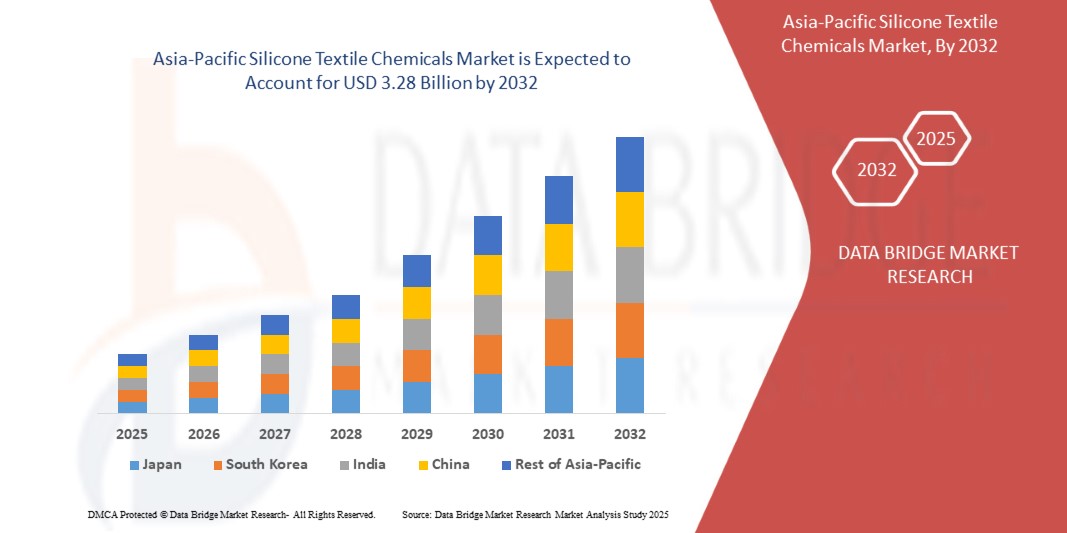
- The Asia-Pacific Silicone Textile Chemicals Market was valued at USD 1.98 billion in 2024 and is projected to reach USD 3.28 billion by 2032, growing at a CAGR of 6.50% during the forecast period.
- This growth is driven by increasing demand for functional and high-performance textiles, expanding apparel and home furnishing sectors, and rising adoption of eco-friendly and sustainable chemical solutions.
Silicone Textile Chemicals Market Analysis
- Silicone textile chemicals are specialty compounds used to impart enhanced softness, elasticity, water repellency, and durability to textiles. These chemicals play a vital role in elevating fabric performance and aesthetics in a wide range of textile applications.
- The market is witnessing robust growth due to rising demand for value-added textiles in apparel, technical textiles, and home furnishings, along with ongoing innovations in textile processing technologies.
- China is expected to dominate the Asia-Pacific silicone textile chemicals market, accounting for over 38.75% of the market share, owing to its vast textile manufacturing base, strong export capacity, and growing domestic consumption.
- India is projected to be the fastest-growing country during the forecast period, fueled by the expanding organized retail sector, increasing disposable income, and government support for textile manufacturing under schemes like PLI (Production-Linked Incentive).
- The Softening Agents segment is expected to hold the largest market share of 41.12%, driven by its extensive usage in enhancing fabric softness, elasticity, and drapability across various textile categories, particularly in fashion and home décor applications.
Report Scope and Silicone Textile Chemicals Market Segmentation
|
Attributes |
Silicone Textile Chemicals Market Insights |
|
Segments Covered |
|
|
Countries Covered |
Asia-Pacific
|
|
Key Market Players |
|
|
Market Opportunities |
|
|
Value Added Data Infosets |
In addition to the insights on market scenarios such as market value, growth rate, segmentation, geographical coverage, and major players, the market reports curated by the Data Bridge Market Research also include in-depth expert analysis, pricing analysis, brand share analysis, consumer survey, demography analysis, supply chain analysis, value chain analysis, raw material/consumables overview, vendor selection criteria, PESTLE Analysis, Porter Analysis, and regulatory framework. |
Silicone Textile Chemicals Market Trends
“Shift Toward Sustainable and Non-Toxic Silicone-Based Textile Finishes”
- One prominent trend in the Asia-Pacific Silicone Textile Chemicals Market is the increasing adoption of sustainable, non-toxic silicone-based textile chemicals.
- This trend is fueled by stricter environmental regulations, rising consumer awareness regarding eco-friendly textiles, and demand for safer alternatives to conventional textile finishes.
For instance, companies like Wacker Chemie AG and Shin-Etsu Chemical Co., Ltd. are developing low-VOC and solvent-free silicone softeners and emulsions that meet global eco-labeling standards such as OEKO-TEX® and ZDHC.
- The emphasis on reducing hazardous substances in the textile value chain is prompting textile manufacturers to switch to silicone-based formulations that offer durability, softness, water repellency, and breathability without compromising environmental safety.
- As sustainable production becomes a top priority across the textile industry, silicone textile chemicals are positioned to see accelerated growth due to their ability to meet both performance and ecological requirements.
Silicone Textile Chemicals Market Dynamics
Driver
“Growing Demand for High-Performance and Functional Textiles”
- The growing demand for high-performance textiles in sectors such as sportswear, medical textiles, and automotive interiors is a major driver for the silicone textile chemicals market.
- Silicone-based formulations offer excellent thermal stability, softness, hydrophobicity, and resistance to washing, making them ideal for enhancing fabric performance.
- This demand is supported by the increasing preference for multifunctional clothing that offers comfort, protection, and aesthetics, particularly in emerging economies with a rising middle class.
For instance, Momentive Performance Materials and Bluestar Silicones have introduced advanced silicone emulsions and softeners that enhance textile resilience, flexibility, and touch while ensuring low yellowing and non-toxicity.
- The shift toward smart textiles and wearable technologies further reinforces the need for silicone chemicals, which can maintain fabric properties under electronic integration or rigorous usage conditions.
- As consumers and manufacturers alike seek value-added textile products, silicone textile chemicals will remain a preferred solution due to their versatility and performance.
Restraint/Challenge
“Price Sensitivity in Developing Economies”
- Price sensitivity in developing economies poses a significant challenge to the widespread adoption of silicone textile chemicals, especially among small and medium-sized textile manufacturers.
- Silicone-based products are often costlier than traditional textile finishing agents, owing to higher raw material costs and complex formulations.
For instance, manufacturers in cost-sensitive markets such as India and Southeast Asia often face budget constraints that deter them from investing in premium silicone solutions despite their performance benefits.
- Furthermore, limited awareness about the long-term cost efficiency and ecological benefits of silicone finishes leads many textile processors to continue using cheaper, less sustainable alternatives.
- The higher upfront cost of silicone textile chemicals, unless offset by regulatory incentives or end-customer demand, may limit market penetration in price-conscious regions and restrict overall market expansion.
Silicone Textile Chemicals Market Scope
The market is segmented on the basis of type, form, silicone technology, silicone modifications, textile type, and application.
- By Type
On the basis of type, the Asia-Pacific Silicone Textile Chemicals Market is segmented into Silicon Softeners, Micro Emulsion Silicon, and Others. The Silicon Softeners segment is projected to dominate the market with the largest revenue share of 38.7% in 2025, owing to its widespread application in textile finishing for improving softness, smoothness, and drape of fabrics, especially in apparel and home furnishing textiles.
However, the Micro Emulsion Silicon segment is anticipated to grow at the highest CAGR of 7.64% during the forecast period (2025–2032). This growth is primarily driven by the rising demand for ultra-fine particle emulsions that offer enhanced fabric penetration, durable softness, and minimal yellowing, making them highly suitable for high-end fashion and technical textiles.
- By Form
On the basis of form, the market is segmented into Fluids, Emulsions, and Antifoams. The Emulsions segment accounted for the largest share of 40.1% in 2025, driven by their compatibility with a wide range of fabric types and processing systems, as well as their role in enhancing tactile properties and color fastness.
Meanwhile, the Antifoams segment is expected to witness the fastest CAGR of 7.28% during the forecast period, supported by growing textile production in emerging economies and the need for effective foam control in high-speed dyeing and finishing operations to ensure processing efficiency.
- By Silicone Technology
Based on silicone technology, the market is categorized into Polydimethylsiloxanes and Special Silicone Fluids. The Polydimethylsiloxanes (PDMS) segment is set to lead with a market share of 54.3% in 2025, due to its cost-effectiveness, superior hydrophobicity, and compatibility with a wide variety of textile substrates.
However, the Special Silicone Fluids segment is expected to register the highest CAGR of 7.45% over the forecast period, driven by increasing demand for high-performance, multifunctional finishes in technical and smart textiles applications.
By Silicone Modifications
On the basis of silicone modifications, the market is segmented into Methyl Group, Amino Group, Hydrophilic Group, Hydrogen Group, and Other Organo Modifications. The Amino Group segment is forecasted to hold the largest market share of 36.5% in 2025, primarily due to its widespread use in fabric softeners that provide long-lasting softness and elasticity in various garment applications.
Conversely, the Hydrophilic Group segment is projected to witness the highest CAGR of 7.39%, driven by rising demand for moisture management and quick-dry properties in performance and sportswear textiles.
- By Textile Type
Based on textile type, the market is segmented into Component Fibers, Synthetic Fibers, and Inorganic Fibers. The Synthetic Fibers segment is estimated to dominate with a market share of 49.6% in 2025, supported by the growing production and usage of polyester and nylon in mainstream textile manufacturing.
Meanwhile, the Inorganic Fibers segment is anticipated to grow at a CAGR of 7.20%, attributed to increasing utilization of silicone chemicals in specialized technical textiles such as glass fiber and ceramic-based fabrics used in high-temperature or fire-resistant applications.
- By Application
By application, the market is segmented into Apparel, Home and Office Furnishing, Technical Textiles, and Others. The Apparel segment leads the market with a share of 43.8% in 2025, driven by consumer preference for premium-feel garments, rising fashion consciousness, and the adoption of silicone finishes for softness, wrinkle resistance, and breathability.
However, Technical Textiles are expected to exhibit the highest CAGR of 7.82% during 2025–2032, owing to rapid industrialization, growth in automotive, healthcare, and defense sectors, and increasing demand for multifunctional and durable textiles where silicone chemicals play a vital role in enhancing fabric properties.
Asia-Pacific Silicone Textile Chemicals Market Regional Analysis
The Asia-Pacific Silicone Textile Chemicals Market is projected to grow at a CAGR of 8.67% in 2025, making it the fastest-growing region globally for silicone-based textile finishing solutions. This growth is driven by the expansion of textile manufacturing hubs, rising consumer demand for high-quality apparel, and the shift toward performance and functional textiles. Increasing investment in smart textiles, along with favorable trade agreements and government-backed textile innovation programs across countries like China, India, and Bangladesh, are fueling widespread adoption of advanced silicone-based chemistries for softness, durability, and water repellency.
- China Silicone Textile Chemicals Market Insight
China dominates the Asia-Pacific Silicone Textile Chemicals Market, holding the largest market share of 41.2% in 2025. This leadership is attributed to its massive textile production base, robust export capabilities, and integration of advanced textile finishing technologies. The widespread use of silicone softeners and hydrophilic emulsions in both apparel and technical textiles is driven by consumer demand for comfort, wrinkle resistance, and moisture control. Furthermore, initiatives under the "Made in China 2025" plan to upgrade textile production standards are pushing manufacturers to adopt high-performance silicone chemistries aligned with sustainability and energy-efficiency goals.
- India Silicone Textile Chemicals Market Insight
The India Silicone Textile Chemicals Market is expected to register the highest CAGR of 9.23% during the forecast period (2025–2032). This strong growth is supported by increasing investments in textile parks, growing domestic consumption of fashion and home furnishing products, and a shift toward sustainable textile processing. Rising exports of garments and technical textiles, coupled with government schemes such as the PLI (Production-Linked Incentive) for the textile sector, are encouraging the adoption of silicone-based finishing agents to enhance product appeal and functionality. Additionally, the rise of athleisure and performance wear is accelerating the use of modified silicone technologies for stretchability, water repellency, and skin comfort.
Silicone Textile Chemicals Market Players
The Silicone Textile Chemicals industry is primarily led by well-established companies, including:
- Wacker Chemie AG (Germany)
- Momentive Performance Materials Inc. (U.S.)
- Shin-Etsu Chemical Co., Ltd. (Japan)
- Elkem ASA (Norway)
- Dow Inc. (U.S.)
- KCC Corporation (South Korea)
- CHT Group (Germany)
- Nicca Chemical Co., Ltd. (Japan)
- Evonik Industries AG (Germany)
- Fineotex Chemical Limited (India)
- Zschimmer & Schwarz GmbH & Co KG (Germany)
- Silibase Silicone (China)
- Dynasol Elastomers (Spain)
Latest Developments in Asia-Pacific Silicone Textile Chemicals Market
- In April 2025, Wacker Chemie AG introduced a new generation of hydrophilic silicone softeners under its FINISH CT series in China. These softeners are designed to improve moisture management and fabric comfort, particularly for performance wear and activewear. The development addresses rising consumer demand for breathable and skin-friendly textiles in the Asia-Pacific region.
- In January 2025, Shin-Etsu Chemical Co., Ltd. announced the expansion of its silicone emulsion production line at its Vietnam facility. This move aims to meet the growing demand from textile exporters in Southeast Asia, especially for high-performance finishing agents that enhance softness and elasticity in synthetic and blended fabrics.
- In October 2024, Momentive Performance Materials launched a new silicone antifoam agent tailored for textile dyeing and finishing operations in India. The product offers high temperature and chemical resistance, reducing foam-related issues and improving operational efficiency in continuous textile processing lines.
- In August 2024, Dow introduced a specialized amino-modified silicone fluid under its DOWSIL™ textile enhancer range in Indonesia. This new product delivers a silky touch and durable softness while being compatible with various fiber types. The development supports Dow’s strategy to provide multi-functional and sustainable finishing chemistries to textile processors in ASEAN countries.
- In May 2024, Bluestar Silicones (Elkem) expanded its textile chemical product portfolio in Asia by launching a new series of environmentally compliant silicone microemulsions in India and Bangladesh. These products cater to the growing market for eco-friendly finishes in home furnishing and technical textile applications, aligning with global brands' sustainability sourcing goals.

- Interactive Data Analysis Dashboard
- Company Analysis Dashboard for high growth potential opportunities
- Research Analyst Access for customization & queries
- Competitor Analysis with Interactive dashboard
- Latest News, Updates & Trend analysis
- Harness the Power of Benchmark Analysis for Comprehensive Competitor Tracking
Apac Silicone Textile Chemicals Market, Supply Chain Analysis and Ecosystem Framework
To support market growth and help clients navigate the impact of geopolitical shifts, DBMR has integrated in-depth supply chain analysis into its Apac Silicone Textile Chemicals Market research reports. This addition empowers clients to respond effectively to global changes affecting their industries. The supply chain analysis section includes detailed insights such as Apac Silicone Textile Chemicals Market consumption and production by country, price trend analysis, the impact of tariffs and geopolitical developments, and import and export trends by country and HSN code. It also highlights major suppliers with data on production capacity and company profiles, as well as key importers and exporters. In addition to research, DBMR offers specialized supply chain consulting services backed by over a decade of experience, providing solutions like supplier discovery, supplier risk assessment, price trend analysis, impact evaluation of inflation and trade route changes, and comprehensive market trend analysis.
Data collection and base year analysis are done using data collection modules with large sample sizes. The stage includes obtaining market information or related data through various sources and strategies. It includes examining and planning all the data acquired from the past in advance. It likewise envelops the examination of information inconsistencies seen across different information sources. The market data is analysed and estimated using market statistical and coherent models. Also, market share analysis and key trend analysis are the major success factors in the market report. To know more, please request an analyst call or drop down your inquiry.
The key research methodology used by DBMR research team is data triangulation which involves data mining, analysis of the impact of data variables on the market and primary (industry expert) validation. Data models include Vendor Positioning Grid, Market Time Line Analysis, Market Overview and Guide, Company Positioning Grid, Patent Analysis, Pricing Analysis, Company Market Share Analysis, Standards of Measurement, Global versus Regional and Vendor Share Analysis. To know more about the research methodology, drop in an inquiry to speak to our industry experts.
Data Bridge Market Research is a leader in advanced formative research. We take pride in servicing our existing and new customers with data and analysis that match and suits their goal. The report can be customized to include price trend analysis of target brands understanding the market for additional countries (ask for the list of countries), clinical trial results data, literature review, refurbished market and product base analysis. Market analysis of target competitors can be analyzed from technology-based analysis to market portfolio strategies. We can add as many competitors that you require data about in the format and data style you are looking for. Our team of analysts can also provide you data in crude raw excel files pivot tables (Fact book) or can assist you in creating presentations from the data sets available in the report.













