The Asia-Pacific Electronic Medical Records (EMR) market refers to digital healthcare information systems designed to capture, store, manage, and retrieve patient clinical data in electronic format across healthcare settings. EMR solutions enable the systematic documentation of patient demographics, medical histories, diagnoses, laboratory results, imaging data, prescriptions, and treatment plans, supporting accurate and efficient clinical decision-making. These systems are developed using advanced health IT technologies such as cloud computing, interoperability standards, data analytics, and increasingly artificial intelligence to ensure secure data handling, real-time access, and continuity of care. EMR implementation typically involves software deployment, system integration, data migration, user training, ongoing technical support, and regulatory compliance management, delivered through hospitals, specialty clinics, ambulatory care centers, and primary healthcare facilities.
The APAC EMR market encompasses both software platforms and associated services, including implementation, customization, maintenance, and cloud-based subscription models, aimed at improving healthcare delivery efficiency and patient outcomes. Market growth is driven by government-led digital health initiatives, rising healthcare expenditure, expanding hospital infrastructure, and increasing demand for data-driven healthcare management across the region. Additional growth drivers include the rapid adoption of cloud-based solutions in cost-sensitive markets, increasing patient volumes due to aging populations, and the integration of EMRs with telehealth, e-prescribing, and hospital information systems. Key participants include global health IT vendors, regional EMR providers, and local technology firms serving public and private healthcare providers across developed and emerging APAC economies.
Access Full Report @ https://www.databridgemarketresearch.com/reports/asia-pacific-electronic-medical-records-emr-market
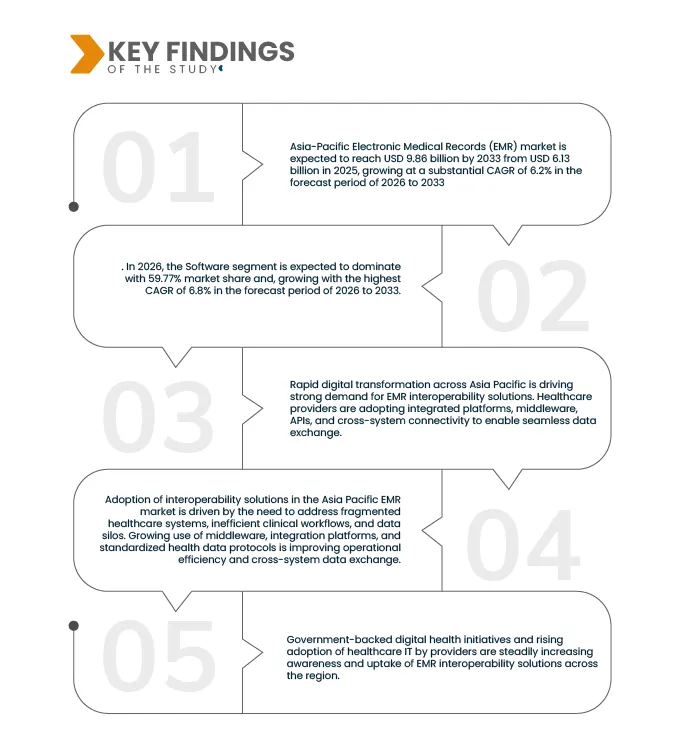
Data Bridge Market Research analyzes that the Asia-Pacific Electronic Medical Records (EMR) Market is expected to reach USD 9.86 billion by 2033 from USD 6.13 billion in 2025, growing at a substantial CAGR of 6.2% in the forecast period of 2026 to 2033.
Key Findings of the Study
Rapid Adoption of Robotic-Assisted Surgeries and Automation in Healthcare
The Asia-Pacific (APAC) region is experiencing a significant transformation in healthcare delivery through the rapid adoption of robotic-assisted surgeries and automation technologies. Factors such as rising healthcare expenditures, increasing demand for minimally invasive procedures, and the need to improve surgical precision and patient outcomes are driving this trend. Countries including Japan, China, South Korea, and India are actively integrating advanced Electro-Medical Robotics (EMR) systems across hospitals and specialized medical centers, enabling surgeons to perform complex procedures with higher accuracy, reduced recovery times, and fewer complications.
Hospitals and healthcare providers in APAC are investing heavily in robotic surgical platforms to enhance efficiency, reduce human error, and optimize resource utilization. Robotic systems are being deployed not only for general surgery but also for specialties like orthopedics, cardiology, urology, and neurosurgery. Furthermore, automation technologies such as AI-assisted diagnostics, robotic drug delivery, and teleoperated surgical devices are contributing to the digitalization and modernization of healthcare infrastructure in the region.
Report Scope and Market Segmentation
|
Report Metric
|
Details
|
|
Forecast Period
|
2026 to 2033
|
|
Base Year
|
2025
|
|
Historic Year
|
2024 (Customizable 2018-2024)
|
|
Quantitative Units
|
Revenue in USD Billion
|
|
Segments Covered
|
By Component (Software, Services), By Type (Interoperable EMR, Traditional EMR, Speech Enabled EMR, AI/NLP Enabled EMR, Others), By Deployment model (Cloud Based Setups, On premise EMR, Hybrid Setups), By Application (Specialty Application, General Application, Population health /Analytics, Telemedicine / patient engagement modules, others), By Purchase mode (GPOS, Individual), By Operating system (Windows, Android, Linux, IOS, Others), By Enterprise (Large Enterprise, Mid-sized Enterprise, Small Enterprise, Solo Enterprise), By End User (Hospitals, Ambulatory Surgical Centers, Clinics, Specialized Clinics, Diagnostic and imaging centers, Government and public health agencies, Long term care & rehabilitation centers, Others)
|
|
Region Covered
|
Asia-Pacific
|
|
Market Players Covered
|
Epic Systems, Oracle, Medical Information Technology, Inc., GE HealthCare, athenahealth, McKesson, eClinicalWorks, Napier Healthcare Solutions, HealthPlix, CureMD, Veradigm, Practo, Greenway Health, WebPT, DocEngage AgileEMR, OSP, INFOR HEALTHCARE, Tebra, DOCPULSE, HALEMIND INC., JVS GROUP, AWS (Docon Technologies), SUVARNA TECHNOSOFT PVT. LTD., SYNODUS, Nano Medic Care Sdn. Bhd., AOIKUMO, Pt Medika integrasi teknologi, AGFA HEALTHCARE and, among others
|
|
Data Points Covered in the Report
|
In addition to the insights on market scenarios such as market value, growth rate, segmentation, geographical coverage, and major players, the market reports curated by the Data Bridge Market Research also include depth expert analysis, patient epidemiology, pipeline analysis, pricing analysis, and regulatory framework.
|
Segment Analysis
Asia-Pacific Electronic Medical Records (EMR) market is categorized into eight notable segments which are based on Component, Type, Deployment model, Application, Purchase mode, Operating System, Enterprise, End User.
- On the basis of Component, Asia-Pacific Electronic Medical Records (EMR) market is segmented into Software, Services, the Software segment is further sub segmented into Core EMR platform.
In 2026, the Software segment is expected to dominate the market
In 2026, the Software segment is expected to dominate with 59.77% due to the increasing preference of healthcare providers for integrated, scalable, and user-friendly digital record systems over paper-based or fragmented clinical documentation. EMR software solutions enable efficient management of patient data, clinical workflows, and administrative processes, making them a critical component of hospital and clinic digitalization initiatives across the region.
- On the basis of Type, the Asia-Pacific Electronic Medical Records (EMR) market is segmented into Interoperable EMR, Traditional EMR, Speech Enabled EMR, AI/NLP Enabled EMR, Others.
In 2026, the Interoperable EMR segment is expected to dominate the market
In 2026, the Interoperable EMR segment is expected to dominate with 47.83% market share due to its critical role in enabling seamless, accurate, and secure exchange of patient health information across multiple healthcare systems and providers. Interoperable EMR platforms allow hospitals, clinics, laboratories, pharmacies, and diagnostic centers to access and share real-time patient data, supporting coordinated care, continuity of treatment, and informed clinical decision-making across diverse care settings.
- On the basis of Deployment model, the Asia-Pacific Electronic Medical Records (EMR) market is segmented into Cloud Based Setups, On premise EMR, Hybrid Setups. In 2026, the Cloud Based Setups segment is expected to dominate with 63.83% market share
- On the basis of Application, Asia-Pacific Electronic Medical Records (EMR) market is segmented into Specialty Application, General Application, Population health /Analytics, Telemedicine / patient engagement modules, others. In 2026, Specialty Application segment is expected to dominate with 51.75% market share.
- On the basis of Purchase mode, the Asia-Pacific Electronic Medical Records (EMR) market is segmented into GPOS, Individual. In 2026, GPOS segment is expected to dominate with 82.20% market share
- On the basis of Operating system, the Asia-Pacific Electronic Medical Records (EMR) market is segmented into Windows, android, Linux, IOS, Others. In 2026, the Windows segment is expected to dominate the with 52.88% market share
- On the basis of Enterprise, the Asia-Pacific Electronic Medical Records (EMR) market is segmented into Large Enterprise, Mid-sized Enterprise, Small Enterprise, Solo Enterprise. In 2026, the Large Enterprise segment is expected to dominate the with 62.39% market share
- On the basis of End User, the Asia-Pacific Electronic Medical Records (EMR) market is segmented into Hospitals, Ambulatory Surgical Centers, Clinics, Specialized Clinics, Diagnostic and imaging centers, Government and public health agencies, Long term care & rehabilitation centers, Others, In 2026, the Hospitals segment is expected to dominate the with 37.79% market share
Major Players
Data Bridge Market Research analyzes Epic Systems, Oracle, Medical Information Technology, Inc., GE HealthCare, athenahealth as the major market players of the market.
Market Development
- In September 2025, MEDITECH announced new artificial intelligence initiatives for its Expanse EHR at MEDITECH LIVE 2025, introducing AI tools that assist clinicians, patients, and administrators within their native workflows. Features include the MyHealth patient portal assistant, clinician chatbots, voice-enabled mobile apps, and AI-powered operational tools like automated discharge summaries and claim support. These innovations aim to enhance care delivery, improve efficiency, reduce clinician workload, and support personalized, data-driven healthcare.
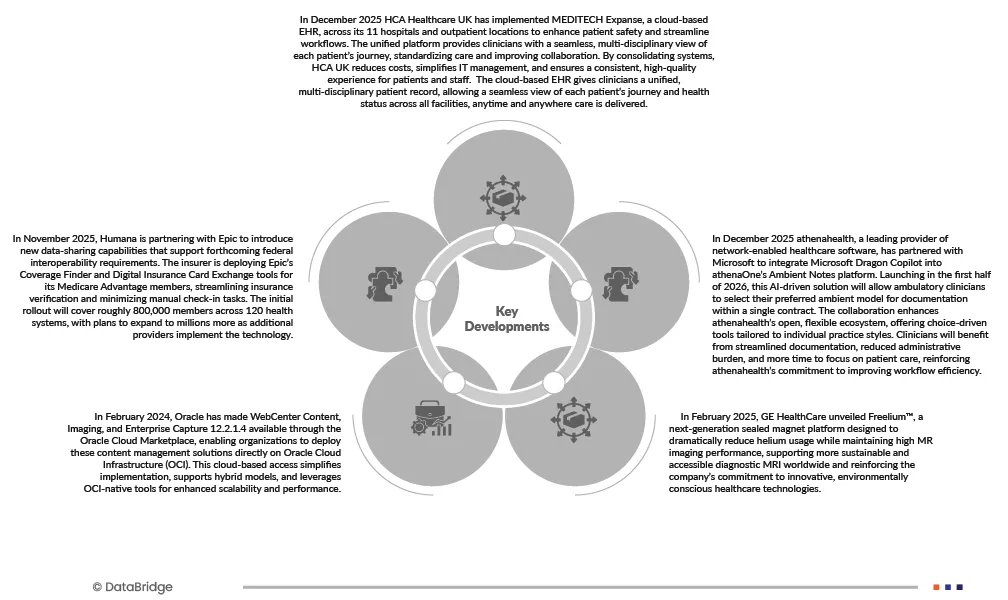
- In November 2026, Humana is partnering with Epic to introduce new data-sharing capabilities that support forthcoming federal interoperability requirements. The insurer is deploying Epic’s Coverage Finder and Digital Insurance Card Exchange tools for its Medicare Advantage members, streamlining insurance verification and minimizing manual check-in tasks. The initial rollout will cover roughly 800,000 members across 120 health systems, with plans to expand to millions more as additional providers implement the technology.
- In February 2024, Oracle has made WebCenter Content, Imaging, and Enterprise Capture 12.2.1.4 available through the Oracle Cloud Marketplace, enabling organizations to deploy these content management solutions directly on Oracle Cloud Infrastructure (OCI). This cloud-based access simplifies implementation, supports hybrid models, and leverages OCI-native tools for enhanced scalability and performance.
- In January 2025, GE HealthCare announced a US $138 million investment to expand its contrast media manufacturing facility in Cork, Ireland, which will increase annual production capacity by an additional 25 million patient doses by the end of 2027 to meet growing global demand for imaging agents.
- In December 2025, athenahealth, a leading provider of network-enabled healthcare software, has partnered with Microsoft to integrate Microsoft Dragon Copilot into athenaOne’s Ambient Notes platform. Launching in the first half of 2026, this AI-driven solution will allow ambulatory clinicians to select their preferred ambient model for documentation within a single contract. The collaboration enhances athenahealth’s open, flexible ecosystem, offering choice-driven tools tailored to individual practice styles. Clinicians will benefit from streamlined documentation, reduced administrative burden, and more time to focus on patient care, reinforcing athenahealth’s commitment to improving workflow efficiency.
For more detailed information about the Asia-Pacific Electronic Medical Records (EMR) Market report, click here – https://www.databridgemarketresearch.com/reports/asia-pacific-electronic-medical-records-emr-market