


What is the North America Bioinformatics Market Size and Growth Rate?
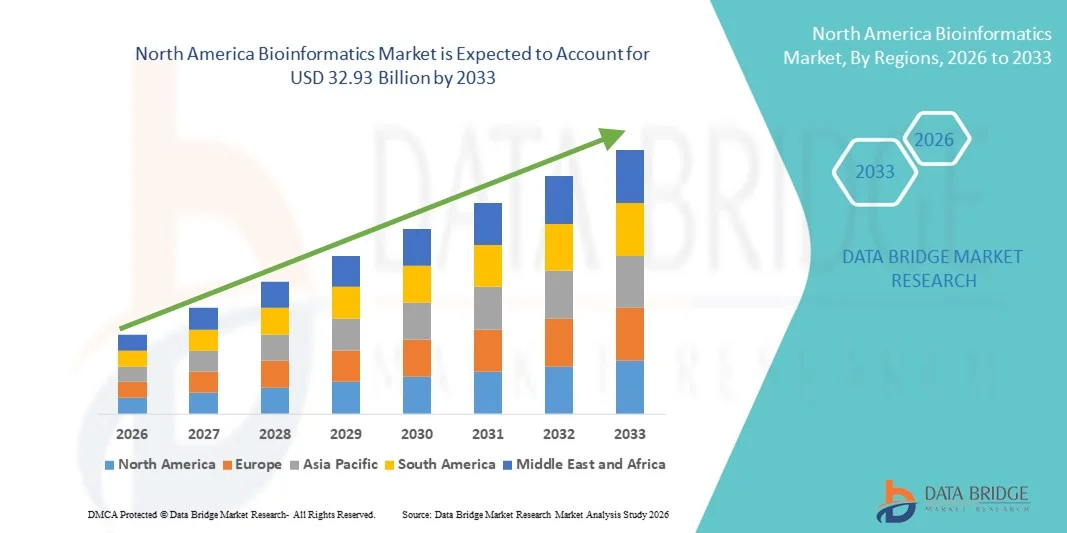
- As per Data Bridge Market Research analysis, the North America bioinformatics market size was valued at USD 6.80 billion in 2025 and is expected to reach USD 32.93 billion by 2033, at a CAGR of 21.8% during the forecast period
- The market growth is largely driven by increasing investments in genomics research, rising adoption of high-throughput sequencing technologies, and the integration of AI and machine learning in biological data analysis, leading to advanced insights in healthcare and drug discovery
- Furthermore, growing demand for personalized medicine, precision healthcare solutions, and efficient management of large-scale biological datasets is positioning bioinformatics as a critical component of modern life sciences research. These converging factors are accelerating the adoption of bioinformatics platforms, thereby significantly boosting the industry's growth
Market Size & Forecast
- Global Market Value (2025): USD 6.80 billion
- Expected Market Value (2033): USD 32.93 billion
- Forecast CAGR (2026-2033): 21.8%
What are the Major Takeaways of North America Bioinformatics Market?
- Bioinformatics, providing computational tools and software for the analysis and interpretation of biological data, is increasingly vital in modern life sciences, healthcare, and pharmaceutical research due to its ability to handle large-scale genomic, proteomic, and clinical datasets efficiently
- The escalating demand for bioinformatics solutions is primarily fueled by the growing adoption of next-generation sequencing (NGS) technologies, rising investments in personalized medicine, and increasing integration of AI and machine learning for predictive analytics in drug discovery and disease research
- The United States dominated the North America bioinformatics market with the largest revenue share of 72.5% in 2025, characterized by advanced research infrastructure, high healthcare R&D expenditure, and a strong presence of key industry players, with substantial growth in bioinformatics platform adoption, particularly in genomics and clinical data analysis, driven by innovations from both established biotech companies and startups focusing on AI-driven analytics and cloud-based solutions
- Canada is expected to be the fastest-growing country in the North America bioinformatics market during the forecast period due to increasing government funding for genomic research, rising collaborations between academic institutions and industry, and growing adoption of precision medicine initiatives
- Genomics & Drug Development segment dominated the bioinformatics market with a market share of 46.3% in 2025, driven by its critical role in precision medicine, disease biomarker discovery, and large-scale sequencing projects
Report Scope and North America Bioinformatics Market Segmentation
|
Attributes |
North America Bioinformatics Key Market Insights |
|
Segments Covered |
|
|
Countries Covered |
North America
|
|
Key Market Players |
|
|
Market Opportunities |
|
|
Value Added Data Infosets |
In addition to the insights on market scenarios such as market value, growth rate, segmentation, geographical coverage, and major players, the market reports curated by the Data Bridge Market Research also include in-depth expert analysis, patient epidemiology, pipeline analysis, pricing analysis, and regulatory framework |
What is the Key Trend in the North America Bioinformatics Market?
AI-Driven Predictive Analytics and Cloud Integration
- A significant and accelerating trend in the North America bioinformatics market is the integration of artificial intelligence (AI) and cloud computing platforms, enabling advanced predictive analytics and real-time collaboration for large-scale biological data analysis
- For instance, Illumina’s DRAGEN Bio-IT Platform leverages AI for ultra-fast genomic data processing and can be accessed via cloud infrastructure, allowing researchers to perform complex analyses remotely and collaboratively
- AI integration in bioinformatics enables features such as predictive modeling for disease outcomes, identification of novel drug targets, and automated pattern recognition in multi-omics datasets. For instance, companies such as Genestack utilize AI to optimize multi-omics data interpretation and provide actionable insights for precision medicine
- Cloud-based bioinformatics platforms facilitate centralized management of genomic, proteomic, and clinical datasets, allowing multiple research teams to access and analyze data seamlessly from different locations. This centralized approach accelerates data-driven discoveries and enhances research efficiency
- This trend towards AI-enhanced and cloud-integrated bioinformatics solutions is reshaping expectations in life sciences research. Consequently, companies such as Seven Bridges are developing AI-enabled bioinformatics pipelines with scalable cloud access, predictive analytics, and real-time data visualization
- The demand for bioinformatics platforms combining AI and cloud capabilities is growing rapidly across both academic and commercial research sectors, as institutions increasingly prioritize efficiency, collaboration, and actionable insights from large-scale biological data
- The rise of real-time bioinformatics dashboards and visualization tools is allowing decision-makers to interpret complex datasets more intuitively. For instance, platforms such as Benchling offer interactive dashboards for project tracking and data visualization, enhancing research planning and operational efficiency
North America Bioinformatics Market Dynamics
Driver
Increasing Adoption Due to Rising Genomics Research and Precision Medicine
- The increasing focus on genomics research, coupled with rising demand for personalized and precision medicine, is a significant driver for the heightened adoption of bioinformatics solutions
- For instance, in March 2025, Thermo Fisher Scientific launched a cloud-enabled bioinformatics platform designed to accelerate genomic research and integrate AI-driven analytics into clinical workflows. Such initiatives by key players are expected to propel the bioinformatics market growth during the forecast period
- As healthcare and pharmaceutical companies pursue targeted therapies and biomarker-driven drug discovery, bioinformatics platforms provide crucial support through data analysis, predictive modeling, and visualization tools
- Furthermore, the growing investment in high-throughput sequencing and multi-omics studies is creating a demand for sophisticated bioinformatics solutions capable of managing, integrating, and interpreting vast datasets
- The increasing collaboration between academic institutions, hospitals, and biotech companies to advance personalized medicine further propels the adoption of bioinformatics platforms across North America
- Expanding use of AI and machine learning algorithms for disease modeling, clinical trial optimization, and drug repurposing is driving bioinformatics demand. For instance, companies such as Recursion Pharmaceuticals leverage AI-enabled bioinformatics to accelerate therapeutic discovery
- Government and private funding for genomics and healthcare R&D in the U.S. and Canada is increasing adoption of advanced bioinformatics platforms. For instance, NIH grants supporting large-scale genomic projects are fueling investment in data analysis infrastructure
Restraint/Challenge
Data Security Concerns and High Implementation Costs
- Concerns surrounding the cybersecurity and privacy of sensitive genomic and clinical data pose a significant challenge to broader adoption of bioinformatics platforms. As these platforms rely on cloud connectivity and digital storage, they are susceptible to data breaches and unauthorized access, raising anxieties among research institutions and healthcare providers
- For instance, reports of vulnerabilities in genomic data storage systems have made some organizations hesitant to fully transition to cloud-based bioinformatics solutions
- Addressing these security concerns through encryption, secure authentication, and compliance with regulatory frameworks such as HIPAA is crucial for building trust. Companies such as QIAGEN emphasize their robust data security protocols and secure cloud infrastructure in their offerings
- In addition, the high cost of implementing advanced bioinformatics platforms, including software licenses, cloud infrastructure, and computational resources, can be a barrier for smaller research labs or budget-constrained institutions. While some open-source tools exist, comprehensive AI-driven and cloud-integrated solutions often come with a premium price
- Overcoming these challenges through improved data security measures, cost-effective deployment models, and institutional training programs will be vital for sustained growth in the North America bioinformatics market
- Lack of standardized data formats and interoperability between different bioinformatics platforms can slow adoption, requiring additional resources for data integration. For instance, some research labs face challenges combining legacy datasets with modern AI-enabled platforms
- Limited availability of skilled bioinformaticians and data scientists is constraining market growth, as institutions require trained personnel to fully leverage complex bioinformatics solutions. For instance, universities and companies are increasingly launching specialized training programs to address this skills gap
How is the North America Bioinformatics Market Segmented?
The market is segmented on the basis of type, sector, application, purchase mode, method, and end-user.
- By Type
On the basis of type, the North America bioinformatics market is segmented into knowledge management tools, bioinformatics software, and bioinformatics services. The bioinformatics software segment dominated the market with the largest revenue share in 2025, driven by the increasing adoption of advanced sequencing technologies and multi-omics research. Software solutions provide essential tools for data storage, analysis, visualization, and interpretation of complex biological datasets. Researchers in genomics, proteomics, and metabolomics rely heavily on software platforms for predictive modeling and biomarker discovery. The segment also benefits from integration with AI and cloud computing, allowing high-throughput analysis and remote collaboration. Established software providers such as Illumina, Thermo Fisher, and QIAGEN offer comprehensive platforms that are widely adopted across academic, clinical, and biotech sectors. Demand for bioinformatics software continues to grow as institutions aim to improve research efficiency, reduce turnaround times, and accelerate drug discovery pipelines.
The bioinformatics services segment is anticipated to witness the fastest growth rate during 2026–2033, fueled by outsourcing trends in research and clinical studies. Services include data analysis, consulting, custom pipeline development, and managed bioinformatics solutions, enabling smaller labs and biotech startups to access high-end analytics without investing heavily in infrastructure. Contract research organizations increasingly leverage these services for genomics, proteomics, and AI-driven predictive analyses. Growth is further supported by rising collaborations between pharmaceutical companies and service providers for drug discovery and clinical trial optimization. The convenience of subscription-based services and pay-per-use models makes them accessible to academic institutes and biotech firms, contributing to rapid adoption.
- By Sector
On the basis of sector, the market is segmented into medical biotechnology, academics, animal biotechnology, agricultural biotechnology, environmental biotechnology, forensic biotechnology, and others. The medical biotechnology segment dominated the North America bioinformatics market in 2025, driven by increasing demand for precision medicine, disease biomarker discovery, and genomics-based diagnostics. Hospitals, research institutes, and pharmaceutical companies utilize bioinformatics platforms to analyze patient genomics and identify therapeutic targets. Advanced software and AI-enabled analytics facilitate personalized treatment strategies, accelerating clinical decision-making. The dominance is also supported by substantial R&D investment in oncology, immunology, and rare disease research.
The academics segment is expected to be the fastest-growing sector during 2026–2033, fueled by expanding adoption of bioinformatics in universities and research institutions. Academic research focuses on multi-omics studies, evolutionary biology, and functional genomics, generating increasing volumes of complex data. Government funding, grants, and collaborative programs promote the deployment of AI-powered bioinformatics tools in classrooms and laboratories. Student training programs and open-access bioinformatics platforms further contribute to growth. In addition, integration with cloud-based platforms enables institutions to share datasets, perform joint analyses, and accelerate research outputs.
- By Application
On the basis of application, the market is segmented into genomics & drug development, proteomics, evolutionary studies, agricultural studies, veterinary science, metabolomics, transcriptomics, and others. The genomics & drug development segment dominated the North America bioinformatics market in 2025 with a market share of 46.3%, driven by large-scale sequencing projects, personalized medicine initiatives, and targeted drug discovery programs. Researchers rely on bioinformatics platforms to process high-throughput sequencing data, identify biomarkers, and simulate drug-target interactions. Pharmaceutical companies increasingly integrate genomics analytics into clinical trial design, accelerating therapeutic development. Platforms with AI and cloud integration further enhance predictive modeling, making genomics a central application for bioinformatics adoption.
The proteomics segment is expected to witness the fastest growth during 2026–2033, fueled by increasing demand for protein structure-function analysis, biomarker discovery, and proteome-wide studies in disease research. Proteomics applications are expanding in precision medicine, oncology, and vaccine development. Integration of mass spectrometry data with AI-powered bioinformatics platforms enables rapid analysis and visualization, supporting high-throughput proteome profiling. Academic, clinical, and biotech research increasingly leverage these platforms to uncover disease mechanisms and therapeutic targets, contributing to accelerated market growth.
- By Purchase Mode
On the basis of purchase mode, the market is segmented into group purchase and individual purchase. The individual purchase segment dominated the market in 2025, driven by research institutions, hospitals, and biotech firms procuring tailored software licenses and services for internal projects. Individual purchases offer flexibility to scale platform usage according to research requirements. Researchers prefer dedicated licenses to ensure security, compliance, and uninterrupted access to advanced analytics tools.
The group purchase segment is expected to witness the fastest growth during 2026–2033, fueled by consortiums, academic networks, and corporate R&D teams procuring shared licenses. Group purchasing reduces costs, provides centralized access, and enables collaborative analyses across departments or institutions. Cloud-based subscriptions and managed services further enhance the adoption of group licensing models. Platforms such as Seven Bridges and Benchling facilitate multi-user access, accelerating adoption. The scalability and cost-efficiency of group purchase models make this segment the fastest-growing.
- By Method
On the basis of method, the market is segmented into genomics and proteomics. The genomics segment dominated the market in 2025, driven by the proliferation of next-generation sequencing (NGS), genome-wide association studies, and precision medicine initiatives. Genomic analysis platforms provide crucial insights for disease risk assessment, drug development, and population genomics research. Integration with AI and multi-omics tools further enhances the dominance of genomics in bioinformatics applications.
The proteomics segment is expected to be the fastest-growing method during 2026–2033, fueled by rising research in protein profiling, biomarker discovery, and functional proteomics studies. AI-assisted analysis of proteomic datasets enables rapid identification of therapeutic targets and disease pathways. Pharmaceutical and biotech companies are increasingly adopting proteomics methods for drug development, clinical studies, and vaccine research, contributing to rapid growth. Growth is further fueled by high-throughput capabilities, cloud accessibility, and predictive analytics features, making proteomics the fastest-growing method segment.
- By End-User
On the basis of end-user, the market is segmented into research and academic institutes, clinical research organizations (CROs), biotech and pharmaceutical companies, research laboratories, hospitals, and others. The biotech and pharmaceutical companies segment dominated the market in 2025, driven by the growing need for bioinformatics in drug discovery, clinical trial design, and personalized medicine. These companies leverage bioinformatics platforms to analyze multi-omics datasets, optimize therapeutic strategies, and accelerate R&D pipelines.
The research and academic institutes segment is expected to witness the fastest growth during 2026–2033, fueled by increasing adoption of bioinformatics in higher education and academic research programs. Expanding government funding for genomics, proteomics, and AI-driven studies, along with collaborative research initiatives, drives demand in this segment. Cloud-based platforms and subscription models enable institutions to scale analyses, train students, and support multi-institutional projects efficiently.
North America Bioinformatics Market Regional Analysis
- The United States dominated the North America bioinformatics market with the largest revenue share of 72.5% in 2025, characterized by advanced research infrastructure, high healthcare R&D expenditure, and a strong presence of key industry players, with substantial growth in bioinformatics platform adoption
- Institutions and companies in the region increasingly rely on bioinformatics platforms for genomics, proteomics, and multi-omics data analysis, enhancing drug discovery, precision medicine, and clinical research outcomes
- The widespread adoption is further supported by substantial government and private funding, a well-established network of research universities, and increasing collaborations between academic, clinical, and industrial organizations
The U.S. Bioinformatics Market Insight
The U.S. bioinformatics market captured the largest revenue share of 72.5% in 2025 within North America, fueled by the rapid adoption of advanced sequencing technologies and multi-omics research. Research institutions, hospitals, and pharmaceutical companies are increasingly leveraging bioinformatics platforms for genomics, proteomics, and drug discovery applications. The growing demand for precision medicine and personalized therapies is driving the uptake of AI-driven bioinformatics solutions. In addition, government and private funding initiatives supporting genomic and clinical research are accelerating platform deployment. Integration with cloud-based tools and predictive analytics enhances research efficiency, collaboration, and actionable insights. These factors collectively establish the U.S. as the dominant hub for bioinformatics in North America.
Canada Bioinformatics Market Insight
The Canada bioinformatics market is anticipated to grow at a noteworthy CAGR during the forecast period, driven by increasing government investment in genomics research and the expanding adoption of precision medicine initiatives. Academic institutions and research hospitals are key adopters, leveraging bioinformatics tools for multi-omics studies, clinical trials, and translational research. The presence of collaborative research programs and partnerships with biotech and pharmaceutical companies is fostering market expansion. In addition, cloud-based bioinformatics solutions are enabling small and medium-sized research labs to access advanced analytics without heavy infrastructure investment. The growing focus on AI integration for predictive modeling and biomarker discovery is further propelling growth. Canada’s emphasis on research innovation and healthcare technology adoption supports the sustained expansion of its bioinformatics market.
Mexico Bioinformatics Market Insight
The Mexico bioinformatics market is expected to grow at a noteworthy CAGR during the forecast period, driven by increasing investments in genomics research, biotechnology, and healthcare innovation. Academic institutions, research hospitals, and emerging biotech firms are increasingly adopting bioinformatics platforms for genomics, proteomics, and multi-omics data analysis. Government initiatives supporting precision medicine, disease research, and digital healthcare are accelerating market adoption. Cloud-based bioinformatics solutions and AI-powered analytics enable cost-effective access for smaller research labs and startups, enhancing scalability and collaboration. The growing pharmaceutical and clinical research sectors are leveraging bioinformatics for drug discovery, biomarker identification, and clinical trial optimization. These factors collectively position Mexico as an emerging hub for bioinformatics in North America.
Which are the Top Companies in North America Bioinformatics Market?
The North America Bioinformatics industry is primarily led by well-established companies, including:
- Illumina, Inc. (U.S.)
- DNAnexus Inc. (U.S.)
- Seven Bridges Genomics Inc. (U.S.)
- Thermo Fisher Scientific Inc. (U.S.)
- QIAGEN (Netherlands)
- Agilent Technologies Inc. (U.S.)
- Eurofins Scientific (Luxembourg)
- PerkinElmer Inc. (U.S.)
- Charles River Laboratories International Inc. (U.S.)
- Bio Rad Laboratories Inc. (U.S.)
- Twist Bioscience Corporation (U.S.)
- Strand Life Sciences (U.S.)
- Basepair, Inc. (U.S.)
- Antigen Discovery Inc. (U.S.)
- Strateos Inc. (U.S.)
- BioAge Labs, Inc. (U.S.)
- ArrayGen Technologies Inc. (U.S.)
- Antigen Discovery, Inc. (U.S.)
- BioMap Inc. (U.S.)
- Abiosciences Inc. (U.S.)
What are the Recent Developments in North America Bioinformatics Market?
- In July 2025, UGenome AI announced a strategic partnership with KonAnBio to expand its bioinformatics service offerings, combining strengths to enhance throughput, quality, and scalability of computational biology services across genomic and multi-omics research
- In April 2025, Signios Bio (formerly MedGenome US Research) launched an AI‑driven multiomics and bioinformatics platform designed to power precision medicine and drug discovery through integrated genomic, proteomic, and metabolomic analytics
- In March 2025, DNAnexus, Inc. announced a strategic collaboration with Alida Biosciences (AlidaBio) to enhance RNA modification and expression analysis by integrating AlidaBio’s EpiScout™ epitranscriptomics analysis software on the DNAnexus cloud platform, enabling advanced bioinformatics workflows for epitranscriptomics research and accelerating biomarker discovery and personalized medicine approaches
- In October 2024, SCIEX and Bioinformatics Solutions Inc. (BSI) expanded their collaboration with the co‑development of the advanced PEAKS 12.5 proteomics software, fully compatible with the ZenoTOF 7600+ system, improving sensitivity and scalability for proteomics analysis workflows
- In February 2023, BioSkryb launched new bioinformatics platforms at the Advances in Genome Biology and Technology (AGBT) conference, including the ResolveOME whole genome/transcriptome amplification system and BaseJumper bioinformatics visualization platform boosting multi‑omics data interpretation

- Interactive Data Analysis Dashboard
- Company Analysis Dashboard for high growth potential opportunities
- Research Analyst Access for customization & queries
- Competitor Analysis with Interactive dashboard
- Latest News, Updates & Trend analysis
- Harness the Power of Benchmark Analysis for Comprehensive Competitor Tracking
Data collection and base year analysis are done using data collection modules with large sample sizes. The stage includes obtaining market information or related data through various sources and strategies. It includes examining and planning all the data acquired from the past in advance. It likewise envelops the examination of information inconsistencies seen across different information sources. The market data is analysed and estimated using market statistical and coherent models. Also, market share analysis and key trend analysis are the major success factors in the market report. To know more, please request an analyst call or drop down your inquiry.
The key research methodology used by DBMR research team is data triangulation which involves data mining, analysis of the impact of data variables on the market and primary (industry expert) validation. Data models include Vendor Positioning Grid, Market Time Line Analysis, Market Overview and Guide, Company Positioning Grid, Patent Analysis, Pricing Analysis, Company Market Share Analysis, Standards of Measurement, Global versus Regional and Vendor Share Analysis. To know more about the research methodology, drop in an inquiry to speak to our industry experts.
Data Bridge Market Research is a leader in advanced formative research. We take pride in servicing our existing and new customers with data and analysis that match and suits their goal. The report can be customized to include price trend analysis of target brands understanding the market for additional countries (ask for the list of countries), clinical trial results data, literature review, refurbished market and product base analysis. Market analysis of target competitors can be analyzed from technology-based analysis to market portfolio strategies. We can add as many competitors that you require data about in the format and data style you are looking for. Our team of analysts can also provide you data in crude raw excel files pivot tables (Fact book) or can assist you in creating presentations from the data sets available in the report.













