Global Veterinary Chemistry Analyzer Market
Market Size in USD Billion
CAGR :
% 
 USD
2.99 Billion
USD
5.58 Billion
2025
2033
USD
2.99 Billion
USD
5.58 Billion
2025
2033
 Forecast Period Forecast Period |
2026 –2033 |
 Market Size (Base Year) Market Size (Base Year) |
USD 2.99 Billion |
 Market Size (Forecast Year) Market Size (Forecast Year) |
USD 5.58 Billion |
 CAGR CAGR |
% |
| Major Markets Players |
|
Veterinary Chemistry Analyzer Market Size
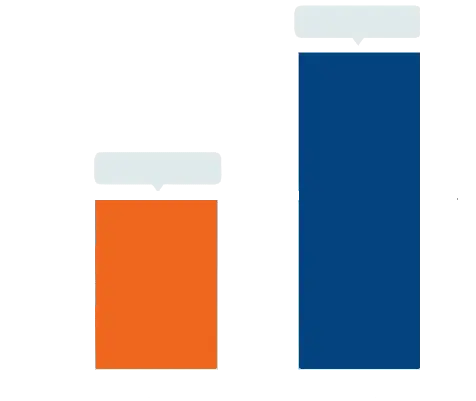
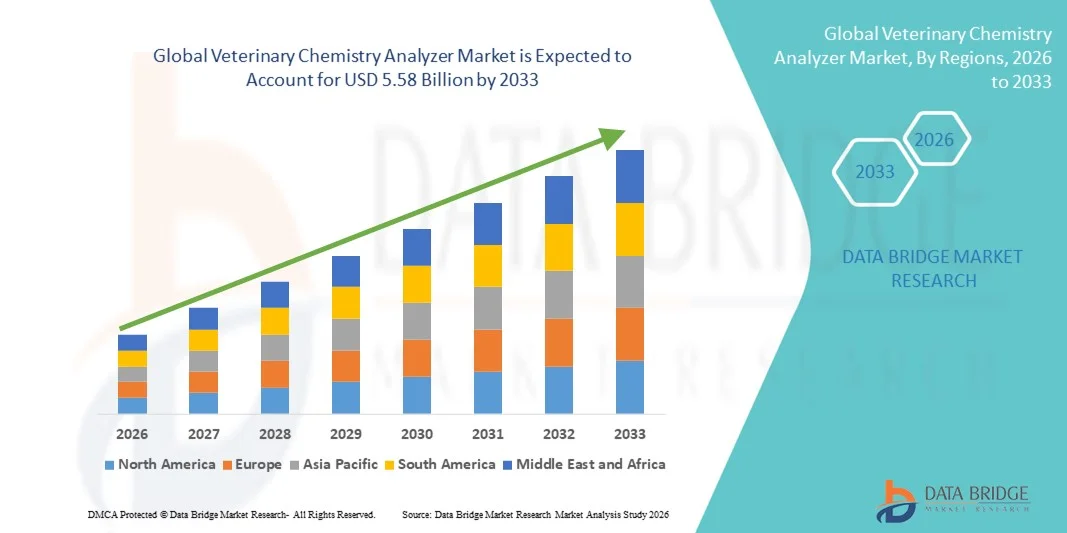
- The global veterinary chemistry analyzer market size was valued at USD 2.99 billion in 2025 and is expected to reach USD 5.58 billion by 2033, at a CAGR of 8.12% during the forecast period
- The market growth is largely fueled by the increasing adoption of advanced diagnostic technologies, rising prevalence of animal diseases, and growing demand for rapid and accurate veterinary testing solutions in both livestock and companion animal healthcare settings, leading to improved disease management and productivity
- Furthermore, rising awareness among veterinarians and pet owners about preventive healthcare, increasing investments in veterinary clinics and laboratories, and the need for automated, high-throughput testing systems are establishing veterinary chemistry analyzers as essential tools in modern veterinary diagnostics. These converging factors are accelerating the uptake of Veterinary Chemistry Analyzer solutions, thereby significantly boosting the industry’s growth
Veterinary Chemistry Analyzer Market Analysis
- Veterinary chemistry analyzers, including automated and semi-automated analyzers for blood, serum, and other biological samples, are increasingly vital in modern veterinary diagnostics due to their ability to provide rapid, accurate, and high-throughput testing for both companion and livestock animals, improving disease management and animal healthcare outcomes
- The escalating demand for veterinary chemistry analyzers is primarily fueled by rising awareness of preventive animal healthcare, increasing prevalence of animal diseases, growing veterinary infrastructure, and the need for precise and efficient laboratory workflows in veterinary clinics, hospitals, and research facilities
- North America dominated the veterinary chemistry analyzer market with the largest revenue share of 37.6% in 2025, driven by high adoption of advanced diagnostic technologies, strong presence of key industry players, growing investments in veterinary healthcare, and widespread usage in both small and large animal practices, with the U.S. leading regional growth
- Asia-Pacific is expected to be the fastest-growing region in the veterinary chemistry analyzer market during the forecast period due to expanding livestock farming, rising pet ownership, increasing veterinary healthcare spending, and rapid modernization of laboratory infrastructure in countries such as China and India
- The Companion Animals segment accounted for the largest market revenue share of 61.4% in 2025, driven by increasing pet ownership and rising expenditure on pet healthcare
Report Scope and Veterinary Chemistry Analyzer Market Segmentation
|
Attributes |
Veterinary Chemistry Analyzer Key Market Insights |
|
Segments Covered |
|
|
Countries Covered |
North America
Europe
Asia-Pacific
Middle East and Africa
South America
|
|
Key Market Players |
|
|
Market Opportunities |
|
|
Value Added Data Infosets |
In addition to the insights on market scenarios such as market value, growth rate, segmentation, geographical coverage, and major players, the market reports curated by the Data Bridge Market Research also include in-depth expert analysis, patient epidemiology, pipeline analysis, pricing analysis, and regulatory framework. |
Veterinary Chemistry Analyzer Market Trends
Advancements in Automated Veterinary Diagnostics
- A key trend in the global veterinary chemistry analyzer market is the increasing adoption of fully automated and high-throughput analyzers for veterinary diagnostics
- These systems are designed to deliver rapid, accurate, and reliable biochemical analyses of animal samples, improving laboratory efficiency and diagnostic precision
- For instance, in 2023, IDEXX Laboratories launched its Catalyst Dx chemistry analyzer for small animal clinics, offering enhanced throughput and automated sample processing. Similarly, Abbott Laboratories expanded its veterinary diagnostic portfolio with the Alinity Vet system, enabling comprehensive panels for multiple species with minimal manual intervention
- Integration of advanced features such as multiplex testing, data connectivity, and automated quality control is becoming more prevalent, allowing veterinary laboratories to optimize workflow, reduce human error, and maintain regulatory compliance
- The trend toward portable and bench-top analyzers is also rising, particularly in field clinics and remote veterinary practices, enabling on-site rapid diagnostics for improved animal health outcomes
Veterinary Chemistry Analyzer Market Dynamics
Driver
Increasing Demand for Efficient and Accurate Veterinary Diagnostics
- The growing prevalence of companion animals, livestock, and exotic pets is driving demand for veterinary diagnostic solutions that provide accurate and rapid results. Veterinary clinics and hospitals require reliable chemistry analyzers to support preventive care, disease management, and therapeutic monitoring
- For instance, in 2024, Heska Corporation launched an updated version of its VetTest Chemistry Analyzer with expanded assay capabilities, helping clinics enhance diagnostic speed and accuracy
- Furthermore, increasing adoption of advanced veterinary healthcare practices, rising pet ownership, and heightened awareness of animal health standards contribute to market growth
- The growing veterinary pharmaceutical and biotechnology sectors, coupled with expanding veterinary services in emerging economies, are also boosting demand for high-performance analyzers
Restraint/Challenge
High Equipment Costs and Technical Expertise Requirements
- The relatively high cost of automated veterinary chemistry analyzers poses a challenge, particularly for small-scale veterinary clinics and laboratories in developing regions. Initial capital investment, ongoing maintenance, and reagent costs can limit adoption
- For instance, sophisticated analyzers from Randox Laboratories and Ortho Clinical Diagnostics require trained personnel to operate and maintain, creating barriers for clinics with limited technical staff
- In addition, integrating new analyzers into existing laboratory workflows, ensuring data management compliance, and maintaining consistent quality control can be challenging
- Overcoming these challenges through the development of cost-effective analyzers, user-friendly interfaces, remote service support, and training programs will be critical for sustained growth in the Veterinary Chemistry Analyzer market
Veterinary Chemistry Analyzer Market Scope
The market is segmented on the basis of product, application, and animal type.
- By Product
On the basis of product, the Veterinary Chemistry Analyzer market is segmented into Instruments and Consumables. The Instruments segment dominated the largest market revenue share of 52.3% in 2025, driven by the increasing adoption of automated and high-throughput analyzers in veterinary laboratories and clinics. Veterinary instruments are critical for accurate diagnostics, offering rapid analysis and integration with laboratory information systems. Rising awareness about preventive veterinary care and advanced diagnostics supports demand. Veterinary hospitals, research institutions, and diagnostic centers rely heavily on reliable instruments for blood chemistry, urinalysis, and other analyses. Continuous technological advancements, including miniaturization and multi-parameter analyzers, enhance functionality. Instruments are preferred for companion animals due to high precision needs, and for livestock to monitor herd health. Regulatory approvals and standardization further strengthen market share. The expanding veterinary diagnostics market globally contributes to sustained growth. Large-scale adoption in developed regions drives revenue dominance. Ongoing training and service support improve instrument utilization. Overall, instruments remain the dominant segment due to essential diagnostic role and technological sophistication.
The Consumables segment is expected to witness the fastest CAGR of 11.2% from 2026 to 2033, fueled by increasing demand for test kits, reagents, and disposable components. Consumables are critical for routine blood chemistry, urinalysis, glucose, and electrolyte monitoring, enabling accurate and rapid results. Rising veterinary testing volumes globally drive demand. Consumables support point-of-care testing in companion animal clinics and on-farm diagnostics in livestock. Cost-effective, ready-to-use consumables enhance laboratory efficiency. Growing awareness of animal health monitoring programs accelerates adoption. Expansion of veterinary services in emerging markets further supports growth. Manufacturers focus on optimizing reagent stability and multi-test compatibility. Overall, consumables represent the fastest-growing segment due to recurring use, high testing volume, and global expansion of veterinary services.
- By Application
On the basis of application, the Veterinary Chemistry Analyzer market is segmented into Blood Chemistry Analysis, Urinalysis, Glucose Monitoring, and Blood Gas & Electrolyte Analysis. The Blood Chemistry Analysis segment held the largest market revenue share of 45.7% in 2025, driven by its widespread use for comprehensive health assessment in both companion animals and livestock. Blood chemistry panels are critical for disease diagnosis, treatment monitoring, and preventive care. Veterinary clinics and diagnostic laboratories rely heavily on automated analyzers for high-volume blood testing. Increasing pet ownership and awareness of preventive healthcare accelerate demand. Integration with laboratory information management systems enhances workflow efficiency. Growth in livestock health management programs supports adoption in farms. Advanced multi-parameter analyzers further strengthen segment leadership. Continuous introduction of high-throughput analyzers improves testing capacity. Overall, blood chemistry analysis dominates due to essential role in diagnostics and preventive veterinary care.
The Glucose Monitoring segment is projected to witness the fastest CAGR of 12.5% from 2026 to 2033, fueled by rising prevalence of diabetes in companion animals and the need for routine glucose monitoring in critical care. Increasing awareness among pet owners about chronic disease management supports growth. Glucose analyzers are widely used in veterinary hospitals and clinics for rapid, accurate testing. Adoption of portable and point-of-care devices enhances convenience. Technological advancements in continuous glucose monitoring improve reliability and patient outcomes. The growing prevalence of obesity and metabolic disorders in pets drives recurring testing demand. Veterinary nutrition and management programs further boost adoption. Overall, glucose monitoring represents the fastest-growing application segment due to rising chronic disease management needs and point-of-care testing expansion.
- By Animal Type
On the basis of animal type, the Veterinary Chemistry Analyzer market is segmented into Companion Animals and Livestock. The Companion Animals segment accounted for the largest market revenue share of 61.4% in 2025, driven by increasing pet ownership and rising expenditure on pet healthcare. Pet owners are increasingly opting for advanced diagnostic testing for preventive and curative care. Veterinary hospitals and clinics focus on companion animal diagnostics for routine checkups, chronic disease management, and surgical preparations. Growing awareness about pet wellness and advanced treatment options supports segment dominance. Integration of automated analyzers in clinics improves efficiency and accuracy. Continuous product innovation in multi-parameter analyzers enhances usability. Overall, companion animals dominate due to higher healthcare spending and demand for accurate diagnostics.
The Livestock segment is expected to witness the fastest CAGR of 10.8% from 2026 to 2033, driven by the increasing focus on herd health management and preventive veterinary care in agriculture. Livestock diagnostics are critical for monitoring metabolic health, detecting diseases, and improving productivity. Rising adoption of automated analyzers for large-scale testing enhances operational efficiency. Government programs promoting animal health and disease control contribute to growth. Technological advancements in analyzers facilitate rapid on-site testing in farms. Expansion of dairy and meat industries globally further supports segment growth. Overall, livestock represents the fastest-growing segment due to increasing herd health monitoring and automation adoption.
Veterinary Chemistry Analyzer Market Regional Analysis
- North America dominated the veterinary chemistry analyzer market with the largest revenue share of 37.6% in 2025
- Driven by high adoption of advanced diagnostic technologies, strong presence of key industry players, growing investments in veterinary healthcare, and widespread usage in both small and large animal practices. The U.S. leads regional growth, supported by well-established veterinary clinics, hospitals, and laboratory networks
- Veterinary clinics and diagnostic laboratories in the region are increasingly adopting automated chemistry analyzers for small and large animals to improve throughput, accuracy, and workflow efficiency. For instance, IDEXX Laboratories expanded its Catalyst Dx analyzer line to meet rising demand in small animal practices
U.S. Veterinary Chemistry Analyzer Market Insight
The U.S. veterinary chemistry analyzer market captured the largest revenue share within North America, fueled by advanced veterinary diagnostics infrastructure, strong R&D investment, and growing veterinary healthcare expenditure. Companies such as Abbott Laboratories and Heska Corporation are developing analyzers capable of fast biochemical testing for multiple species, supporting clinics and laboratories in enhancing diagnostic accuracy and operational efficiency.
Europe Veterinary Chemistry Analyzer Market Insight
The Europe veterinary chemistry analyzer market is expected to grow steadily, supported by increasing veterinary healthcare investments, regulatory emphasis on diagnostic accuracy, and adoption of automated laboratory solutions. Countries such as Germany, France, and the U.K. are incorporating high-throughput chemistry analyzers in veterinary hospitals and diagnostic labs to optimize workflows and improve clinical outcomes.
U.K. Veterinary Chemistry Analyzer Market Insight
The U.K. veterinary chemistry analyzer market is anticipated to expand at a notable CAGR, driven by rising companion animal ownership, demand for rapid diagnostics, and adoption of automated analyzers in small and large animal practices. Veterinary clinics are increasingly integrating portable and benchtop chemistry analyzers to facilitate faster decision-making and enhance patient care.
Germany Veterinary Chemistry Analyzer Market Insight
The German veterinary chemistry analyzer market is experiencing strong growth due to the country’s advanced veterinary healthcare infrastructure, focus on laboratory automation, and adoption of high-quality analyzers in both private and research veterinary facilities. Manufacturers such as Randox Laboratories are providing solutions that improve throughput and diagnostic precision for multi-species testing.
Asia-Pacific Veterinary Chemistry Analyzer Market Insight
Asia-Pacific veterinary chemistry analyzer market is expected to be the fastest-growing region during the forecast period, driven by expanding livestock farming, rising pet ownership, increasing veterinary healthcare spending, and rapid modernization of laboratory infrastructure in countries such as China and India. Local and multinational companies are scaling production of cost-effective chemistry analyzers for small and large animals, while veterinary diagnostic services are expanding to tier-2 and tier-3 cities. For example, Mindray Medical International strengthened its veterinary analyzer portfolio for APAC markets in 2024.
Japan Veterinary Chemistry Analyzer Market Insight
Japan’s veterinary chemistry analyzer market is growing due to high technological adoption, advanced veterinary infrastructure, and demand for rapid diagnostic solutions. The aging pet population and focus on companion animal health are driving the adoption of automated chemistry analyzers capable of multi-analyte testing in clinics and laboratories.
China Veterinary Chemistry Analyzer Market Insight
China veterinary chemistry analyzer market accounted for the largest market share in Asia-Pacific in 2025, supported by rapid urbanization, increased veterinary healthcare spending, and growing livestock and companion animal populations. Domestic manufacturers and multinational companies are expanding distribution networks and providing affordable, high-throughput analyzers to meet the increasing demand from veterinary hospitals and diagnostic laboratories.
Veterinary Chemistry Analyzer Market Share
The Veterinary Chemistry Analyzer industry is primarily led by well-established companies, including:
- Abaxis, Inc. (U.S.)
- IDEXX Laboratories, Inc. (U.S.)
- Bayer AG (Germany)
- Siemens Healthineers AG (Germany)
- F. Hoffmann-La Roche Ltd. (Switzerland)
- Ortho Clinical Diagnostics (U.S.)
- Mindray Medical International Ltd. (China)
- Nova Biomedical Corporation (U.S.)
- Beckman Coulter, Inc. (U.S.)
- Zoetis Inc. (U.S.)
- Randox Laboratories Ltd. (U.K.)
- Merck KGaA (Germany)
- Thermo Fisher Scientific Inc. (U.S.)
- Analytik Jena AG (Germany)
- Horiba Ltd. (Japan)
- Microlab Instruments Pvt. Ltd. (India)
- Dr. Ehrenstorfer GmbH (Germany)
- Heska Corporation (U.S.)
- OptiMedica Corporation (U.S.)
- Shenzhen Mindray Bio-Medical Electronics Co., Ltd. (China)
Latest Developments in Global Veterinary Chemistry Analyzer Market
- In March 2023, Agappe Diagnostics launched its VET CARE veterinary diagnostic division, offering a range of point‑of‑care solutions including veterinary chemistry analyzers designed to increase accessibility in veterinary hospitals and clinics
- In August 2023, Seamaty Technology introduced four new veterinary analyzers — including the VG2 blood gas electrolyte immunoassay analyzer, VG1 veterinary blood gas & electrolyte analyzer, Vi1 veterinary fluorescence immunoassay analyzer, and hematology analyzers VBC30 and VBC50 — enhancing diagnostic capability for metabolic, immunoassay, and blood cell testing in pet hospitals
- In September 2024, Zoetis Inc. unveiled its Vetscan OptiCell, a new cartridge‑based hematology and diagnostic analyzer powered by AI to deliver rapid and precise complete blood count (CBC) results at the point of care — improving efficiency for veterinary practices
- In July 2024, EKF Diagnostics launched the Biosen C‑Line, an advanced glucose and lactate analyzer with touchscreen controls and enhanced connectivity that integrates seamlessly with veterinary lab information systems, boosting clinical usage for metabolic monitoring and diagnostics
- In January 2025, BIONOTE introduced the Vcheck H, a multifunction veterinary clinical chemistry analyzer capable of evaluating white blood cells, red blood cells, platelets, reticulocytes, and hemoglobin — expanding rapid diagnostics in laboratory and clinic settings
SKU-
Get online access to the report on the World's First Market Intelligence Cloud
- Interactive Data Analysis Dashboard
- Company Analysis Dashboard for high growth potential opportunities
- Research Analyst Access for customization & queries
- Competitor Analysis with Interactive dashboard
- Latest News, Updates & Trend analysis
- Harness the Power of Benchmark Analysis for Comprehensive Competitor Tracking
Research Methodology
Data collection and base year analysis are done using data collection modules with large sample sizes. The stage includes obtaining market information or related data through various sources and strategies. It includes examining and planning all the data acquired from the past in advance. It likewise envelops the examination of information inconsistencies seen across different information sources. The market data is analysed and estimated using market statistical and coherent models. Also, market share analysis and key trend analysis are the major success factors in the market report. To know more, please request an analyst call or drop down your inquiry.
The key research methodology used by DBMR research team is data triangulation which involves data mining, analysis of the impact of data variables on the market and primary (industry expert) validation. Data models include Vendor Positioning Grid, Market Time Line Analysis, Market Overview and Guide, Company Positioning Grid, Patent Analysis, Pricing Analysis, Company Market Share Analysis, Standards of Measurement, Global versus Regional and Vendor Share Analysis. To know more about the research methodology, drop in an inquiry to speak to our industry experts.
Customization Available
Data Bridge Market Research is a leader in advanced formative research. We take pride in servicing our existing and new customers with data and analysis that match and suits their goal. The report can be customized to include price trend analysis of target brands understanding the market for additional countries (ask for the list of countries), clinical trial results data, literature review, refurbished market and product base analysis. Market analysis of target competitors can be analyzed from technology-based analysis to market portfolio strategies. We can add as many competitors that you require data about in the format and data style you are looking for. Our team of analysts can also provide you data in crude raw excel files pivot tables (Fact book) or can assist you in creating presentations from the data sets available in the report.