Global Soft Tissue Repair Market
Market Size in USD Billion
CAGR :
% 
 USD
24.90 Billion
USD
39.32 Billion
2024
2032
USD
24.90 Billion
USD
39.32 Billion
2024
2032
 Forecast Period Forecast Period |
2025 –2032 |
 Market Size (Base Year) Market Size (Base Year) |
USD 24.90 Billion |
 Market Size (Forecast Year) Market Size (Forecast Year) |
USD 39.32 Billion |
 CAGR CAGR |
% |
| Major Markets Players |
|
Soft Tissue Repair Market Size
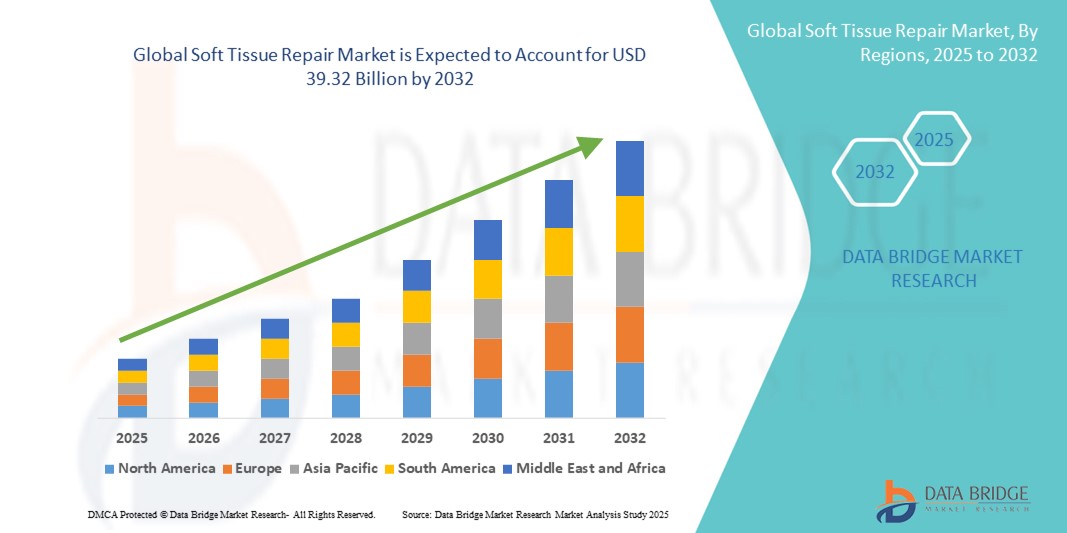
- The global soft tissue repair market size was valued at USD 24.90 billion in 2024 and is expected to reach USD 39.32 billion by 2032, at a CAGR of 5.88% during the forecast period
- The market growth is primarily driven by the increasing incidence of soft tissue injuries due to sports, trauma, and aging populations, along with the rising number of surgical procedures worldwide
- In addition, advancements in biological implants, growing preference for minimally invasive procedures, and heightened awareness of early intervention treatments are positioning soft tissue repair as a vital segment in modern medical care. These converging factors are fueling market expansion and strengthening the industry's long-term outlook
Soft Tissue Repair Market Analysis
- Soft tissue repair, encompassing surgical procedures and products designed to restore function to damaged muscles, ligaments, and tendons, is becoming increasingly essential in orthopedic, sports medicine, and general surgical practices due to its role in improving mobility and quality of life for patients
- The rising prevalence of sports injuries, trauma cases, and age-related degenerative conditions is significantly driving demand for soft tissue repair solutions, alongside the growing acceptance of biologic implants and advanced tissue regeneration technologies
- North America dominated the soft tissue repair market with the largest revenue share of 41.8% in 2024, owing to a well-established healthcare infrastructure, high procedure volumes, and early adoption of cutting-edge medical technologies, with the U.S. leading in soft tissue grafts and biologics used in orthopedic and reconstructive surgeries
- Asia-Pacific is projected to be the fastest growing region in the soft tissue repair market during the forecast period, supported by a rapidly aging population, improving healthcare access, and increased investments in medical infrastructure
- The hernia repair segment dominated the soft tissue repair market with a market share of 40.2% in 2024, driven by the rising number of hernia surgeries globally and the growing adoption of mesh-based and laparoscopic repair techniques
Report Scope and Soft Tissue Repair Market Segmentation
|
Attributes |
Soft Tissue Repair Key Market Insights |
|
Segments Covered |
|
|
Countries Covered |
North America
Europe
Asia-Pacific
Middle East and Africa
South America
|
|
Key Market Players |
|
|
Market Opportunities |
|
|
Value Added Data Infosets |
In addition to the insights on market scenarios such as market value, growth rate, segmentation, geographical coverage, and major players, the market reports curated by the Data Bridge Market Research also include in-depth expert analysis, pricing analysis, brand share analysis, consumer survey, demography analysis, supply chain analysis, value chain analysis, raw material/consumables overview, vendor selection criteria, PESTLE Analysis, Porter Analysis, and regulatory framework. |
Soft Tissue Repair Market Trends
Innovation in Biologic Grafts and Regenerative Technologies
- A prominent and accelerating trend in the global soft tissue repair market is the growing integration of biologic grafts and regenerative medicine technologies. These innovations are significantly enhancing patient outcomes by promoting natural tissue healing and reducing the risk of rejection or complications compared to synthetic alternatives
- For instance, companies such as Arthrex and Smith+Nephew are expanding their biologics portfolios with advanced collagen-based and allograft tissue repair products designed to mimic the body’s natural extracellular matrix. Similarly, Integra LifeSciences offers biologically derived matrices aimed at promoting cellular ingrowth and tissue remodeling
- These biologic solutions enable enhanced repair and regeneration in applications such as tendon reinforcement, hernia repair, and wound closure. Innovations include decellularized dermal matrices, acellular collagen scaffolds, and growth factor-infused grafts that actively stimulate the healing process while minimizing inflammation and scarring
- The shift toward biologic implants aligns with the growing clinical preference for minimally invasive, tissue-preserving techniques that reduce recovery time and improve long-term mobility. Surgeons are increasingly selecting biologic materials for complex repairs due to their compatibility and improved patient safety profiles
- This trend is reshaping surgical approaches in orthopedics, sports medicine, and general surgery by offering durable, biocompatible alternatives to traditional mesh and synthetic materials. As healthcare systems emphasize personalized treatment and enhanced recovery, demand for regenerative and biologically advanced soft tissue repair products is rising sharply
- Leading players, including Tissue Regenix and MTF Biologics, are investing heavily in R&D to develop next-generation biologics tailored to various soft tissue types, further advancing the field and creating new growth opportunities for both established and emerging market participants
Soft Tissue Repair Market Dynamics
Driver
Rising Prevalence of Soft Tissue Injuries and Advancements in Surgical Techniques
- The increasing incidence of soft tissue injuries stemming from sports activities, trauma, aging populations, and repetitive strain serves as a primary driver for the expanding soft tissue repair market
- For instance, the growing number of ACL tears, rotator cuff injuries, and hernias has led to a surge in surgical interventions globally. This trend is amplified by the rising participation in physical activities and fitness regimens across all age groups
- In response, companies such as Medtronic and Becton, Dickinson and Company (BD) are introducing advanced repair systems and bioabsorbable fixation products that streamline procedures and reduce complications. The adoption of laparoscopic and arthroscopic methods further improves surgical precision, recovery time, and patient satisfaction
- Moreover, hospitals and ambulatory surgical centers are embracing newer techniques such as all-inside repairs and hybrid biologic-synthetic approaches to enhance healing and reduce re-operation rates. These medical advancements are driving the demand for highly specialized soft tissue repair products
- The rising awareness of early treatment, combined with the availability of innovative surgical tools and implants, is also encouraging physicians and patients asuch as to opt for timely intervention, thereby expanding the addressable market
Restraint/Challenge
High Costs and Regulatory Complexity of Biologic Products
- Despite their clinical advantages, the high cost associated with biologic grafts and regenerative tissue repair products poses a significant challenge, particularly in cost-sensitive and developing healthcare markets
- For instance, while biologic meshes and allograft materials offer superior healing properties, their production, processing, and storage requirements make them substantially more expensive than synthetic alternatives. This cost barrier often limits access in publicly funded health systems or among uninsured patient populations
- In addition, regulatory scrutiny surrounding the approval of biologic implants—especially those involving human- or animal-derived tissues—adds complexity and delays market entry for novel solutions. Companies must adhere to stringent standards from regulatory bodies such as the FDA and EMA, which may increase time-to-market and development costs
- Reimbursement limitations and variability across regions also hinder the adoption of advanced repair products, creating disparities in access to best-in-class care. Manufacturers are challenged to balance innovation with affordability to ensure widespread adoption
- Overcoming these hurdles through value-based pricing models, patient-specific outcome studies, and streamlined regulatory pathways will be critical to ensuring continued market growth and equitable access to soft tissue repair innovations globally
Soft Tissue Repair Market Scope
The market is segmented on the basis of product, application, injury location, and end use.
- By Product
On the basis of product, the soft tissue repair market is segmented into tissue patch/mesh, fixation devices, and laparoscopic instruments. The tissue patch/mesh segment held the largest market revenue share in 2024, driven by the high demand for mesh-based solutions in hernia repair and reconstructive surgeries. Biologic and synthetic mesh products are increasingly used for their durability, biocompatibility, and ability to promote tissue regeneration. This segment continues to dominate due to technological advancements in composite mesh designs and the widespread clinical adoption of tension-free repair techniques.
The fixation devices segment is expected to register the fastest growth rate from 2025 to 2032, fueled by innovations in bioabsorbable and metallic fixation systems. These devices are essential for anchoring soft tissue during repair and are gaining popularity due to their application in orthopedic and sports medicine surgeries. Improved surgical outcomes and patient mobility post-intervention are further accelerating demand for advanced fixation tools.
- By Application
On the basis of application, the soft tissue repair market is segmented into hernia repair, skin repair, dermatology, pelvic and vaginal sling procedures, orthopedic repair, dental repair, breast reconstruction repair, head and neck products, and others. The hernia repair segment dominated the market in 2024 with a market share of 40.2%, accounting for the largest revenue share owing to the high prevalence of hernia cases globally and increasing adoption of minimally invasive laparoscopic repair techniques. Both synthetic and biologic meshes are extensively utilized in inguinal, incisional, and umbilical hernia surgeries, driving segment growth.
The orthopedic repair segment is projected to witness rapid growth during the forecast period due to a surge in sports-related injuries and degenerative musculoskeletal conditions. Soft tissue repair solutions for ligaments, tendons, and cartilage are being adopted widely in arthroscopic and reconstructive procedures, further propelling demand.
- By Injury Location
On the basis of injury location, the soft tissue repair market is segmented into knee, shoulder, hip, small joints, and others based on injury location. The knee segment held the largest market share in 2024, driven by the high volume of ACL and meniscus repair surgeries, especially among athletes and older adults with degenerative joint conditions. Increasing awareness of early surgical intervention and advancements in biologic grafts are contributing to the segment’s dominance.
The shoulder segment is expected to grow at a significant pace during the forecast period, primarily due to the rise in rotator cuff and labral repair procedures. Enhanced surgical techniques and a growing aging population with shoulder dysfunctions are key growth drivers for this segment.
- By End Use
On the basis of end use, the soft tissue repair market is segmented into hospitals, ambulatory surgical centers (ASCs), clinics, and others. The hospitals segment accounted for the largest revenue share in 2024, attributed to the high volume of complex soft tissue surgeries performed in these settings, coupled with advanced infrastructure and availability of specialized personnel. The ability to manage acute trauma and large-scale elective surgeries also supports hospital-based procedures.
The ambulatory surgical centers segment is projected to grow at the fastest rate from 2025 to 2032, owing to the shift toward outpatient care, lower procedural costs, and faster recovery times. ASCs are increasingly equipped with advanced laparoscopic and arthroscopic equipment, making them ideal for performing soft tissue repair procedures with shorter hospital stays and reduced infection risks.
Soft Tissue Repair Market Regional Analysis
- North America dominated the soft tissue repair market with the largest revenue share of 41.8% in 2024, owing to a well-established healthcare infrastructure, high procedure volumes, and early adoption of cutting-edge medical technologies, with the U.S. leading in soft tissue grafts and biologics used in orthopedic and reconstructive surgeries
- The region benefits from a large base of skilled surgeons, widespread insurance coverage for soft tissue procedures, and a growing elderly population prone to musculoskeletal disorders and degenerative conditions
- The increasing focus on sports medicine, rising demand for minimally invasive procedures, and the rapid adoption of biologic and regenerative repair solutions further support market expansion across the United States and Canada
U.S. Soft Tissue Repair Market Insight
The U.S. soft tissue repair market captured the largest revenue share of 80.4% in 2024 within North America, driven by the high volume of surgical procedures and growing prevalence of soft tissue injuries from sports, aging, and trauma. Strong reimbursement frameworks and advanced healthcare infrastructure are key contributors to this dominance. The widespread use of biologic grafts, arthroscopic techniques, and minimally invasive surgeries further accelerates market growth. Continuous R&D investments by key players, along with increasing demand for outpatient soft tissue repair procedures, are also supporting expansion in the U.S. market.
Europe Soft Tissue Repair Market Insight
The Europe soft tissue repair market is projected to grow at a substantial CAGR during the forecast period, driven by increasing orthopedic and reconstructive procedures and a rising elderly population. Demand is further supported by the adoption of biologic implants and tissue regeneration technologies. Regulatory emphasis on patient safety and clinical outcomes is prompting hospitals to adopt advanced, evidence-based soft tissue repair solutions. Applications such as hernia repair, tendon reconstruction, and pelvic floor procedures are witnessing robust demand across the region.
U.K. Soft Tissue Repair Market Insight
The U.K. soft tissue repair market is anticipated to grow at a noteworthy CAGR during the forecast period, fueled by the increasing burden of musculoskeletal disorders and enhanced focus on surgical innovation. The National Health Service (NHS) is increasingly adopting biologic and minimally invasive solutions to reduce patient recovery time and improve outcomes. Rising participation in sports and physical activities is also contributing to the growing demand for tendon, ligament, and cartilage repair procedures across public and private healthcare settings.
Germany Soft Tissue Repair Market Insight
The Germany soft tissue repair market is expected to expand at a considerable CAGR during the forecast period, supported by a strong medical device manufacturing sector and a high rate of elective surgeries. The country’s focus on innovation and quality-driven healthcare services is fostering the adoption of regenerative implants and minimally invasive procedures. Demand is rising across both orthopedic and general surgery segments, particularly in ligament and hernia repairs, as hospitals and ASCs increasingly invest in advanced surgical technologies.
Asia-Pacific Soft Tissue Repair Market Insight
The Asia-Pacific soft tissue repair market is poised to grow at the fastest CAGR of 23.6% from 2025 to 2032, driven by expanding healthcare infrastructure, rising surgical volumes, and increased awareness of early intervention treatments. Countries such as China, Japan, and India are witnessing rapid growth in orthopedic and general surgical procedures due to urbanization, aging populations, and higher injury rates. Government-backed healthcare reforms and increasing access to biologic and synthetic repair materials are also contributing to market expansion in the region.
Japan Soft Tissue Repair Market Insight
The Japan soft tissue repair market is gaining traction due to its aging population, high healthcare standards, and strong preference for advanced surgical techniques. The demand for soft tissue repair is increasing in orthopedic and reconstructive applications, particularly for shoulder, hip, and knee injuries. The country's focus on robotics, precision surgery, and biologics is enhancing treatment quality and patient outcomes, further driving the adoption of soft tissue repair products.
India Soft Tissue Repair Market Insight
The India soft tissue repair market accounted for the largest revenue share in Asia-Pacific in 2024, supported by a rising middle-class population, growing access to healthcare, and increasing demand for orthopedic surgeries. The country’s expanding network of hospitals and surgical centers, along with a surge in accident- and lifestyle-related injuries, is fueling demand. Government initiatives to boost surgical care accessibility, alongside the availability of cost-effective biologic and synthetic implants, are propelling growth in both urban and rural settings.
Soft Tissue Repair Market Share
The soft tissue repair industry is primarily led by well-established companies, including:
- Johnson & Johnson and its affiliates (India)
- Smith + Nephew (U.K.)
- Integra LifeSciences (U.S.)
- BD (U.S.)
- LifeCell International Pvt. Ltd. (India)
- Organogenesis Inc. (U.S.)
- Medtronic (Ireland)
- Stryker (U.S.)
- Arthrex, Inc. (U.S.)
- Wright Medical Group N.V. (U.S.)
- Boston Scientific Corporation (U.S.)
- AbbVie Inc. (Ireland)
- CryoLife, Inc. (U.S.)
- Athersys, Inc. (U.S.)
- Zimmer Biomet (U.S.)
- LifeNet Health, (U.S.)
- Stem Cell, Inc. (U.S.)
- Isto Biologics (U.S.)
What are the Recent Developments in Global Soft Tissue Repair Market?
- In April 2025, BD launched the Phasix ST Umbilical Mesh, an industry-first bioabsorbable mesh designed specifically for umbilical hernia repair. This mesh offers a non-permanent solution to address patient preferences and surgeon requirements. It is available in three sizes to accommodate a broad spectrum of umbilical soft tissue defects. The Phasix ST Umbilical Mesh adds to BD's growing family of absorbable products, which have been supported by over 85 clinical publications and more than 4,000 patients studied
- In March 2024, Medtronic announced the launch of the Symbotex Composite Mesh, a synthetic mesh intended for the reinforcement of abdominal wall soft tissue. This mesh is designed to address weaknesses in the abdominal wall, commonly associated with hernia repairs. The Symbotex Composite Mesh is part of Medtronic's comprehensive portfolio aimed at enhancing surgical outcomes in soft tissue repair procedures
- In June 2023, Integra LifeSciences announced the completion of enrollment in the DuraSorb Monofilament Mesh clinical trial. This milestone is a significant step toward the potential approval of DuraSorb for two-stage breast reconstruction procedures. The DuraSorb Mesh aims to provide surgeons with a reliable solution for soft tissue reinforcement in complex reconstructive surgeries
- In March 2023, Smith+Nephew introduced an enhanced sports medicine portfolio, focusing on innovations in soft tissue repair. The portfolio includes advanced technologies aimed at improving the repair and regeneration of soft and hard tissues. Smith+Nephew's commitment to innovation in sports medicine underscores its dedication to restoring patients' bodies and self-belief through technological advancements
- In December 2023, Medtronic launched the Transorb Self-Gripping Resorbable Mesh, designed for the reinforcement of abdominal wall soft tissues during open hernia repair procedures. This mesh eliminates the need for tacks or sutures, offering a simplified surgical approach. The Transorb Mesh is part of Medtronic's commitment to providing innovative solutions that enhance surgical efficiency and patient outcomes
SKU-
Get online access to the report on the World's First Market Intelligence Cloud
- Interactive Data Analysis Dashboard
- Company Analysis Dashboard for high growth potential opportunities
- Research Analyst Access for customization & queries
- Competitor Analysis with Interactive dashboard
- Latest News, Updates & Trend analysis
- Harness the Power of Benchmark Analysis for Comprehensive Competitor Tracking
Research Methodology
Data collection and base year analysis are done using data collection modules with large sample sizes. The stage includes obtaining market information or related data through various sources and strategies. It includes examining and planning all the data acquired from the past in advance. It likewise envelops the examination of information inconsistencies seen across different information sources. The market data is analysed and estimated using market statistical and coherent models. Also, market share analysis and key trend analysis are the major success factors in the market report. To know more, please request an analyst call or drop down your inquiry.
The key research methodology used by DBMR research team is data triangulation which involves data mining, analysis of the impact of data variables on the market and primary (industry expert) validation. Data models include Vendor Positioning Grid, Market Time Line Analysis, Market Overview and Guide, Company Positioning Grid, Patent Analysis, Pricing Analysis, Company Market Share Analysis, Standards of Measurement, Global versus Regional and Vendor Share Analysis. To know more about the research methodology, drop in an inquiry to speak to our industry experts.
Customization Available
Data Bridge Market Research is a leader in advanced formative research. We take pride in servicing our existing and new customers with data and analysis that match and suits their goal. The report can be customized to include price trend analysis of target brands understanding the market for additional countries (ask for the list of countries), clinical trial results data, literature review, refurbished market and product base analysis. Market analysis of target competitors can be analyzed from technology-based analysis to market portfolio strategies. We can add as many competitors that you require data about in the format and data style you are looking for. Our team of analysts can also provide you data in crude raw excel files pivot tables (Fact book) or can assist you in creating presentations from the data sets available in the report.