Global Flexible Foam Market
Market Size in USD Billion
CAGR :
% 
 USD
39.02 Billion
USD
61.72 Billion
2024
2032
USD
39.02 Billion
USD
61.72 Billion
2024
2032
 Forecast Period Forecast Period |
2025 –2032 |
 Market Size (Base Year) Market Size (Base Year) |
USD 39.02 Billion |
 Market Size (Forecast Year) Market Size (Forecast Year) |
USD 61.72 Billion |
 CAGR CAGR |
% |
| Major Markets Players |
|
Flexible Foam Market Size
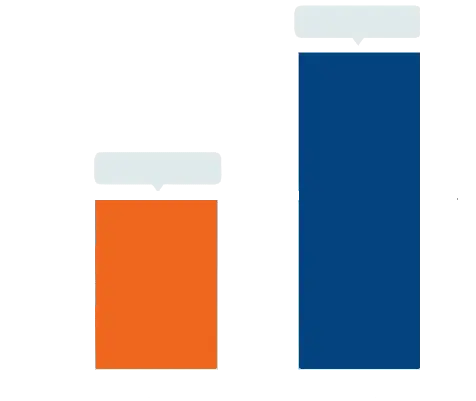
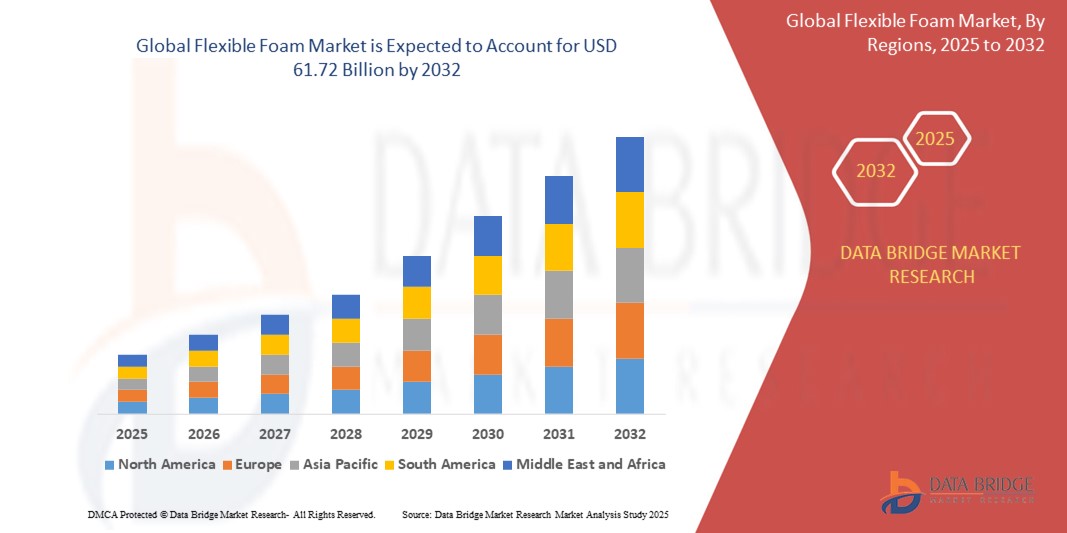
- The Global Flexible Foam Market was valued at USD 39.02 billion in 2024 and is expected to reach USD 61.72 billion by 2032
- During the forecast period of 2025 to 2032 the market is likely to grow at a CAGR of 5.90%, primarily driven by rise in demand for Flexible Foam by the chemical and petrochemical industry in developed and developing economies
- This growth is driven by factors such as rising application areas for Flexible Foam such as by the healthcare industry and growth and expansion of various end user industries especially in the developing economies
Flexible Foam Market Analysis
- Flexible Foam is widely utilized across sectors such as furniture, automotive, packaging, and construction due to its lightweight nature, cushioning properties, and adaptability, making it essential for enhancing comfort, protection, and durability
- The growing demand for Flexible Foam is primarily driven by the expansion of the automotive and furniture industries, rising consumer preference for comfortable and ergonomic products, and increased focus on energy efficiency and sustainability in building materials
- Asia-Pacific leads the Global Flexible Foam Market in terms of revenue share in 2025, owing to rapid urbanization, strong growth in automotive and construction sectors, increasing middle-class population, and rising investments in infrastructure development in countries like China, India, and Southeast Asian nations
- North America is projected to witness the fastest growth in the Global Flexible Foam Market during the forecast period, supported by growing demand for green building materials, increased R&D in bio-based foams, and strong consumer spending on premium furniture and automotive interiors
- The Consumer Products is expected to dominate the Flexible Foam market with a market share of 34.2% in 2025, driven by rising home renovation trends, increasing demand for memory foam mattresses, and the growing popularity of customized and multifunctional furniture solutions
Report Scope and Flexible Foam Market Segmentation
|
Attributes |
Flexible Foam Key Market Insights |
|
Segments Covered |
|
|
Countries Covered |
North America
Europe
Asia-Pacific
Middle East and Africa
South America
|
|
Key Market Players |
|
|
Market Opportunities |
|
|
Value Added Data Infosets |
In addition to the insights on market scenarios such as market value, growth rate, segmentation, geographical coverage, and major players, the market reports curated by the Data Bridge Market Research also include in-depth expert analysis, pricing analysis, brand share analysis, consumer survey, demography analysis, supply chain analysis, value chain analysis, raw material/consumables overview, vendor selection criteria, PESTLE Analysis, Porter Analysis, and regulatory framework. |
Flexible Foam Market Trends
“Increasing Adoption of Eco-Friendly and High-Performance Insulation Solutions”
- There is a rising demand for sustainable, energy-efficient building materials, pushing manufacturers to develop Flexible Foam products with low global warming potential (GWP) and improved thermal performance
- Innovations in formulation are leading to the introduction of bio-based, recyclable, and low-emission Flexible Foam variants, aligning with global sustainability goals and stricter environmental regulations
- Major companies are investing in research to produce next-generation insulation materials that meet both performance and environmental standards
- For instance, In December 2023, BASF introduced a line of eco-friendly polyurethane Flexible Foams featuring bio-based polyols and advanced blowing agents, significantly reducing their environmental footprint without compromising insulation quality
- This trend reflects a broader market shift toward sustainable construction practices, supported by government incentives and growing consumer awareness of climate impacts
Flexible Foam Market Dynamics
Driver
“Growing Demand Across Construction and Automotive Sectors”
- The global construction boom, especially in insulation-intensive applications like residential and commercial buildings, is a major driver for Flexible Foam demand due to its excellent thermal insulation properties and energy efficiency benefits
- In the automotive industry, Flexible Foam is increasingly used for light weighting and noise reduction, supporting fuel efficiency and sustainability goals
- Stringent regulations around energy efficiency and green building standards in regions like North America and Europe are boosting the adoption of Flexible Foam in insulation systems
- According to the U.S. Department of Energy, buildings account for about 40% of total energy consumption, creating strong incentives to adopt insulation solutions like Flexible Foam to reduce energy use
- The robust growth of construction and automotive sectors globally is driving the adoption of Flexible Foam, supporting market expansion
Opportunity
“Expansion of Green Building Initiatives and Adoption of Bio-Based Foams”
- The global emphasis on sustainable construction and energy-efficient materials is creating opportunities for manufacturers to develop bio-based and low-emission Flexible Foams
- Government initiatives promoting green buildings and offering tax incentives for energy-efficient materials further stimulate demand
- Advancements in recycling technologies and the circular economy are encouraging the development of recyclable Flexible Foam products
- In March 2024, BASF launched a new line of bio-based polyurethane Flexible Foams made from renewable feedstock, aligning with sustainability trends and appealing to eco-conscious builders
- The increasing adoption of sustainable practices and innovations in eco-friendly foam products represent a significant opportunity in the global market
Restraint/Challenge
“Environmental Concerns and Volatility in Raw Material Prices”
- The production of traditional Flexible Foams often involves the use of petrochemicals and blowing agents with high Global Warming Potential (GWP), raising environmental and regulatory concerns
- Regulatory bans or restrictions on certain chemical components (e.g., HFCs) in regions like the EU can limit product use and require costly reformulations
- Prices of key raw materials, such as polyols and isocyanates, are highly volatile and susceptible to fluctuations in crude oil prices, affecting overall production costs
- According to the International Energy Agency (IEA), fluctuations in crude oil prices significantly influence the cost of petrochemical derivatives, impacting Flexible Foam pricing and profitability
- Environmental regulations and raw material price volatility remain key challenges to the consistent and cost-effective production of Flexible Foam
Flexible Foam Market Scope
The market is segmented on the basis of product type, grade and application.
- By Product Type
On the basis of type, Flexible Foam market is segmented into Expanded Polypropylene (EPP) Foams, Extruded Polypropylene (XPP) Foams. The Polyurethane (PU) Foam segment dominates the market with the largest revenue share of 41.2% in 2025, due to its versatile applications in furniture, bedding, automotive seating, and packaging. Its superior cushioning properties, thermal insulation capabilities, and affordability make it a preferred material across industries.
The Polyethylene (PE) Foam segment is anticipated to witness the fastest CAGR of 7.9% from 2025 to 2032, driven by its increasing use in protective packaging, sports equipment, and construction insulation. The segment’s growth is further supported by rising demand for lightweight, durable, and moisture-resistant materials in various consumer and industrial applications.
- By Grade
On the basis of distribution channel market is segmented into High Density, Medium Density, Low Density. The Medium Density segment is expected to hold the largest market revenue share in 2025, due to its widespread use in automotive seating, furniture, and consumer goods, offering a balance of performance and cost-effectiveness.
The High Density segment is anticipated to register the fastest growth rate during the forecast period, supported by increasing demand for high-performance insulation and cushioning in advanced industrial and packaging applications.
- By Application
On the basis of distribution channel market is segmented into Automotive, Consumer Products, HVAC-R, Lightweight Constructions, Packaging and Logistics, Others. The Consumer Products segment accounted for the largest market revenue share in 2025, attributed to the rising demand for comfort-driven furniture, bedding, and household goods across emerging and developed markets.
The HVAC-R segment is forecasted to experience the highest growth rate from 2025 to 2032, driven by rapid infrastructure development, climate control needs, and increased emphasis on energy-efficient building systems.
Flexible Foam Market Regional Analysis
- Asia-Pacific dominates the Flexible Foam Market with the largest revenue share of 34.8% in 2024, driven by rapid urbanization, a rising middle-class population, and increasing consumer spending on home improvement and convenience-enhancing solutions.
- The region's robust manufacturing base, particularly in China, South Korea, and Japan, supports efficient production, frequent product innovation, and quick adoption across various end-use industries including furniture, automotive, and packaging.
- Expanding housing and infrastructure projects, along with rising demand for insulation and cushioning materials, are boosting Flexible Foam consumption.
- Key regional players are actively investing in sustainable, lightweight, and high-performance foam products, further propelling growth.
U.S. Flexible Foam Market Insight
The U.S. Flexible Foam market captured the largest revenue share of over 69.34% within North America in 2025, attributed to the widespread use of foam in mattresses, furniture, and automotive seating. Growth is driven by consumer demand for enhanced comfort, ergonomic solutions, and sustainable materials. The market also benefits from advancements in memory foam technology and a rising trend of bed-in-a-box mattress startups. Regulatory support for eco-friendly and low-emission materials is reinforcing domestic production and consumption.
Europe Flexible Foam Market Insight
The Europe Flexible Foam market is projected to expand at a stable CAGR throughout the forecast period, supported by sustainability-oriented policies and rising demand from automotive and construction sectors. Major countries like Germany, France, and Italy are promoting the use of recyclable and low-VOC foam materials. Energy efficiency standards, such as the Europe Ecodesign Directive, are pushing innovation in high-performance insulation and comfort foam applications.
U.K. Flexible Foam Market Insight
The U.K. Flexible Foam market is anticipated to grow at a robust CAGR, fueled by rising home renovation trends and demand for compact, multifunctional furniture solutions. Consumer preference for eco-friendly, hypoallergenic, and fire-resistant foam products is increasing. E-commerce growth and D2C mattress companies are also contributing to the accelerated uptake of polyurethane and memory foams in bedding and home furnishing.
Germany Flexible Foam Market Insight
The Germany Flexible Foam market is expected to see steady growth, anchored by strong demand in automotive interiors, packaging, and advanced construction materials. Germany’s engineering excellence and regulatory emphasis on quality and durability are leading to increased adoption of high-density foams in thermal insulation and acoustic damping applications. Domestic foam manufacturers are focusing on bio-based and circular foam production to align with environmental targets.
Asia-Pacific Flexible Foam Market Insight
The Asia-Pacific Flexible Foam market is poised to register the fastest CAGR of over 9% in 2025, driven by rising urban housing projects, disposable income, and mass-market consumption. Consumers in India, China, and ASEAN countries are increasingly opting for foam-based comfort and packaging solutions, spurred by growth in e-commerce, mobility, and residential construction. The rise of small nuclear families and dual-income earners is accelerating demand for convenience-enhancing and affordable foam-based products. Regional manufacturers are investing in sustainable and fire-retardant foam innovations.
Japan Flexible Foam Market Insight
The Japan Flexible Foam market is experiencing growth due to its focus on precision, compact design, and innovation. Japanese consumers favor durable, lightweight, and energy-saving foam materials in furniture, bedding, and appliances. Key demand is seen in high-tech segments such as automotive, robotics, and home insulation, where advanced foam solutions like viscoelastic and high-resilience polyurethane foams are being adopted. Local producers emphasize quiet operation, thermal efficiency, and sustainability.
China Flexible Foam Market Insight
The China Flexible Foam market accounted for the largest market share in Asia-Pacific in 2025, supported by mass manufacturing capabilities, vast consumer base, and thriving e-commerce platforms. Demand for smart, comfortable, and low-cost foam solutions is surging in applications ranging from furniture to electronics packaging. Government initiatives like "Made in China 2025" and green building codes are encouraging investment in high-efficiency, recyclable foam materials. Increased adoption of Flexible Foam is also seen in rural areas due to expanding electrification and improved housing standards
Flexible Foam Market Share
The Flexible Foam industry is primarily led by well-established companies, including:
- Friedr. Dick GmbH & Co (Germany)
- GLOBAL APPLIANCES USA (U.S.)
- KAI USA LTD (U.S.)
- Kiya corp. (Japan)
- M.A.C. Knife (U.S.)
- Messermeister (Germany)
- Victorinox AG (Switzerland) Anker Innovation Technology Co., Ltd. (China)
- Samsung Electronics Co., Ltd (South Korea)
- Shenzhen Proscenic Technology Co. Ltd. (China)
- Neato Robotics, Inc. (U.S.)
- Cecotec Innovaciones S.L. (Spain)
- L.G. Electronics Inc (South Korea)
- Dyson Limited (U.K.)
- Panasonic Corporation (Japan)
- Sharp Corporation (U.S.)
Latest Developments in Global Flexible Foam Market
- In April 2023, JSP Corporation announced a 50% expansion of its Expanded Polypropylene (EPP) foam production capacity in Japan, scheduled for completion by 2024. This move aims to meet the growing demand for lightweight and recyclable materials in automotive and packaging applications.
- In May 2023, Kaneka Corporation introduced a new environmentally friendly expanded polypropylene foam made from recycled materials. This innovation aligns with the increasing demand for sustainable and recyclable materials in various industries.
- In October 2023, BASF agreed to divest its Neopolen expanded polypropylene (EPP) business to Knauf Industries GmbH. Neopolen is used in manufacturing lightweight molded parts for automotive and HVAC applications. This strategic move allows BASF to focus on other core areas while Knauf Industries strengthens its position in the EPP market.
- In July 2024, ProAmpac introduced the ProActive Recyclable Fresh Tray FT-1000, a lightweight polypropylene-based tray approved for curbside recycling. This innovation caters to the food service and grocery markets' demand for sustainable packaging solutions.
- In April 2024, AmeriTex Pipe & Products LLC announced the construction of a new facility in Conroe, Texas, to extrude corrugated pipe from virgin high-density polyethylene and polypropylene. This expansion aims to meet the growing demand for infrastructure products in the state.
SKU-
Get online access to the report on the World's First Market Intelligence Cloud
- Interactive Data Analysis Dashboard
- Company Analysis Dashboard for high growth potential opportunities
- Research Analyst Access for customization & queries
- Competitor Analysis with Interactive dashboard
- Latest News, Updates & Trend analysis
- Harness the Power of Benchmark Analysis for Comprehensive Competitor Tracking
Global Flexible Foam Market, Supply Chain Analysis and Ecosystem Framework
To support market growth and help clients navigate the impact of geopolitical shifts, DBMR has integrated in-depth supply chain analysis into its Global Flexible Foam Market research reports. This addition empowers clients to respond effectively to global changes affecting their industries. The supply chain analysis section includes detailed insights such as Global Flexible Foam Market consumption and production by country, price trend analysis, the impact of tariffs and geopolitical developments, and import and export trends by country and HSN code. It also highlights major suppliers with data on production capacity and company profiles, as well as key importers and exporters. In addition to research, DBMR offers specialized supply chain consulting services backed by over a decade of experience, providing solutions like supplier discovery, supplier risk assessment, price trend analysis, impact evaluation of inflation and trade route changes, and comprehensive market trend analysis.
Research Methodology
Data collection and base year analysis are done using data collection modules with large sample sizes. The stage includes obtaining market information or related data through various sources and strategies. It includes examining and planning all the data acquired from the past in advance. It likewise envelops the examination of information inconsistencies seen across different information sources. The market data is analysed and estimated using market statistical and coherent models. Also, market share analysis and key trend analysis are the major success factors in the market report. To know more, please request an analyst call or drop down your inquiry.
The key research methodology used by DBMR research team is data triangulation which involves data mining, analysis of the impact of data variables on the market and primary (industry expert) validation. Data models include Vendor Positioning Grid, Market Time Line Analysis, Market Overview and Guide, Company Positioning Grid, Patent Analysis, Pricing Analysis, Company Market Share Analysis, Standards of Measurement, Global versus Regional and Vendor Share Analysis. To know more about the research methodology, drop in an inquiry to speak to our industry experts.
Customization Available
Data Bridge Market Research is a leader in advanced formative research. We take pride in servicing our existing and new customers with data and analysis that match and suits their goal. The report can be customized to include price trend analysis of target brands understanding the market for additional countries (ask for the list of countries), clinical trial results data, literature review, refurbished market and product base analysis. Market analysis of target competitors can be analyzed from technology-based analysis to market portfolio strategies. We can add as many competitors that you require data about in the format and data style you are looking for. Our team of analysts can also provide you data in crude raw excel files pivot tables (Fact book) or can assist you in creating presentations from the data sets available in the report.