Global Diagnostic Imaging Equipment Market
Market Size in USD Billion
CAGR :
% 
 USD
53.60 Billion
USD
78.59 Billion
2024
2032
USD
53.60 Billion
USD
78.59 Billion
2024
2032
 Forecast Period Forecast Period |
2025 –2032 |
 Market Size (Base Year) Market Size (Base Year) |
USD 53.60 Billion |
 Market Size (Forecast Year) Market Size (Forecast Year) |
USD 78.59 Billion |
 CAGR CAGR |
% |
| Major Markets Players |
|
Diagnostic Imaging Equipment Market Size
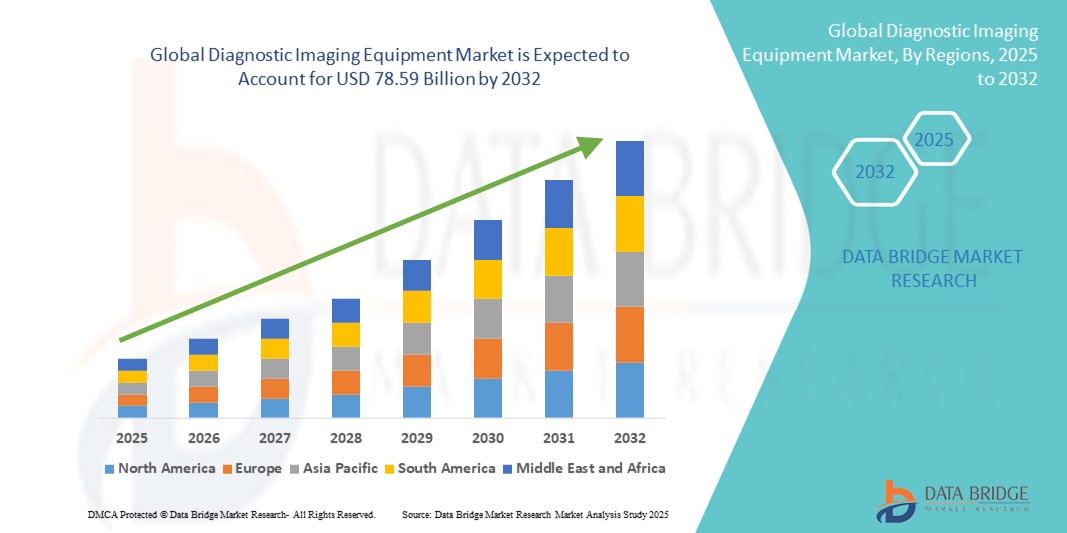
- The global diagnostic imaging equipment market size was valued at USD 53.60 billion in 2024 and is expected to reach USD 78.59 billion by 2032, at a CAGR of 4.90% during the forecast period
- The market growth is primarily driven by the increasing prevalence of chronic diseases, rising demand for early and accurate disease diagnosis, and rapid technological advancements in imaging modalities such as MRI, CT, and ultrasound systems
- In addition, the growing adoption of AI-enabled imaging solutions, coupled with expanding healthcare infrastructure in emerging economies, is propelling the deployment of advanced diagnostic imaging equipment across hospitals, diagnostic centers, and research facilities, thereby significantly boosting the industry’s growth
Diagnostic Imaging Equipment Market Analysis
- Diagnostic imaging equipment, including MRI, CT, X-ray, ultrasound, and nuclear imaging systems, is becoming increasingly essential in modern healthcare for accurate disease detection, monitoring, and treatment planning across hospitals, diagnostic centers, and research facilities
- The rising demand for advanced imaging solutions is primarily driven by the growing prevalence of chronic diseases, aging populations, technological innovations in imaging modalities, and the integration of AI and machine learning for enhanced diagnostic accuracy
- North America dominated the diagnostic imaging equipment market with the largest revenue share of 39% in 2024, attributed to advanced healthcare infrastructure, high adoption of cutting-edge imaging technologies, and a strong presence of major industry players, with the U.S. witnessing significant investments in AI-assisted imaging systems and portable imaging devices
- Asia-Pacific is expected to be the fastest-growing region in the diagnostic imaging equipment market during the forecast period due to expanding healthcare infrastructure, rising healthcare expenditure, and increasing demand for early diagnosis in emerging economies such as China and India
- MRI segment dominated the diagnostic imaging equipment market with a market share of 42.2% in 2024, driven by its superior imaging capabilities, growing applications in neurology and oncology, and ongoing technological advancements that improve scan speed and image resolution
Report Scope and Diagnostic Imaging Equipment Market Segmentation
|
Attributes |
Diagnostic Imaging Equipment Key Market Insights |
|
Segments Covered |
|
|
Countries Covered |
North America
Europe
Asia-Pacific
Middle East and Africa
South America
|
|
Key Market Players |
|
|
Market Opportunities |
|
|
Value Added Data Infosets |
In addition to the insights on market scenarios such as market value, growth rate, segmentation, geographical coverage, and major players, the market reports curated by the Data Bridge Market Research also include in-depth expert analysis, pricing analysis, brand share analysis, consumer survey, demography analysis, supply chain analysis, value chain analysis, raw material/consumables overview, vendor selection criteria, PESTLE Analysis, Porter Analysis, and regulatory framework. |
Diagnostic Imaging Equipment Market Trends
Integration of AI and Advanced Imaging Analytics
- A key and accelerating trend in the global diagnostic imaging equipment market is the integration of artificial intelligence (AI) and advanced imaging analytics into modalities such as MRI, CT, and ultrasound systems. This integration is significantly enhancing diagnostic accuracy, workflow efficiency, and personalized patient care
- For instance, Siemens Healthineers’ AI-Rad Companion assists radiologists by automating measurements and detecting anomalies across multiple imaging modalities, while GE Healthcare’s Edison AI platform enables predictive analytics and workflow optimization
- AI-enabled imaging solutions can analyze vast datasets to identify patterns, suggest diagnoses, and reduce human error, improving both speed and reliability. Certain Philips IntelliSpace AI applications can flag potential abnormalities in real-time and provide actionable insights to clinicians
- Integration with hospital information systems (HIS) and picture archiving and communication systems (PACS) allows centralized management of imaging data, facilitating seamless collaboration among radiologists, clinicians, and healthcare administrators
- This trend towards smarter, more connected imaging equipment is reshaping expectations for healthcare delivery. Companies such as Canon Medical Systems and Fujifilm are developing AI-powered imaging solutions with advanced diagnostic algorithms, automated image reconstruction, and workflow automation to improve patient outcomes
- The demand for AI-integrated diagnostic imaging solutions is growing rapidly across hospitals, diagnostic centers, and research institutions, as healthcare providers increasingly prioritize efficiency, accuracy, and data-driven decision-making
Diagnostic Imaging Equipment Market Dynamics
Driver
Increasing Demand Due to Rising Chronic Diseases and Early Diagnosis Needs
- The growing prevalence of chronic diseases, aging populations, and the rising emphasis on early diagnosis are key drivers of demand for advanced diagnostic imaging equipment
- For instance, in March 2024, Siemens Healthineers launched an AI-assisted CT scanner aimed at improving cardiac and oncology imaging, highlighting how technological innovations are driving market growth
- Diagnostic imaging systems provide non-invasive, precise, and timely detection of diseases, making them essential tools for hospitals and diagnostic centers, particularly in oncology, cardiology, and neurology
- Expansion of healthcare infrastructure in emerging economies and increasing investments in state-of-the-art imaging facilities are further propelling market adoption
- The integration of imaging equipment with digital health platforms, PACS, and electronic health records (EHRs) allows for streamlined workflows and better patient management, enhancing the appeal of these systems to healthcare providers
Restraint/Challenge
High Costs and Regulatory Compliance Hurdles
- The high capital cost of advanced diagnostic imaging equipment, coupled with maintenance and operational expenses, remains a significant barrier to adoption, especially in developing regions and smaller healthcare facilities
- In addition, stringent regulatory standards, including FDA, CE, and local approvals for medical devices, pose challenges for manufacturers in terms of compliance, testing, and timely product launch
- Cybersecurity concerns related to networked imaging systems and patient data protection are growing, necessitating robust encryption, secure authentication protocols, and regular software updates to maintain compliance with HIPAA and GDPR standards
- For instance, in June 2023, a U.S.-based hospital reported a temporary shutdown of its connected MRI and CT systems due to a ransomware attack, highlighting the risks and operational challenges associated with networked imaging equipment
- While some AI-enabled imaging solutions reduce operational costs through efficiency gains, the perceived high investment in new technologies can slow adoption, particularly where hospitals must balance budget constraints
- Overcoming these challenges through cost-effective product designs, scalable solutions, and robust regulatory compliance strategies will be critical for sustaining long-term market growth
Diagnostic Imaging Equipment Market Scope
The market is segmented on the basis of product type, application, portability, and end-users.
- By Product Type
On the basis of product type, the diagnostic imaging equipment market is segmented into X-Ray Imaging (Digital, Analog), MRI, Ultrasound, CT-Scan, and Nuclear Imaging. The MRI segment dominated the market with the largest revenue share of 42.2% in 2024, driven by its superior imaging resolution, non-invasive capabilities, and extensive applications in neurology, oncology, and musculoskeletal imaging. Hospitals and diagnostic centers prefer MRI systems due to their accuracy in detecting soft tissue abnormalities, early disease diagnosis, and minimal radiation exposure. Continuous technological advancements, such as faster scan times and AI-assisted image reconstruction, have further solidified MRI’s dominant position. In addition, the integration of MRI with PACS and AI platforms allows for streamlined workflows and enhanced diagnostic precision, making it the preferred choice for advanced healthcare facilities.
The ultrasound segment is expected to witness the fastest growth from 2025 to 2032, fueled by its portability, cost-effectiveness, and growing use in point-of-care diagnostics across cardiology, obstetrics, and emergency care. Advances in 3D/4D imaging, handheld devices, and AI-driven interpretation tools are expanding ultrasound applications, especially in emerging markets with limited access to high-cost imaging systems. The non-invasive nature, minimal training requirements, and immediate results contribute to its rising adoption in both hospitals and outpatient diagnostic centers.
- By Application
On the basis of application, the diagnostic imaging equipment market is segmented into oncology, cardiology, orthopaedics, and others. The oncology segment dominated in 2024, driven by the rising prevalence of cancer worldwide and the increasing emphasis on early diagnosis and treatment monitoring. Advanced imaging modalities, such as PET-CT and MRI, provide precise tumor localization, staging, and therapy assessment, making them indispensable in cancer care. Investments in oncology-specific imaging technologies by hospitals and diagnostic centers, along with government initiatives for cancer screening programs, further reinforce the segment’s dominance.
The cardiology segment is projected to witness the fastest growth during forecast period, propelled by the increasing incidence of cardiovascular diseases, rising geriatric population, and demand for non-invasive cardiac imaging solutions. Modalities such as CT angiography, echocardiography, and cardiac MRI enable early detection and management of cardiac abnormalities. Integration of AI in cardiac imaging aids in automated measurements, improved diagnostic accuracy, and predictive analytics, driving adoption in hospitals and specialized cardiac centers.
- By Portability
On the basis of portability, the diagnostic imaging equipment market is segmented into stationary X-ray imaging systems and portable X-ray imaging systems. The stationary X-ray imaging systems segment dominated in 2024 due to its high imaging throughput, superior resolution, and suitability for high-volume hospitals and diagnostic centers. These systems are preferred for routine radiographic examinations and specialized procedures requiring consistent image quality. The robustness and reliability of stationary systems make them standard equipment in modern medical facilities, ensuring continued demand.
The portable X-ray imaging systems segment is expected to witness the fastest growth during forecast period, driven by increasing use in emergency care, mobile clinics, and remote healthcare settings. Portable systems offer flexibility, rapid deployment, and cost-efficiency, enabling point-of-care diagnostics in settings with limited infrastructure. Technological advancements, including wireless connectivity, battery-powered operation, and compact designs, are further fueling adoption in both developed and emerging markets.
- By End-Users
On the basis of end-users, the diagnostic imaging equipment market is segmented into hospitals, diagnostic centers, and research centers. The hospitals segment dominated in 2024, owing to the large-scale adoption of advanced imaging equipment for multi-specialty care, high patient volumes, and integrated healthcare delivery. Hospitals invest heavily in MRI, CT, and advanced X-ray systems to provide comprehensive diagnostic services, enhance patient outcomes, and maintain a competitive edge.
The diagnostic centers segment is expected to witness the fastest growth during forecast period, driven by the increasing trend of outpatient diagnostic services, cost-effective imaging solutions, and rising demand for early disease detection. Diagnostic centers often adopt portable and mid-range imaging systems to cater to patients seeking quick, non-invasive, and affordable diagnostic services. Expansion of private diagnostic chains and government-supported diagnostic programs in emerging economies further supports the rapid growth of this segment.
Diagnostic Imaging Equipment Market Regional Analysis
- North America dominated the diagnostic imaging equipment market with the largest revenue share of 39% in 2024, attributed to advanced healthcare infrastructure, high adoption of cutting-edge imaging technologies, and a strong presence of major industry players
- Hospitals and diagnostic centers in the region prioritize early and accurate disease detection, investing heavily in MRI, CT, X-ray, and AI-enabled imaging systems to improve patient outcomes and streamline clinical workflows
- The widespread adoption is further supported by strong research and development capabilities, government initiatives promoting advanced diagnostics, and a technologically savvy population that values precision medicine
U.S. Diagnostic Imaging Equipment Market Insight
The U.S. diagnostic imaging equipment market captured the largest revenue share of 42% in 2024 within North America, driven by high adoption of advanced imaging modalities such as MRI, CT, ultrasound, and AI-assisted systems. Hospitals and diagnostic centers are increasingly investing in cutting-edge imaging technologies to ensure early and accurate disease detection. The growing emphasis on precision medicine, along with robust healthcare infrastructure and high healthcare expenditure, further supports market expansion. Moreover, integration of imaging systems with PACS, electronic health records, and AI analytics platforms is enhancing workflow efficiency and diagnostic accuracy. Rising patient awareness and demand for non-invasive diagnostic solutions are also contributing to the market’s growth.
Europe Diagnostic Imaging Equipment Market Insight
The Europe diagnostic imaging equipment market is projected to expand at a significant CAGR during the forecast period, driven by rising healthcare spending, government initiatives promoting early disease detection, and stringent regulatory standards for medical imaging. The increasing prevalence of chronic diseases and the growing adoption of advanced imaging systems across hospitals and diagnostic centers are fostering market growth. European healthcare providers are also focusing on reducing patient wait times and improving operational efficiency, which encourages the adoption of automated and AI-enabled imaging solutions. The region is witnessing growth across oncology, cardiology, and orthopaedics applications, with new hospital constructions and renovations integrating advanced imaging technologies.
U.K. Diagnostic Imaging Equipment Market Insight
The U.K. diagnostic imaging equipment market is anticipated to grow at a noteworthy CAGR during the forecast period, fueled by the country’s focus on modernizing healthcare facilities and increasing demand for early diagnosis. Government initiatives and NHS investment programs supporting imaging infrastructure upgrades are driving market adoption. In addition, rising awareness of chronic diseases and preventive healthcare among the population is boosting demand for advanced imaging modalities. The U.K.’s well-established hospital and private diagnostic network, combined with the adoption of AI-assisted and portable imaging systems, further supports growth in both clinical and outpatient settings.
Germany Diagnostic Imaging Equipment Market Insight
The Germany diagnostic imaging equipment market is expected to expand at a considerable CAGR during the forecast period, driven by technological advancements and high healthcare expenditure. Germany’s focus on research and development, combined with strong hospital infrastructure and specialized diagnostic centers, promotes the adoption of advanced imaging solutions such as PET-CT, MRI, and high-resolution ultrasound. Increasing emphasis on early disease detection, integrated care, and patient-centric services encourages healthcare providers to invest in efficient and AI-integrated imaging equipment. In addition, Germany’s regulatory framework and emphasis on data security and privacy enhance the deployment of connected imaging systems in both hospitals and outpatient facilities.
Asia-Pacific Diagnostic Imaging Equipment Market Insight
The Asia-Pacific diagnostic imaging equipment market is poised to grow at the fastest CAGR of 25% during the forecast period of 2025 to 2032, driven by rising healthcare expenditure, growing prevalence of chronic diseases, and rapid urbanization in countries such as China, India, and Japan. Increasing government initiatives for digital health adoption, expansion of healthcare infrastructure, and rising patient awareness are fueling the demand for diagnostic imaging equipment. Furthermore, as APAC becomes a manufacturing hub for imaging devices and components, affordability and accessibility of advanced imaging systems are improving, enabling wider adoption across hospitals, diagnostic centers, and research facilities.
Japan Diagnostic Imaging Equipment Market Insight
The Japan diagnostic imaging equipment market is gaining momentum due to the country’s high technological adoption, aging population, and increasing demand for preventive healthcare. Japanese hospitals and diagnostic centers are focusing on modernizing imaging infrastructure with AI-assisted MRI, CT, and ultrasound systems. Integration of imaging equipment with hospital IT networks, PACS, and IoT-enabled devices is enhancing operational efficiency and patient care. Moreover, growing awareness of chronic disease management and rapid urbanization are contributing to the adoption of advanced imaging modalities in both residential and commercial healthcare settings.
India Diagnostic Imaging Equipment Market Insight
The India diagnostic imaging equipment market accounted for the largest market revenue share in Asia-Pacific in 2024, attributed to the country’s expanding healthcare infrastructure, rising middle-class population, and high rates of technological adoption. Hospitals, diagnostic centers, and specialty clinics are increasingly adopting cost-effective yet advanced imaging systems such as portable X-ray, ultrasound, and AI-assisted MRI/CT scanners. Government initiatives promoting digital health, the rise of smart hospitals, and growing awareness of early diagnosis are key factors propelling market growth. In addition, domestic manufacturing and availability of affordable solutions are enabling wider access to diagnostic imaging technologies across urban and semi-urban regions.
Diagnostic Imaging Equipment Market Share
The diagnostic imaging equipment industry is primarily led by well-established companies, including:
- GE HealthCare (U.S.)
- Siemens Healthineers AG (Germany)
- Koninklijke Philips N.V. (Netherlands)
- Canon Medical Systems (Japan)
- Fujifilm Holdings Corporation (Japan)
- Hitachi Medical Corporation (Japan)
- Samsung Medison Co., Ltd. (South Korea)
- Hologic, Inc. (U.S.)
- Carestream Health (U.S.)
- Shenzhen Mindray Bio-Medical Electronics Co., Ltd. (China)
- Esaote SPA (Italy)
- Neusoft Medical Systems (China)
- Shimadzu Corporation (Japan)
- Konica Minolta, Inc. (Japan)
- Agfa-Gevaert Group (Belgium)
- Ziehm Imaging GmbH (Germany)
- PLANMED OY (Finland)
- Elekta (Sweden)
- Varian (U.S.)
- Medtronic (Ireland)
What are the Recent Developments in Global Diagnostic Imaging Equipment Market?
- In June 2025, Philips launched the Flash 5100, a portable point-of-care ultrasound system designed to facilitate rapid and confident assessment in emergency radiology and critical care settings. The system combines intuitive touchscreen controls with enhanced image clarity, addressing the growing need for flexible and efficient imaging solutions
- In May 2025, GE HealthCare introduced the Signa Sprint, an ultra-premium wide-bore 1.5T MRI system designed to deliver high-performance imaging capabilities. This system aims to provide enhanced clarity in clinical and research applications, particularly in cardiology and oncology
- In May 2025, GE HealthCare introduced CleaRecon DL, an artificial intelligence (AI)-driven solution designed to eliminate streak artifacts caused by the pulsatile nature of blood flow in the arteries. This advancement enhances the clarity and accuracy of 3D imaging, particularly in cardiac diagnostics, enabling more precise assessments and improved patient outcomes
- In March 2025, Canon Medical Systems received regulatory clearance for major AI enhancements to the Aquilion ONE / INSIGHT Edition CT scanner, including the new PIQE 1024 matrix and SilverBeam technology. These advancements expand the scanner's capabilities across a broader range of clinical applications, enhancing image quality and diagnostic precision.
- In January 2025, Siemens Healthineers launched the SOMATOM Pro.Pulse, a cutting-edge dual-source CT scanner equipped with AI-assisted myExam Companion. This technology enhances the scanning experience by accommodating patients with high or irregular heart rates and limited breath-hold capabilities, improving diagnostic accuracy and patient comfort
SKU-
Get online access to the report on the World's First Market Intelligence Cloud
- Interactive Data Analysis Dashboard
- Company Analysis Dashboard for high growth potential opportunities
- Research Analyst Access for customization & queries
- Competitor Analysis with Interactive dashboard
- Latest News, Updates & Trend analysis
- Harness the Power of Benchmark Analysis for Comprehensive Competitor Tracking
Research Methodology
Data collection and base year analysis are done using data collection modules with large sample sizes. The stage includes obtaining market information or related data through various sources and strategies. It includes examining and planning all the data acquired from the past in advance. It likewise envelops the examination of information inconsistencies seen across different information sources. The market data is analysed and estimated using market statistical and coherent models. Also, market share analysis and key trend analysis are the major success factors in the market report. To know more, please request an analyst call or drop down your inquiry.
The key research methodology used by DBMR research team is data triangulation which involves data mining, analysis of the impact of data variables on the market and primary (industry expert) validation. Data models include Vendor Positioning Grid, Market Time Line Analysis, Market Overview and Guide, Company Positioning Grid, Patent Analysis, Pricing Analysis, Company Market Share Analysis, Standards of Measurement, Global versus Regional and Vendor Share Analysis. To know more about the research methodology, drop in an inquiry to speak to our industry experts.
Customization Available
Data Bridge Market Research is a leader in advanced formative research. We take pride in servicing our existing and new customers with data and analysis that match and suits their goal. The report can be customized to include price trend analysis of target brands understanding the market for additional countries (ask for the list of countries), clinical trial results data, literature review, refurbished market and product base analysis. Market analysis of target competitors can be analyzed from technology-based analysis to market portfolio strategies. We can add as many competitors that you require data about in the format and data style you are looking for. Our team of analysts can also provide you data in crude raw excel files pivot tables (Fact book) or can assist you in creating presentations from the data sets available in the report.