Global Cancer Immunotherapy Market
Market Size in USD Billion
CAGR :
% 
 USD
95.69 Billion
USD
28.27 Billion
2024
2032
USD
95.69 Billion
USD
28.27 Billion
2024
2032
 Forecast Period Forecast Period |
2025 –2032 |
 Market Size (Base Year) Market Size (Base Year) |
USD 95.69 Billion |
 Market Size (Forecast Year) Market Size (Forecast Year) |
USD 28.27 Billion |
 CAGR CAGR |
% |
| Major Markets Players |
|
Cancer Immunotherapy Market Size
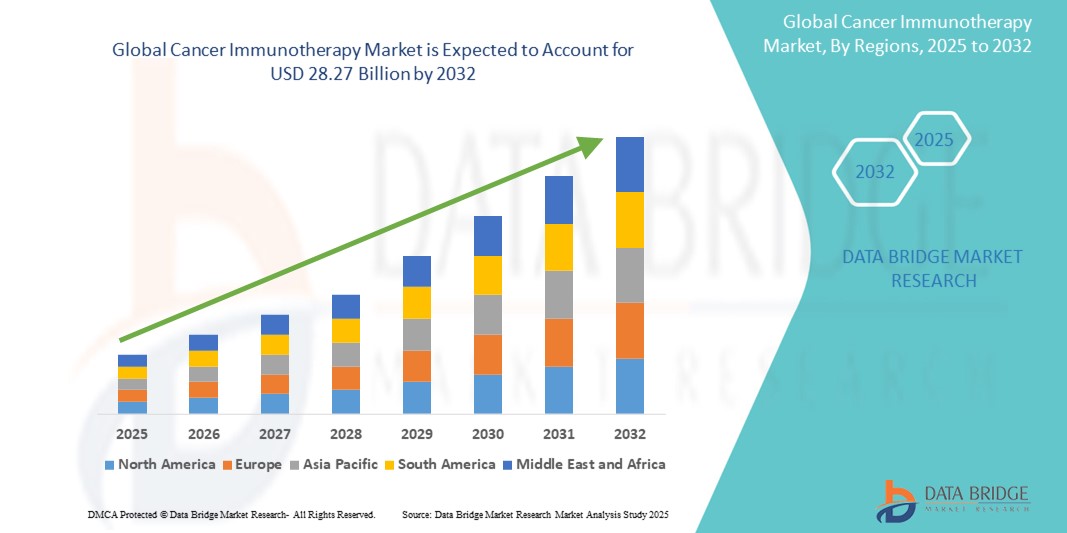
- The global cancer immunotherapy market size was valued at USD 95.69 billion in 2024 and is expected to reach USD 28.27 billion by 2032, at a CAGR of 15.50% during the forecast period
- This growth is driven by factors such as the increasing prevalence of cancer worldwide, advancements in immunotherapy technologies, rising investments in oncology research, favorable government initiatives and approvals, and growing awareness among patients and healthcare providers about immunotherapy treatment options
Cancer Immunotherapy Market Analysis
- The market is largely shaped by advancements in immunotherapy technologies, with treatments such as monoclonal antibodies and checkpoint inhibitors gaining wider adoption due to their improved effectiveness in targeting cancer cells
- Ongoing innovation in therapy development and personalized treatment approaches are helping to expand the application of immunotherapy across various cancer types, influencing market growth steadily
- North America is expected to dominate the cancer immunotherapy market with share of 43.93% due to the presence of advanced healthcare infrastructure high adoption of innovative treatments and strong investments in cancer research and development
- Asia-Pacific is expected to be the fastest growing region in the cancer immunotherapy market during the forecast period due to due to rising cancer prevalence increasing healthcare expenditure improving access to advanced therapies and growing investments in biotechnology and clinical research across emerging economies
- The monoclonal antibodies segment is expected to dominate the cancer immunotherapy market with the largest share of 65.02% in 2025 due to their proven effectiveness in targeting specific cancer cells minimal impact on healthy tissues and wide application across multiple cancer types
Report Scope and Cancer Immunotherapy Market Segmentation
|
Attributes |
Cancer Immunotherapy Key Market Insights |
|
Segments Covered |
|
|
Countries Covered |
North America
Europe
Asia-Pacific
Middle East and Africa
South America
|
|
Key Market Players |
|
|
Market Opportunities |
|
|
Value Added Data Infosets |
In addition to the insights on market scenarios such as market value, growth rate, segmentation, geographical coverage, and major players, the market reports curated by the Data Bridge Market Research also include in-depth expert analysis, patient epidemiology, pipeline analysis, pricing analysis, and regulatory framework. |
Cancer Immunotherapy Market Trends
“Rise of Personalized Approaches in Cancer Immunotherapy”
- Personalized cancer immunotherapy is gaining momentum as a central trend in oncology treatment
- This approach tailors therapies based on individual genetic profiles and tumor characteristics
- Personalized treatments aim to enhance efficacy while minimizing side effects
- For instance, personalized mRNA vaccines are showing promising results in clinical trials
- In conclusion, personalized immunotherapy represents a transformative shift towards more precise and effective cancer treatments
Cancer Immunotherapy Market Dynamics
Driver
“Growing Preference for Immunotherapy Over Traditional Treatments”
- One of the key drivers in the cancer immunotherapy market is the growing shift from chemotherapy and radiation to immunotherapy due to its targeted action and reduced side effects
- Immunotherapy stimulates the immune system to attack cancer cells specifically which reduces collateral damage to healthy tissues unsuch as traditional methods
- For instance, immune checkpoint inhibitors such as pembrolizumab by Merck and nivolumab by Bristol-Myers Squibb have shown significant success in treating melanoma and non-small cell lung cancer
- Physicians are increasingly integrating immunotherapy into cancer care protocols as real-world data supports improved survival outcomes and patient quality of life
- In conclusion the rising adoption of immunotherapy over traditional treatments highlights a fundamental shift in oncology care and reinforces its role as a key market growth driver
Opportunity
“Expansion of Combination Therapy Strategies”
- Combination therapy in cancer immunotherapy is gaining attention for its ability to improve treatment outcomes by integrating it with chemotherapy targeted therapy or radiation
- This approach enhances response durability and helps bypass cancer resistance mechanisms that often limit the effectiveness of single-agent therapies
- For instance, bristol-Myers Squibb's combination of nivolumab and ipilimumab has shown superior survival rates in advanced melanoma compared to monotherapy
- Ongoing trials such as those involving Merck's pembrolizumab in combination with lenvatinib are exploring improved results across various cancer types including endometrial and renal cancers
- In conclusion the growing focus on combination strategies is opening valuable opportunities for more effective therapies and collaborative innovation in cancer treatment development
Restraint/Challenge
“High Cost and Limited Access to Immunotherapy”
- The high cost of cancer immunotherapy particularly monoclonal antibodies and cell-based therapies limits accessibility especially in low and middle income countries
- Treatments such as CAR T-cell therapy can exceed USD 400000 per patient due to complex production and regulatory demands
- For instance, Kymriah by Novartis and Yescarta by Gilead are priced beyond the reach of many healthcare systems without strong insurance or government support
- Even in developed nations the infrastructure requirements and need for skilled personnel add to the delivery cost of these advanced therapies
- In conclusion the financial and logistical burden of immunotherapy remains a major challenge to its widespread adoption and equitable access
Cancer Immunotherapy Market Scope
The market is segmented on the basis of product type, application, end user, form, and distribution channel
|
Segmentation |
Sub-Segmentation |
|
By Product Type |
|
|
By Application |
|
|
By End User |
|
|
By Form
|
|
|
By Distribution Channel
|
|
In 2025, the monoclonal Antibodies segment is projected to dominate the market with a largest share in product type segment
The monoclonal antibodies segment is expected to dominate the cancer immunotherapy market with the largest share of 65.02% in 2025 due to their proven effectiveness in targeting specific cancer cells minimal impact on healthy tissues and wide application across multiple cancer types.
The hospital segment is expected to account for the largest share during the forecast period in end user segment
In 2025, the hospital segment is expected to dominate the market with the largest market share of 68.07% due to the increasing number of cancer admissions availability of advanced immunotherapy procedures and presence of skilled healthcare professionals and infrastructure for administering complex treatments.
Cancer Immunotherapy Market Regional Analysis
“North America Holds the Largest Share in the Cancer Immunotherapy Market”
- North America holds the largest share in the global cancer immunotherapy market with share of 43.93% due to the presence of advanced healthcare infrastructure high adoption of innovative treatments and strong investments in cancer research and development
- The region's dominance is attributed to advanced healthcare infrastructure and significant investments in research and development
- High prevalence of cancer and early adoption of innovative therapies contribute to market leadership
- Presence of major pharmaceutical companies and favorable reimbursement policies support market growth
- Continuous advancements in biotechnology and strong clinical trial activities further reinforce the region's leading position
“Asia-Pacific is Projected to Register the Highest CAGR in the Cancer Immunotherapy Market”
- Asia-Pacific is projected to experience the highest growth rate in the cancer immunotherapy market due to rising cancer prevalence increasing healthcare expenditure improving access to advanced therapies and growing investments in biotechnology and clinical research across emerging economies
- Factors such as increasing cancer incidence and rising healthcare expenditures drive market expansion
- Growing awareness of immunotherapy and improving healthcare infrastructure contribute to rapid adoption
- Government initiatives and collaborations with international organizations enhance access to advanced treatments
- Emerging economies within the region are investing in research and development to support market growth
Cancer Immunotherapy Market Share
The market competitive landscape provides details by competitor. Details included are company overview, company financials, revenue generated, market potential, investment in research and development, new market initiatives, global presence, production sites and facilities, production capacities, company strengths and weaknesses, product launch, product width and breadth, application dominance. The above data points provided are only related to the companies' focus related to market.
The Major Market Leaders Operating in the Market Are:
- Merck & Co., Inc. (U.S.)
- F. Hoffmann-La Roche Ltd (Switzerland)
- Bristol-Myers Squibb Company (U.S.)
- Janssen Pharmaceutical (U.S.)
- AstraZeneca (U.K.)
- Gilead Sciences, Inc. (U.S.)
- Lilly (U.S.)
- Amgen Inc. (U.S.)
- Novartis AG (Switzerland)
- GSK plc. (U.K.)
- Pfizer Inc. (U.S.)
- Incyte (U.S.)
- Celldex Therapeutics (U.S.)
- Atara Biotherapeutics, Inc. (U.S.)
- Cellectis (France)
- AbbVie Inc. (U.S.)
- Bayer AG (Germany)
- BioNTech SE (Germany)
- Moderna, Inc. (U.S.)
- Adaptimmune Therapeutics plc (U.K.)
- Iovance Biotherapeutics, Inc. (U.S.)
- Surface Oncology, Inc. (U.S.)
Latest Developments in Global Cancer Immunotherapy Market
- In November 2024, Dr. Reddy’s Laboratories launched India’s first immuno-oncology drug designed to treat a rare form of head and neck cancer This launch marks a significant advancement in cancer treatment options available in India and highlights the company’s commitment to innovative therapies aimed at improving patient outcomes
- In December 2023, Kadcyla by F. Hoffmann-La Roche Ltd marked a ground-breaking achievement of introducing the first targeted therapy to demonstrate a substantial overall survival benefit for individuals with HER2-positive early-stage breast cancer with residual invasive disease following neo - adjuvant treatment
- In December 2023, F. Hoffmann-La Roche Ltd reported favorable Phase III outcomes for the inavolisib combination in individuals with advanced hormone receptor-positive, HER2-negative breast cancer and a PIK3CA mutation. This contributed to Roche's recognition as one of the most sustainable pharmaceutical companies
- In February 2023, AstraZeneca received approval in the European Union (EU) for the tablet formulation of Calquence (acalabrutinib) in the treatment of Chronic Lymphocytic Leukaemia (CLL) in adult patients. This helped the company enhance its market presence and contribute to its revenue growth
- In October 2022, AstraZeneca's combination of Imjudo (tremelimumab) and Imfinzi (durvalumab) has gained US approval for treating unresectable hepatocellular carcinoma (HCC), the most prevalent type of liver cancer in adults. This approval may lead to increased market share, improved revenue streams, and further established AstraZeneca as a key player in the field of cancer therapeutics
- In May 2022, Bristol-Myers Squibb Company announced the approval of Opdivo plus Yervoy as a first line treatment for adult patients by Japan's Ministry of Health, Labour and Welfare. This helped the company strengthen its product portfolio
SKU-
Get online access to the report on the World's First Market Intelligence Cloud
- Interactive Data Analysis Dashboard
- Company Analysis Dashboard for high growth potential opportunities
- Research Analyst Access for customization & queries
- Competitor Analysis with Interactive dashboard
- Latest News, Updates & Trend analysis
- Harness the Power of Benchmark Analysis for Comprehensive Competitor Tracking
Research Methodology
Data collection and base year analysis are done using data collection modules with large sample sizes. The stage includes obtaining market information or related data through various sources and strategies. It includes examining and planning all the data acquired from the past in advance. It likewise envelops the examination of information inconsistencies seen across different information sources. The market data is analysed and estimated using market statistical and coherent models. Also, market share analysis and key trend analysis are the major success factors in the market report. To know more, please request an analyst call or drop down your inquiry.
The key research methodology used by DBMR research team is data triangulation which involves data mining, analysis of the impact of data variables on the market and primary (industry expert) validation. Data models include Vendor Positioning Grid, Market Time Line Analysis, Market Overview and Guide, Company Positioning Grid, Patent Analysis, Pricing Analysis, Company Market Share Analysis, Standards of Measurement, Global versus Regional and Vendor Share Analysis. To know more about the research methodology, drop in an inquiry to speak to our industry experts.
Customization Available
Data Bridge Market Research is a leader in advanced formative research. We take pride in servicing our existing and new customers with data and analysis that match and suits their goal. The report can be customized to include price trend analysis of target brands understanding the market for additional countries (ask for the list of countries), clinical trial results data, literature review, refurbished market and product base analysis. Market analysis of target competitors can be analyzed from technology-based analysis to market portfolio strategies. We can add as many competitors that you require data about in the format and data style you are looking for. Our team of analysts can also provide you data in crude raw excel files pivot tables (Fact book) or can assist you in creating presentations from the data sets available in the report.