Global Broadcast Equipment Market
Market Size in USD Billion
CAGR :
% 
 USD
8.90 Billion
USD
12.82 Billion
2024
2032
USD
8.90 Billion
USD
12.82 Billion
2024
2032
 Forecast Period Forecast Period |
2025 –2032 |
 Market Size (Base Year) Market Size (Base Year) |
USD 8.90 Billion |
 Market Size (Forecast Year) Market Size (Forecast Year) |
USD 12.82 Billion |
 CAGR CAGR |
% |
| Major Markets Players |
|
Broadcast Equipment Market Size
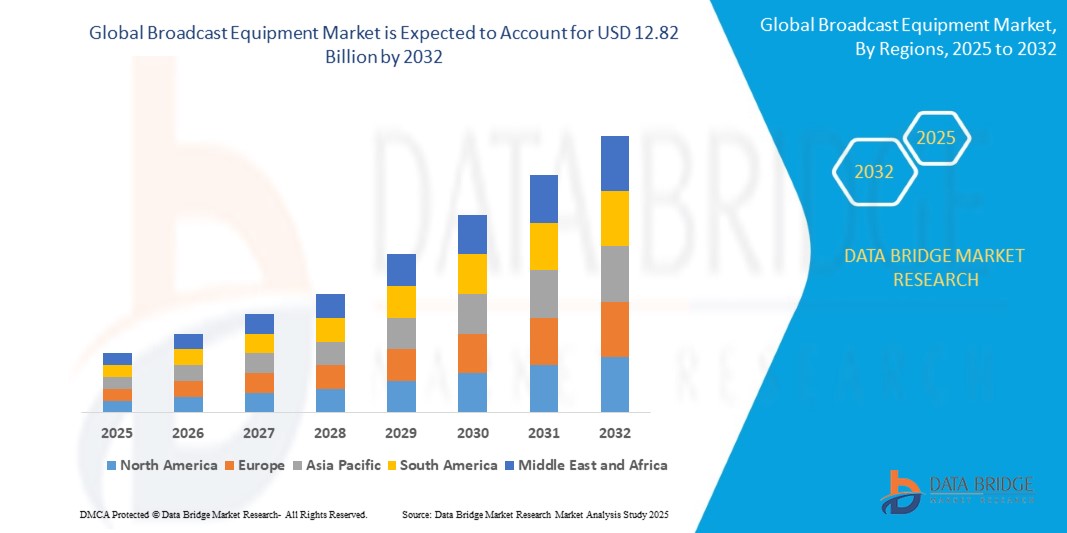
- The global broadcast equipment market size was valued at USD 7.92 billion in 2024 and is expected to reach USD 12.82 billion by 2032, at a CAGR of 6.20% during the forecast period
- This growth is driven by factors such as the rising demand for ultra-HD content, increased adoption of IP-based broadcasting, and the rapid expansion of OTT platforms and digital broadcasting globally
Broadcast Equipment Market Analysis
- Broadcast equipment includes devices used for radio and television production and transmission, such as encoders, transmitters, cameras, and modulators. These are essential for content creation, signal processing, and distribution across various platforms
- The market growth is significantly driven by the rising consumption of high-definition and Ultra HD content, increasing demand for OTT streaming, and transition from analog to digital broadcasting
- North America is expected to dominate the broadcast equipment market with a market share of 38.5%, due to presence of major media and broadcasting companies, advanced technological infrastructure, and early adoption of digital and IP-based broadcasting systems
- Asia-Pacific is expected to be the fastest growing region in the broadcast equipment market with a market share of 34.5%, during the forecast period due to rapid digital transformation, expanding internet penetration, and rising demand for high-quality content across emerging economies
- Digital broadcast segment is expected to dominate the market with a market share of 70.5% due to its superior transmission quality, spectrum efficiency, and ability to support HD and 4K content. It enables seamless integration with IP-based and OTT platforms, aligning with the industry's shift toward digital transformation
Report Scope and Broadcast Equipment Market Segmentation
|
Attributes |
Broadcast Equipment Key Market Insights |
|
Segments Covered |
|
|
Countries Covered |
North America
Europe
Asia-Pacific
Middle East and Africa
South America
|
|
Key Market Players |
|
|
Market Opportunities |
|
|
Value Added Data Infosets |
In addition to the insights on market scenarios such as market value, growth rate, segmentation, geographical coverage, and major players, the market reports curated by the Data Bridge Market Research also include import export analysis, production capacity overview, production consumption analysis, price trend analysis, climate change scenario, supply chain analysis, value chain analysis, raw material/consumables overview, vendor selection criteria, PESTLE Analysis, Porter Analysis, and regulatory framework. |
Broadcast Equipment Market Trends
“Shift Toward IP-Based Broadcasting and Cloud-Enabled Workflows”
- One prominent trend shaping the broadcast equipment market is the growing adoption of IP-based broadcasting and cloud-enabled workflows, replacing traditional SDI-based systems
- This shift enhances operational flexibility, scalability, and cost-efficiency, allowing broadcasters to streamline content production and distribution across multiple platforms
- For instance, broadcasters are increasingly leveraging cloud platforms for remote production, live streaming, and content storage, enabling real-time collaboration and faster content delivery
- These advancements are revolutionizing broadcast infrastructure, supporting the demand for hybrid and remote production setups, and fueling the adoption of advanced, software-defined broadcast equipment
Broadcast Equipment Market Dynamics
Driver
“Rising Demand for High-Quality Content and OTT Expansion”
- The surge in consumer demand for high-definition (HD), 4K, and Ultra HD content is a major driver accelerating the growth of the global broadcast equipment market
- This demand is further fueled by the rapid expansion of over-the-top (OTT) platforms, which require advanced broadcasting infrastructure to deliver seamless, high-quality streaming experiences across multiple devices
- Broadcast service providers are increasingly investing in next-generation equipment to enhance production quality, reduce latency, and support multi-platform content delivery
For instance,
- According to the Motion Picture Association’s 2023 report, global OTT streaming subscriptions exceeded 1.8 billion, highlighting a sharp rise in digital content consumption and the need for robust broadcast equipment to support growing data and performance demands
- Consequently, the widespread consumer preference for on-demand, high-resolution content continues to drive significant investments in modern broadcast technologies and equipment
Opportunity
“Integration of AI and Automation in Broadcasting Workflows”
- The integration of artificial intelligence and automation in broadcast equipment presents a significant opportunity for enhancing content production, management, and distribution efficiency
- AI can be used for real-time content indexing, speech-to-text transcription, automated video editing, and targeted content recommendation, streamlining operations and reducing manual labor
- In addition, broadcasters can leverage AI-driven analytics to understand viewer preferences, personalize content delivery, and optimize advertising strategies for greater audience engagement
For instance,
- In February 2024, according to a report by Deloitte, AI-powered tools are increasingly being used by media houses for automated metadata tagging and quality control, significantly reducing post-production time and improving operational efficiency in live and recorded broadcasts
- The use of AI in broadcast equipment also supports remote and cloud-based production, enabling broadcasters to deliver high-quality, real-time content at reduced costs, thereby opening new avenues for growth and innovation in the industry
Restraint/Challenge
“High Capital Investment and Infrastructure Cost”
- The high cost associated with acquiring and maintaining advanced broadcast equipment poses a major challenge to market growth, especially for small- and medium-sized broadcasters and production houses
- Equipment such as 4K/8K cameras, transmitters, encoders, and IP-based infrastructure can involve substantial upfront investments and require continuous upgrades to remain compatible with evolving technologies
- This financial burden often limits the ability of smaller market players to adopt next-generation systems, restricting market penetration in cost-sensitive regions
For instance,
- In October 2024, according to a report by TV Tech, transitioning to IP-based workflows and 4K broadcasting can cost broadcasters millions of dollars in infrastructure upgrades and workforce training, creating a barrier to widespread adoption among smaller players
- Consequently, the high capital expenditure and associated operational costs can slow down the adoption of modern broadcast technologies, particularly in developing regions and among budget-constrained entities, thereby restraining overall market growth
Broadcast Equipment Market Scope
The market is segmented on the basis of frequency, technology, power range, content type, product type, and application
|
Segmentation |
Sub-Segmentation |
|
By Frequency |
|
|
By Technology |
|
|
By Power Range |
|
|
By Content Type |
|
|
By Product Type |
|
|
By Application |
|
In 2025, the digital broadcast is projected to dominate the market with a largest share in technology segment
The digital broadcast segment is expected to dominate the broadcast equipment market with the largest share of 70.5% in 2025 due to its superior transmission quality, spectrum efficiency, and ability to support HD and 4K content. It enables seamless integration with IP-based and OTT platforms, aligning with the industry's shift toward digital transformation. In addition, regulatory mandates for digital switchover in many countries are accelerating its adoption globally.
The dish antennas is expected to account for the largest share during the forecast period in product type market
In 2025, the dish antennas segment is expected to dominate the market with the largest market share of 25.9% due to its widespread use in satellite broadcasting, especially in remote and underserved regions. Dish antennas offer reliable signal reception over long distances and are essential for both direct-to-home (DTH) and commercial broadcast applications. Their cost-effectiveness and ability to support high-quality, uninterrupted transmission further drive their demand.
Broadcast Equipment Market Regional Analysis
“North America Holds the Largest Share in the Broadcast Equipment Market”
- North America dominates the broadcast equipment market with a market share of estimated 38.5%, driven, by presence of major media and broadcasting companies, advanced technological infrastructure, and early adoption of digital and IP-based broadcasting systems
- U.S. holds a market share of 60.5%, due to its robust demand for 4K and UHD content, widespread OTT consumption, and strong investments in next-generation broadcasting technologies
- The region benefits from strong R&D capabilities, significant government support for digital innovation, and a high concentration of broadcast infrastructure providers
- In addition, the increasing popularity of sports and live events, coupled with advanced content delivery systems, continues to fuel demand for modern broadcast solutions across North America
“Asia-Pacific is Projected to Register the Highest CAGR in the Broadcast Equipment Market”
- Asia-Pacific is expected to witness the highest growth rate in the broadcast equipment market with a market share of 34.5%, driven by rapid digital transformation, expanding internet penetration, and rising demand for high-quality content across emerging economies
- Countries such as China, India, South Korea, and Japan are driving market expansion due to large-scale investments in broadcasting infrastructure and the growth of OTT platforms catering to vast, content-hungry audiences
- Japan remains a mature and technologically advanced market, with broadcasters adopting 8K production and transmission technologies ahead of global peers, particularly for major events and sports coverage
- India is projected to exhibit the fastest CAGR of 12.4%, supported by increasing smartphone usage, government initiatives for digital broadcasting, and growing adoption of cloud-based and IP-enabled production workflows
Broadcast Equipment Market Share
The market competitive landscape provides details by competitor. Details included are company overview, company financials, revenue generated, market potential, investment in research and development, new market initiatives, global presence, production sites and facilities, production capacities, company strengths and weaknesses, product launch, product width and breadth, application dominance. The above data points provided are only related to the companies' focus related to market.
The Major Market Leaders Operating in the Market Are:
- Harmonic, Inc. (U.S.)
- CommScope (U.S.)
- Grass Valley (Canada)
- Global Invacom (U.K.)
- Telefonaktiebolaget LM Ericsson (Sweden)
- Evertz (Canada)
- General Dynamics Mission Systems, Inc. (U.S.)
- Sencore (U.S.)
- AvL Technologies (U.S.)
- EVS Broadcast Equipment (Belgium)
- Belden Inc. (U.S.)
- Elma Electronic (Switzerland)
- Broadcast Electronics (U.S.)
- OMB (Spain)
- Wellav Technologies Ltd. (China)
- ACORDE Technologies S.A. (Spain)
- Eletec (France)
- ETL Systems Ltd (U.K.)
- Clyde Broadcast Technology Ltd (U.K.)
Latest Developments in Global Broadcast Equipment Market
- In April 2025, FEMA lifted a 65-day hold on USD 38 million in grant reimbursements to the Corporation for Public Broadcasting (CPB). This funding supports public media stations in upgrading their infrastructure, including transitions to advanced technologies such as ATSC 3.0 and digital alert capabilities, enhancing public alert systems across the U.S.
- In the 2025 NAB Show in Las Vegas, broadcasters and technology companies highlighted advancements in NextGen TV (ATSC 3.0). With availability in 76% of U.S. households, features such as High Dynamic Range (HDR) video and immersive Dolby Atmos audio were demonstrated. Companies such as Gray Media showcased enhancements including HDR10+ and Dolby Vision for live events, reflecting the industry's momentum in transforming viewing experiences through advanced broadcasting technologies
- In April 2024, Haivision Systems, a leading provider of real-time video networking and visual collaboration solutions, announced a successful integration of its advanced video encoders, decoders, and mobile video transmitters with Sony Corporation’s Creators’ Cloud for Enterprise. This collaboration highlights the effectiveness of Haivision's technology in conjunction with Sony's cloud production platform
- In February 2024, Sony unveiled the PDT-FP1, a dedicated portable data transmitter designed for high-speed, low-latency video and still image data transport over 5G networks. This innovative wireless communication device, when attached to a camera, facilitates rapid transmission from image capture to delivery, making it ideal for applications such as news reporting, event photography, and broadcast video production
- In January 2021, Electec announced the DDS digital broadcast FM transmitters and DDS radio digital FM modulator, available at 88-108 MHz frequency modulation 30 to 600 watts and 1.2 kilowatts for commercial and community radio stations
SKU-
Get online access to the report on the World's First Market Intelligence Cloud
- Interactive Data Analysis Dashboard
- Company Analysis Dashboard for high growth potential opportunities
- Research Analyst Access for customization & queries
- Competitor Analysis with Interactive dashboard
- Latest News, Updates & Trend analysis
- Harness the Power of Benchmark Analysis for Comprehensive Competitor Tracking
Global Broadcast Equipment Market, Supply Chain Analysis and Ecosystem Framework
To support market growth and help clients navigate the impact of geopolitical shifts, DBMR has integrated in-depth supply chain analysis into its Global Broadcast Equipment Market research reports. This addition empowers clients to respond effectively to global changes affecting their industries. The supply chain analysis section includes detailed insights such as Global Broadcast Equipment Market consumption and production by country, price trend analysis, the impact of tariffs and geopolitical developments, and import and export trends by country and HSN code. It also highlights major suppliers with data on production capacity and company profiles, as well as key importers and exporters. In addition to research, DBMR offers specialized supply chain consulting services backed by over a decade of experience, providing solutions like supplier discovery, supplier risk assessment, price trend analysis, impact evaluation of inflation and trade route changes, and comprehensive market trend analysis.
Research Methodology
Data collection and base year analysis are done using data collection modules with large sample sizes. The stage includes obtaining market information or related data through various sources and strategies. It includes examining and planning all the data acquired from the past in advance. It likewise envelops the examination of information inconsistencies seen across different information sources. The market data is analysed and estimated using market statistical and coherent models. Also, market share analysis and key trend analysis are the major success factors in the market report. To know more, please request an analyst call or drop down your inquiry.
The key research methodology used by DBMR research team is data triangulation which involves data mining, analysis of the impact of data variables on the market and primary (industry expert) validation. Data models include Vendor Positioning Grid, Market Time Line Analysis, Market Overview and Guide, Company Positioning Grid, Patent Analysis, Pricing Analysis, Company Market Share Analysis, Standards of Measurement, Global versus Regional and Vendor Share Analysis. To know more about the research methodology, drop in an inquiry to speak to our industry experts.
Customization Available
Data Bridge Market Research is a leader in advanced formative research. We take pride in servicing our existing and new customers with data and analysis that match and suits their goal. The report can be customized to include price trend analysis of target brands understanding the market for additional countries (ask for the list of countries), clinical trial results data, literature review, refurbished market and product base analysis. Market analysis of target competitors can be analyzed from technology-based analysis to market portfolio strategies. We can add as many competitors that you require data about in the format and data style you are looking for. Our team of analysts can also provide you data in crude raw excel files pivot tables (Fact book) or can assist you in creating presentations from the data sets available in the report.