Global Beauty Devices Market
Market Size in USD Billion
CAGR :
% 
 USD
2.49 Billion
USD
3.18 Billion
2024
2032
USD
2.49 Billion
USD
3.18 Billion
2024
2032
 Forecast Period Forecast Period |
2025 –2032 |
 Market Size (Base Year) Market Size (Base Year) |
USD 2.49 Billion |
 Market Size (Forecast Year) Market Size (Forecast Year) |
USD 3.18 Billion |
 CAGR CAGR |
% |
| Major Markets Players |
|
Beauty Devices Market Size
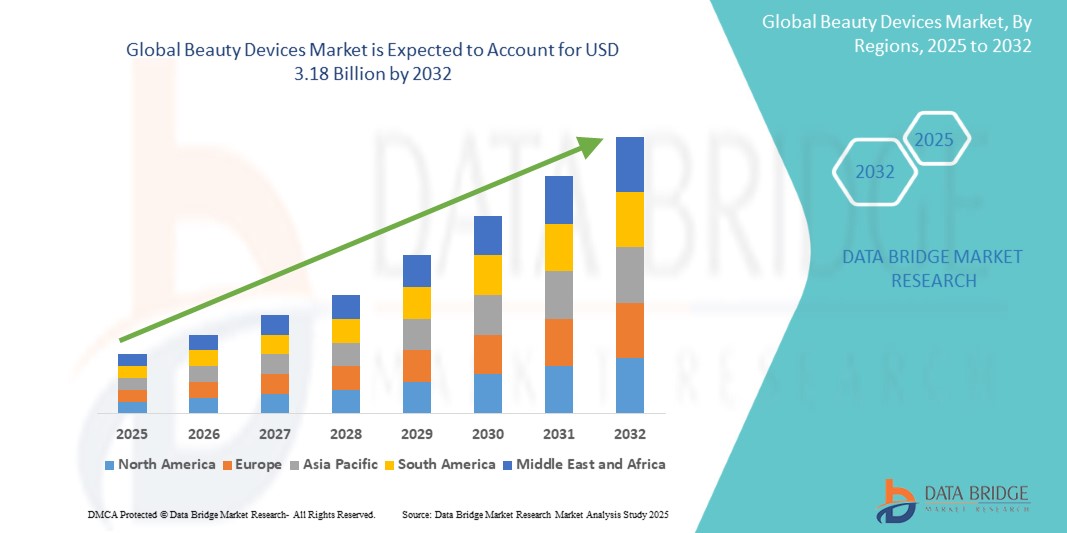
- The global beauty devices market was valued at USD 2.49 billion in 2024 and is expected to reach USD 3.18 billion by 2032
- During the forecast period of 2025 to 2032 the market is likely to grow at a CAGR of 3.10%, primarily driven by rising prevalence of skin disorders
- This growth is driven by increasing consumer demand for at-home beauty treatments and advancements in non-invasive aesthetic procedures
Beauty Devices Market Analysis
- Beauty Devices have gained widespread popularity due to increasing consumer focus on personal grooming, rising demand for anti-aging solutions, and growing awareness of at-home skincare treatments. Their effectiveness in skin rejuvenation, hair removal, and acne treatment has strengthened their presence in the beauty and wellness industry
- The market is primarily driven by technological advancements, expanding applications in dermatology clinics and home-use devices, and increasing investments in R&D for innovative beauty technologies. In addition, supportive regulatory approvals and the rising influence of social media beauty trends are further fueling market expansion
- For instance, in the U.S. and Europe, the demand for high-tech beauty devices has surged due to increasing consumer interest in personalized skincare solutions, contributing to sustained market growth
- Globally, beauty devices continue to be a key player in the skincare and aesthetics industry, with innovations such as AI-powered skincare analyzers, RF-based anti-aging treatments, and multi-functional beauty tools driving industry evolution and ensuring long-term market expansion
Report Scope and Beauty Devices Market Segmentation
|
Attributes |
Beauty Devices Key Market Insights |
|
Segments Covered |
|
|
Countries Covered |
North America
Europe
Asia-Pacific
Middle East and Africa
South America
|
|
Key Market Players |
|
|
Market Opportunities |
|
|
Value Added Data Infosets |
In addition to the insights on market scenarios such as market value, growth rate, segmentation, geographical coverage, and major players, the market reports curated by the Data Bridge Market Research also include depth expert analysis, patient epidemiology, pipeline analysis, pricing analysis, and regulatory framework |
Beauty Devices Market Trends
“Rising Integration of Beauty Devices in Personalized Skincare Solutions”
- The increasing demand for customized skincare is driving the adoption of beauty devices, widely recognized for their role in anti-aging, acne treatment, and skin rejuvenation
- Beauty tech companies are integrating AI-powered skin analyzers, LED therapy, and radiofrequency (RF) devices to cater to a growing consumer preference for personalized beauty solutions
- The rising influence of social media trends and the growing popularity of at-home beauty treatments are accelerating the development of multi-functional beauty devices for daily skincare
For instance,
- In June 2024, L'Oréal launched an AI-powered Beauty Device designed for real-time skin analysis and customized treatment recommendations
- In March 2024, Foreo introduced a next-generation LED mask with enhanced anti-aging and acne-reducing technology
- In December 2023, Philips expanded its skincare portfolio with a smart facial cleansing device featuring ultrasonic technology for deep cleansing
- As the beauty and wellness sector continues to grow, beauty devices will evolve with advanced skincare innovations, supporting personalized treatments, at-home solutions, and dermatology-grade results for a tech-savvy consumer base
Beauty Devices Market Dynamics
Driver
“Rising Adoption of Beauty Devices for Anti-Aging and Skin Rejuvenation”
- The increasing consumer focus on youthful skin and non-invasive beauty treatments is a major driver of the beauty devices market, as advanced light therapy, micro current, and radiofrequency (RF) technologies help reduce wrinkles and improve skin elasticity
- Dermatologists and skincare professionals are increasingly recommending at-home beauty devices for anti-aging treatments, collagen stimulation, and skin tightening, catering to a growing demand for professional-grade results
- Ongoing technological advancements and clinical studies validating the effectiveness of beauty devices in skin rejuvenation are further accelerating their adoption in the personal care industry
For instance,
- In October 2024, NuFace launched an advanced micro current device designed for deeper facial contouring and enhanced wrinkle reduction
- In May 2024, L’Oréal partnered with dermatologists to develop AI-powered beauty devices for personalized skincare regimens
- In November 2023, Foreo introduced a next-generation LED therapy mask, clinically proven to improve skin texture and reduce fine lines
- As beauty-conscious consumers continue to seek effective at-home skincare solutions, the beauty devices market will witness continuous innovation, expanding its role in anti-aging, skin hydration, and long-term dermatological care
Opportunity
“Expanding Applications of Beauty Devices in Personalized Skincare”
- The rising demand for customized skincare solutions is creating significant opportunities for the beauty devices market, as consumers seek tailored treatments for various skin concerns, including acne, wrinkles, and hyperpigmentation
- Increasing investments in AI-driven beauty technology are driving innovations in smart beauty devices, enabling real-time skin analysis and personalized treatment recommendations
- Beauty brands and dermatologists are integrating advanced skin-tracking tools, enhancing the effectiveness of at-home skincare regimens and expanding the market reach
For instance,
- In March 2025, L’Oréal introduced an AI-powered skincare device capable of analyzing hydration levels and recommending personalized treatments
- In December 2024, Foreo launched an upgraded LED mask featuring targeted light therapy for acne and anti-aging benefits
- In July 2024, NuFace expanded its product line with a smart micro current device that adapts to individual skin needs, improving treatment precision
- As consumers increasingly prioritize science-backed beauty solutions, the Beauty Devices market will continue to evolve, driving innovation in skincare technology and expanding its role in personalized beauty and wellness
Restraint/Challenge
“Concerns over Long-Term Efficacy and Safety of Beauty Devices”
- Growing concerns regarding the long-term effectiveness and safety risks of Beauty Devices are challenging market expansion, particularly among sensitive skin users and individuals with pre-existing conditions
- Increased awareness of skin irritation, overstimulation, and potential adverse effects from frequent use has led to more cautious consumer adoption and stricter dermatological recommendations
- Regulatory bodies are tightening safety guidelines on home-use beauty devices, requiring extensive clinical validation and improved user education to ensure compliance
For instance,
- In January 2025, the U.S. FDA issued updated safety regulations for at-home laser and microcurrent beauty devices, highlighting potential risks of prolonged exposure
- As safety concerns grow, manufacturers must prioritize technological advancements, scientific research, and comprehensive user education to maintain consumer trust and drive sustainable growth in the Beauty Devices market
Beauty Devices Market Scope
The market is segmented on the basis of product type, mode of operation, age group, end user, and distribution channel.
|
Segmentation |
Sub-Segmentation |
|
By Product Type |
|
|
By Age Group |
|
|
By Mode of Operation
|
|
|
By End User |
|
|
By Distribution Channel |
|
Beauty Devices Market Regional Analysis
“North America is the Dominant Region in the Beauty Devices Market”
- North America leads the global beauty devices market, driven by rising consumer demand, technological advancements, and a growing focus on skincare and personal wellness
- The U.S. and Canada dominate the region due to high disposable income, strong presence of premium beauty brands, and rapid adoption of smart beauty technologies
- Innovations in anti-aging treatments, customized skincare solutions, and AI-driven beauty devices have further accelerated market expansion
- In addition, the presence of leading beauty tech companies, expanding e-commerce platforms, and growing consumer interest in at-home beauty solutions contribute to the region’s market leadership
“Asia-Pacific is projected to register the Highest Growth Rate”
- Asia-Pacific is expected to witness the highest growth rate in the Beauty Devices market, driven by rising disposable income, increasing beauty consciousness, and growing demand for advanced skincare solutions.
- China and Japan are emerging as key markets due to strong beauty-tech innovation, expanding luxury beauty segment, and high consumer adoption of smart beauty devices.
- China leads the region in Beauty Devices production, with rapid e-commerce growth, advanced skincare technologies, and rising demand for personalized beauty solutions
- Japan is witnessing strong market growth due to aging population, preference for high-tech skincare, and expanding dermatology-driven beauty trends
- Technological advancements, increasing influencer-driven marketing, and strategic partnerships among leading beauty brands further contribute to Asia-Pacific’s market expansion
Beauty Devices Market Share
The market competitive landscape provides details by competitor. Details included are company overview, company financials, revenue generated, market potential, investment in research and development, new market initiatives, global presence, production sites and facilities, production capacities, company strengths and weaknesses, product launch, product width and breadth, application dominance. The above data points provided are only related to the companies' focus related to market.
The Major Market Leaders Operating in the Market Are:
- Nu Skin Enterprises Inc. (U.S.)
- Candela Corporation (U.S.)
- Tria Laser (U.S.)
- Capillus (U.S.)
- Termosalud (Spain)
- FOREO (Sweden)
- Tech4Beauty (Germany)
- Koninklijke Philips N.V. (Netherlands)
- Conair LLC (U.S.)
- Lumenis Be Ltd. (Israel)
- Cynosure Lutronic (U.S.)
- Sciton (U.S.)
- Fotona (Slovenia)
- Procter & Gamble (U.S.)
- Colgate-Palmolive Company (U.S.)
- STRATA Skin Sciences (U.S.)
- NuFACE (U.S.)
- Cutera, Inc. (U.S.)
- Merz North America, Inc. (U.S.)
- El.En. SpA (Italy)
- YA-MAN Ltd. (Japan)
- Panasonic Corporation (Japan)
- Alma Lasers (Israel)
- Bausch Health Companies Inc. (Canada)
- Photomedex (U.S.)
Latest Developments in Global Beauty Devices Market
- In March 2023, L'Oreal filed for a patent on a novel technology, enabling individuals to create custom-blended cosmetics that perfectly match their skin tones through a mobile app
- In October 2022, Promoitalia introduced iWave, a unique body microwave contouring device that has demonstrated safe and effective results in fat reduction
- In June 2022, Cynosure launched the Elite iQ platform across the U.S., Europe, and Australia, featuring patented Skintel technology for customized laser hair removal and skin revitalization treatments
- In June 2022, LightStim unveiled LightElipsaTM, its latest LED light therapy device, advancing non-invasive skincare treatments
- In November 2021, Lancer Skincare collaborated with tech startup ByondXR to introduce The Virtual Lancer Dermatology Shop, a digital experience designed to provide in-home dermatology benefits.
SKU-
Get online access to the report on the World's First Market Intelligence Cloud
- Interactive Data Analysis Dashboard
- Company Analysis Dashboard for high growth potential opportunities
- Research Analyst Access for customization & queries
- Competitor Analysis with Interactive dashboard
- Latest News, Updates & Trend analysis
- Harness the Power of Benchmark Analysis for Comprehensive Competitor Tracking
Research Methodology
Data collection and base year analysis are done using data collection modules with large sample sizes. The stage includes obtaining market information or related data through various sources and strategies. It includes examining and planning all the data acquired from the past in advance. It likewise envelops the examination of information inconsistencies seen across different information sources. The market data is analysed and estimated using market statistical and coherent models. Also, market share analysis and key trend analysis are the major success factors in the market report. To know more, please request an analyst call or drop down your inquiry.
The key research methodology used by DBMR research team is data triangulation which involves data mining, analysis of the impact of data variables on the market and primary (industry expert) validation. Data models include Vendor Positioning Grid, Market Time Line Analysis, Market Overview and Guide, Company Positioning Grid, Patent Analysis, Pricing Analysis, Company Market Share Analysis, Standards of Measurement, Global versus Regional and Vendor Share Analysis. To know more about the research methodology, drop in an inquiry to speak to our industry experts.
Customization Available
Data Bridge Market Research is a leader in advanced formative research. We take pride in servicing our existing and new customers with data and analysis that match and suits their goal. The report can be customized to include price trend analysis of target brands understanding the market for additional countries (ask for the list of countries), clinical trial results data, literature review, refurbished market and product base analysis. Market analysis of target competitors can be analyzed from technology-based analysis to market portfolio strategies. We can add as many competitors that you require data about in the format and data style you are looking for. Our team of analysts can also provide you data in crude raw excel files pivot tables (Fact book) or can assist you in creating presentations from the data sets available in the report.