Global 13 Propanediol Pdo Market
Market Size in USD Billion
CAGR :
% 
 USD
724.74 Billion
USD
1,553.53 Billion
2024
2032
USD
724.74 Billion
USD
1,553.53 Billion
2024
2032
 Forecast Period Forecast Period |
2025 –2032 |
 Market Size (Base Year) Market Size (Base Year) |
USD 724.74 Billion |
 Market Size (Forecast Year) Market Size (Forecast Year) |
USD 1,553.53 Billion |
 CAGR CAGR |
% |
| Major Markets Players |
|
Global 1,3 Propanediol Market Size
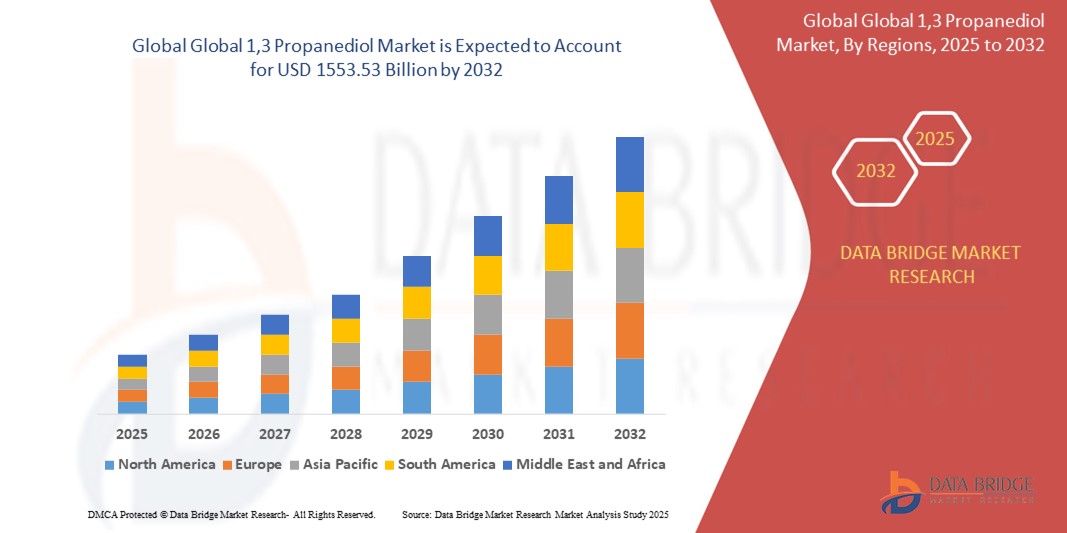
- The global 1,3 propanediol market size was valued at USD 724.74 million in 2024 and is expected to reach USD 1553.53 billion by 2032, at a CAGR of 10.00% during the forecast period
- This growth is driven by factors such as the increasing demand for sustainable and bio-based products, advancements in fermentation technology, rising use in personal care and cosmetic formulations, and expanding applications in polymers such as polytrimethylene terephthalate (PTT)
Global 1,3 Propanediol Market Analysis
- The market for 1,3 propanediol continues to witness a steady increase in demand, primarily due to its consistent usage in the production of specialty polymers
- Manufacturers are focusing more on product innovation by integrating 1,3 propanediol into formulations that enhance product quality
- North America is expected to dominate the 1,3 Propanediols market due to the strong demand for bio-based products in personal care and cosmetics
- Asia-Pacific is expected to be the fastest growing region in the 1,3 Propanediol market during the forecast period due to increasing industrialization and the rising demand for sustainable and bio-based products across key sectors.
- The bio-based segment is expected to dominate the 1,3 propanediol market with the largest share of 55.14% in 2025 due to the growing consumer demand for sustainable and environmentally friendly products. As industries, particularly personal care, textiles, and packaging, shift towards greener alternatives, bio-based 1,3 propanediol is increasingly preferred for its lower environmental impact compared to petroleum-derived options. This segment benefits from advancements in biotechnology and fermentation processes, making it more cost-effective and scalable.
Report Scope and 1,3 Propanediol Market Segmentation
|
Attributes |
Global 1,3 Propanediol Key Market Insights |
|
Segments Covered |
|
|
Countries Covered |
North America
Europe
Asia-Pacific
Middle East and Africa
South America
|
|
Key Market Players |
|
|
Market Opportunities |
|
|
Value Added Data Infosets |
In addition to the insights on market scenarios such as market value, growth rate, segmentation, geographical coverage, and major players, the market reports curated by the Data Bridge Market Research also include import export analysis, production capacity overview, production consumption analysis, price trend analysis, climate change scenario, supply chain analysis, value chain analysis, raw material/consumables overview, vendor selection criteria, PESTLE Analysis, Porter Analysis, and regulatory framework. |
1,3 Propanediol Market Trends
“Growing Shift Toward Bio-Based 1,3 Propanediol Solutions”
- Bio-based production of 1,3 propanediol reduces reliance on fossil fuels, aligning with global sustainability goals
- Consumers are increasingly favoring products derived from renewable resources, influencing market dynamics
- For instance, bio-based 1,3 propanediol is utilized in producing polytrimethylene terephthalate, a polymer known for its resilience and eco-friendliness
- Manufacturers are investing in bio-based technologies to meet the growing demand for sustainable materials
- In conclusion, this shift towards bio-based production is expected to continue, shaping the future landscape of the 1,3 propanediol market
1,3 Propanediol Market Dynamics
Driver
“Rising Demand for Sustainable Alternatives in Polymer Manufacturing”
- The preference for sustainable materials is driving the use of bio-based 1,3 propanediol in the polymer industry
- Companies like DuPont Tate & Lyle are producing bio-based 1,3 propanediol from corn glucose for applications in polymers and textiles
- For instance, polytrimethylene terephthalate, made from 1,3 propanediol, is gaining popularity due to its biodegradability and recyclability in consumer goods
- The increasing regulatory push for greener materials has led to a rise in the adoption of bio-based raw materials in manufacturing processes
- In conclusion, consumer demand for eco-friendly products is further boosting the market for bio-based 1,3 propanediol as brands emphasize sustainability in their product offerings
- This growing shift towards sustainable alternatives is reshaping the market and encouraging further investment in bio-based production technologies
Opportunity
“Expanding Application in Personal Care and Cosmetic Products”
- The growing demand for natural and renewable ingredients is making 1,3 propanediol a preferred choice in personal care formulations
- Leading personal care brands are incorporating bio-based 1,3 propanediol in their products to promote a sustainable and eco-friendly image
- The compound enhances moisturizing properties and improves product texture, making it ideal for lotions, creams, and cleansers
- E-commerce growth and influencer-driven marketing are increasing consumer awareness, driving demand for clean-label, non-toxic beauty products
- Regulatory approvals for its safety and versatility in cosmetics are making 1,3 propanediol a key ingredient in product development
- This opportunity to integrate sustainable ingredients into personal care products is transforming the market and encouraging brands to invest in greener alternatives
Restraint/Challenge
“High Production Costs Compared to Petrochemical Alternatives”
- The high production cost of bio-based 1,3 propanediol is a major challenge to its widespread adoption
- Unlike petrochemical-based routes, bio-based production involves higher raw material costs, specialized equipment, and complex processing
- These elevated production costs make bio-based 1,3 propanediol less competitive in price-sensitive markets like bulk polymer manufacturing
- Fluctuations in biomass feedstock availability can impact price stability and complicate procurement strategies for manufacturers
- Small and medium-sized enterprises with limited budgets may find it difficult to justify the premium cost of bio-based solutions
1,3 Propanediol Market Scope
The market is segmented on the basis of source and application.
|
Segmentation |
Sub-Segmentation |
|
By Source |
|
|
By Application |
|
In 2025, the bio-based segment is projected to dominate the market with a largest share in source segment
The bio-based segment is expected to dominate the 1,3 propanediol market with the largest share of 55.14% in 2025 due to the growing consumer demand for sustainable and environmentally friendly products. As industries, particularly personal care, textiles, and packaging, shift towards greener alternatives, bio-based 1,3 propanediol is increasingly preferred for its lower environmental impact compared to petroleum-derived options. This segment benefits from advancements in biotechnology and fermentation processes, making it more cost-effective and scalable.
The polytrimethylene terephthalate (PTT) segment is expected to account for the largest share during the forecast period in application segment
In 2025, the polytrimethylene terephthalate (PTT) segment is expected to dominate the market with the largest market share of 67.10% due to its increasing demand in various applications, especially in the textile and automotive industries. PTT, made from bio-based 1,3 propanediol, offers superior properties such as high durability, stain resistance, and enhanced softness, making it a preferred choice for manufacturing fibers, carpets, and upholstery. The growing shift toward sustainable materials in these industries is driving the adoption of PTT, as it is biodegradable and recyclable, aligning with the global sustainability trends.
1,3 Propanediol Market Regional Analysis
“North America Holds the Largest Share in the 1,3 Propanediol Market”
- North America holds the largest market share in the 1,3 propanediol market due to the strong demand for bio-based products in personal care and cosmetics
- The U.S. market is expected to continue dominating, driven by the growing preference for eco-friendly, non-toxic ingredients in skincare and beauty products
- North America has established infrastructure for bio-based production, with key players like DuPont and Dow Chemical investing in 1,3 propanediol manufacturing
- The presence of advanced research and development facilities further supports the market's dominance in the region
- Government regulations and consumer awareness of sustainability issues are contributing to the increasing adoption of bio-based ingredients in various industries
“Asia-Pacific is Projected to Register the Highest CAGR in the 1,3 Propanediol Market”
- The Asia Pacific region is witnessing rapid growth in the 1,3 propanediol market due to increasing industrialization and the rising demand for sustainable and bio-based products across key sectors
- Growing demand for sustainable products in textiles, personal care, and automotive sectors is driving market growth in the region
- Increasing urbanization and the rise of middle-class consumers are fueling demand for eco-friendly alternatives in personal care products
- Government support for sustainable practices and renewable resources is boosting the market's development in the region
- The shift towards green chemistry and bio-based solutions is creating strong growth opportunities in Asia Pacific, especially among young, environmentally-conscious consumers
Global 1,3 Propanediol Market Share
The market competitive landscape provides details by competitor. Details included are company overview, company financials, revenue generated, market potential, investment in research and development, new market initiatives, global presence, production sites and facilities, production capacities, company strengths and weaknesses, product launch, product width and breadth, application dominance. The above data points provided are only related to the companies' focus related to market.
The Major Market Leaders Operating in the Market Are:
- DuPont (U.S.)
- Tate & Lyle (U.K.)
- Zouping Mingxing Chemical Co. Ltd. (China)
- Merck KGaA (Germany)
- Alfa Aesar (U.S.)
- Thermo Fisher Scientific (U.S.)
- Connect Chemicals (Germany)
- MakingCosmetics Inc. (U.S.)
- trc-canada (Canada)
- Tokyo Chemical Industry (Japan)
- Metabolic Explorer (France)
- Haihang Industry Co., Ltd. (China)
- Zhangjiagang Glory Biomaterial Co., Ltd. (China)
- Shell Chemicals LP (U.S.)
- Primient Covation LLC (U.S.)
- Eastman Chemical Company (U.S.)
- Genomatica (U.S.)
- Roquette Frères (France)
- Shenghong Group Holdings (China)
- Hunan Rivers Bioengineering Co., Ltd. (China)
- Salicylates and Chemicals Pvt. Ltd. (India)
- Chongqing Kunlun Chemical Co., Ltd. (China)
- DSM (Netherlands)
Latest Developments in Global 1,3 Propanediol Market
- In April 2023, Ningbo Juhua Chemical & Science Co., Ltd. awarded a contract to Technip Energies for a 1,3 PDO plant with an annual capacity of 72 kilo tons in Ningbo, Zhejiang, China. This is part of the company’s initiative to expand its petrochemical new material business
- In November 2023, the market for 1,3-propanediol witnessed a significant boost with the launch of new bio-based products targeting sustainable applications. Companies are increasingly focusing on renewable 1,3-propanediol for use in cosmetics, polymers, and personal care industries. The growing demand for eco-friendly chemicals is driving innovations and partnerships across the sector
- In January 2024, Germany-based chemical manufacturer Nordmann acquired Italy-based SD Chemicals S.r.l., a distributor of raw materials catering to the cosmetics industry catering to skin care, hair care, and makeup applications. This acquisition will enable Nordmann to expand its presence and enhance customer reach
SKU-
Get online access to the report on the World's First Market Intelligence Cloud
- Interactive Data Analysis Dashboard
- Company Analysis Dashboard for high growth potential opportunities
- Research Analyst Access for customization & queries
- Competitor Analysis with Interactive dashboard
- Latest News, Updates & Trend analysis
- Harness the Power of Benchmark Analysis for Comprehensive Competitor Tracking
Global 13 Propanediol Pdo Market, Supply Chain Analysis and Ecosystem Framework
To support market growth and help clients navigate the impact of geopolitical shifts, DBMR has integrated in-depth supply chain analysis into its Global 13 Propanediol Pdo Market research reports. This addition empowers clients to respond effectively to global changes affecting their industries. The supply chain analysis section includes detailed insights such as Global 13 Propanediol Pdo Market consumption and production by country, price trend analysis, the impact of tariffs and geopolitical developments, and import and export trends by country and HSN code. It also highlights major suppliers with data on production capacity and company profiles, as well as key importers and exporters. In addition to research, DBMR offers specialized supply chain consulting services backed by over a decade of experience, providing solutions like supplier discovery, supplier risk assessment, price trend analysis, impact evaluation of inflation and trade route changes, and comprehensive market trend analysis.
Research Methodology
Data collection and base year analysis are done using data collection modules with large sample sizes. The stage includes obtaining market information or related data through various sources and strategies. It includes examining and planning all the data acquired from the past in advance. It likewise envelops the examination of information inconsistencies seen across different information sources. The market data is analysed and estimated using market statistical and coherent models. Also, market share analysis and key trend analysis are the major success factors in the market report. To know more, please request an analyst call or drop down your inquiry.
The key research methodology used by DBMR research team is data triangulation which involves data mining, analysis of the impact of data variables on the market and primary (industry expert) validation. Data models include Vendor Positioning Grid, Market Time Line Analysis, Market Overview and Guide, Company Positioning Grid, Patent Analysis, Pricing Analysis, Company Market Share Analysis, Standards of Measurement, Global versus Regional and Vendor Share Analysis. To know more about the research methodology, drop in an inquiry to speak to our industry experts.
Customization Available
Data Bridge Market Research is a leader in advanced formative research. We take pride in servicing our existing and new customers with data and analysis that match and suits their goal. The report can be customized to include price trend analysis of target brands understanding the market for additional countries (ask for the list of countries), clinical trial results data, literature review, refurbished market and product base analysis. Market analysis of target competitors can be analyzed from technology-based analysis to market portfolio strategies. We can add as many competitors that you require data about in the format and data style you are looking for. Our team of analysts can also provide you data in crude raw excel files pivot tables (Fact book) or can assist you in creating presentations from the data sets available in the report.