Asia Pacific Renal Dialysis Equipment Market
Market Size in USD Million
CAGR :
% 
 USD
268.11 Million
USD
361.32 Million
2024
2032
USD
268.11 Million
USD
361.32 Million
2024
2032
 Forecast Period Forecast Period |
2025 –2032 |
 Market Size (Base Year) Market Size (Base Year) |
USD 268.11 Million |
 Market Size (Forecast Year) Market Size (Forecast Year) |
USD 361.32 Million |
 CAGR CAGR |
% |
| Major Markets Players |
|
Renal Dialysis Equipment Market Size
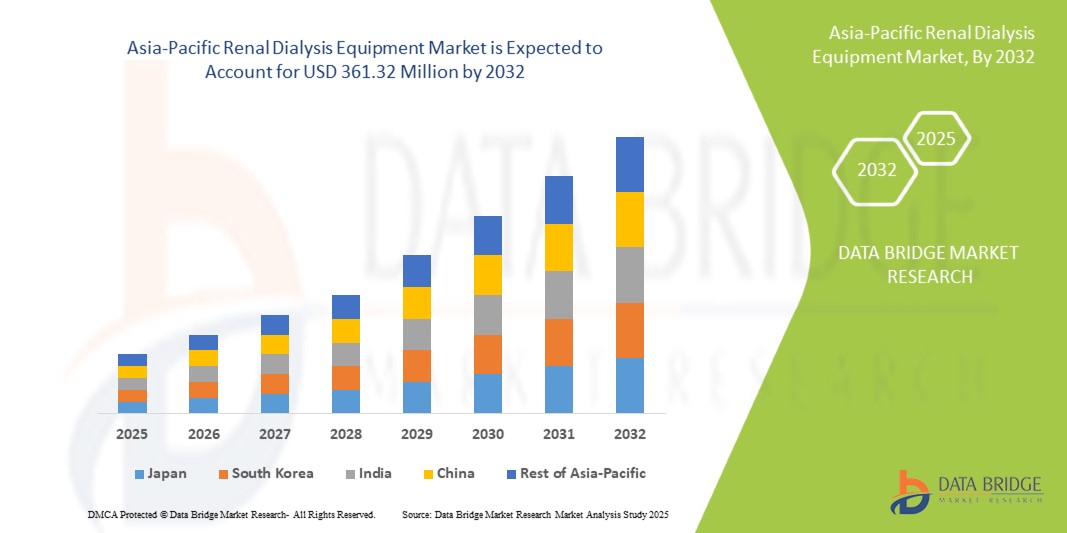
- The Asia-Pacific Renal Dialysis Equipment Market Treatment market was valued at USD 268.11 million in 2024 and is expected to reach USD 361.32 Million by 2032, at a CAGR of 3.8%, during the forecast period
- The rising incidence of chronic kidney disease (CKD) and the growing emphasis on early-stage diagnosis and treatment are driving demand for the Renal Dialysis Equipment Market in Asia-Pacific . Additionally, increasing awareness about the importance of managing kidney health, coupled with advancements in hemodialysis and peritoneal dialysis technologies, is further propelling market growth.
Renal Dialysis Equipment Market Analysis
- Renal Dialysis Equipment are specialized machines used to filter waste products and excess fluids from the blood, typically for patients with chronic kidney disease (CKD) or acute kidney failure. These devices are crucial in maintaining kidney function when natural kidneys are no longer able to perform the filtration process effectively. Advanced renal dialysis technologies, including hemodialysis and peritoneal dialysis systems, improve treatment outcomes, enhance patient comfort, and contribute to better quality of life for patients.
- China emerges as a leading region in the Asia-Pacific Renal Dialysis Equipment Market, supported by a well-established healthcare infrastructure, widespread awareness of kidney diseases, and favorable reimbursement policies for dialysis treatments.
- Ongoing investments in innovative dialysis technologies, including home dialysis systems, AI-powered monitoring tools, and portable dialysis machines, along with a rising geriatric population and increased focus on chronic kidney disease prevention, continue to drive growth and technological advancements in the region’s renal dialysis equipment market.
Report Scope and Renal Dialysis Equipment Market Segmentation
|
Attributes |
Renal Dialysis Equipment Market Key Market Insights |
|
Segments Covered |
|
|
Countries Covered |
Asia-Pacific
|
|
Key Market Players |
|
|
Market Opportunities |
|
|
Value Added Data Infosets |
In addition to the insights on market scenarios such as market value, growth rate, segmentation, geographical coverage, and major players, the market reports curated by the Data Bridge Market Research also include import export analysis, production capacity overview, production consumption analysis, price trend analysis, climate change scenario, supply chain analysis, value chain analysis, raw material/consumables overview, vendor selection criteria, PESTLE Analysis, Porter Analysis, and regulatory framework. |
Renal Dialysis Equipment Market Trends
“Shift Toward Home-Based Dialysis Solutions”
- A significant trend in the Asia-Pacific Renal Dialysis Equipment Market is the growing shift toward home-based dialysis solutions, driven by patient demand for greater convenience, autonomy, and improved quality of life.
- Home hemodialysis and peritoneal dialysis equipment are becoming more accessible, with innovations in portable devices and simplified systems enabling patients to receive treatment in the comfort of their homes, reducing the need for frequent visits to dialysis centers.
- For instance, compact home dialysis machines with user-friendly interfaces and remote monitoring capabilities are enabling better patient engagement and outcomes, while also easing the burden on healthcare systems.
- Advancements in telemedicine and remote monitoring technologies are complementing this trend, allowing healthcare providers to continuously monitor patient conditions, adjust dialysis prescriptions, and intervene when necessary, enhancing patient safety.
- This shift toward home-based solutions is expected to reduce healthcare costs, improve treatment adherence, and increase overall patient satisfaction, further fueling growth in the Asia-Pacific Renal Dialysis Equipment Market.
Renal Dialysis Equipment Market Dynamics
Driver
“Rising Prevalence of Chronic Kidney Disease (CKD) and Increased Demand for Dialysis Treatments”
- As the Asia-Pacific n population continues to age, combined with rising risk factors such as obesity, diabetes, and hypertension, the prevalence of chronic kidney disease (CKD) is growing significantly. CKD remains a leading cause of morbidity and mortality, driving an urgent need for effective renal dialysis equipment to manage end-stage kidney disease.
- Renal Dialysis Equipment, including hemodialysis machines and peritoneal dialysis devices, offer life-saving solutions for CKD patients, enabling them to manage their condition and maintain a stable quality of life. These technologies are increasingly favored due to their ability to provide reliable, efficient, and personalized treatment for patients.
For instance,
- According to the National Kidney Foundation (2024), more than 37 million chinese are living with kidney disease, with 726,000 individuals requiring dialysis or a kidney transplant.
- Recent data from the Centers for Disease Control and Prevention (CDC) indicates that kidney disease is expected to affect 1 in 7 adults by 2030, highlighting the rising need for dialysis treatments.
- The growing burden of CKD and the rising number of dialysis patients are driving demand for high-quality renal dialysis equipment. Along with this, increased awareness through healthcare campaigns and early-stage diagnosis efforts are accelerating adoption rates.
- As dialysis technologies advance with improvements in treatment efficiency, patient comfort, and home dialysis options, healthcare providers are increasingly recommending dialysis as a frontline treatment for CKD. This convergence of clinical need, awareness, and technological advancement is driving robust growth in the Asia-Pacific Renal Dialysis Equipment Market.
Opportunity
“Technological Advancements in Dialysis Equipment and Home-Based Solutions”
- Significant innovations in renal dialysis systems—such as portable hemodialysis machines, home-based dialysis units, and remote monitoring technologies—are transforming the dialysis treatment landscape. These advancements offer greater convenience, flexibility, and personalized care, allowing patients to receive treatment at home or in less conventional settings.
- Cutting-edge technologies, including artificial intelligence (AI)-driven monitoring systems and cloud-connected platforms, are enhancing the ability to track treatment progress, predict patient outcomes, and reduce complications, ensuring a more comprehensive approach to patient care.
For instance,
- Companies like Baxter, Fresenius Medical Care, and DaVita are at the forefront of developing home dialysis systems that are easy to use, and remotely monitored, and require fewer visits to dialysis centers.
- In 2024, the introduction of AI-powered algorithms for predictive dialysis treatments allowed for more accurate treatment regimens, reducing complications and hospitalizations.
- These technological innovations meet the increasing demand for patient-centric care and personalized treatment solutions, especially for the growing CKD patient population in both urban and rural areas.
- Companies that invest in next-generation dialysis technologies, such as wearable dialysis systems, smart infusion pumps, and patient management platforms, are well-positioned to capture market share in the expanding Asia-Pacific Renal Dialysis Equipment Market.
Restraint/Challenge
“High Equipment Costs and Limited Access to Dialysis Centers”
- The high cost of acquiring and maintaining advanced renal dialysis equipment, such as home dialysis systems and remote monitoring devices, presents a significant barrier to widespread adoption, particularly in low-income communities and underserved areas. Even in wealthier regions, limited reimbursement and insurance coverage for home dialysis solutions may deter adoption.
- While advances in dialysis technology improve patient outcomes, the associated costs of setup, patient training, and system maintenance often prevent smaller clinics and community hospitals from providing these advanced options.
- Further, the availability of dialysis centers and the capacity to treat a growing number of patients can be a limiting factor, especially in rural areas where dialysis centers are fewer and patients face long travel times for treatments.
For instance,
- In 2023, the average cost of setting up home dialysis for a patient could range from USD 10,000 to USD 30,000, excluding maintenance and ongoing costs.
- A report by the Indian Kidney Fund (2024) highlighted that rural areas face a 40% shortage in dialysis centers, significantly limiting patient access to critical treatment.
- To overcome these barriers, solutions such as mobile dialysis units, government initiatives for subsidies, and insurance reform will be necessary to enhance access and improve overall market penetration in underserved regions.
Renal Dialysis Equipment Market Scope
The market is segmented on the product, distribution channel, end user.
|
Segmentation |
Sub-Segmentation |
|
By Product |
|
|
By distribution channel |
|
|
By End Users |
|
In 2025, the Peritoneal Dialysis Solutions is Projected to Dominate the Market with the Largest Share in the product Segment
The Peritoneal Dialysis Solutions segment is expected to dominate the Asia-Pacific Renal Dialysis Equipment Market in 2025, accounting for the largest market share of approximately 68.7%. This leadership is primarily driven by the increasing preference for home-based dialysis treatments, which offer greater flexibility, convenience, and reduced healthcare costs for patients. Additionally, advancements in peritoneal dialysis technology, such as improved dialysate solutions and automated systems, are enhancing treatment efficiency and patient comfort, contributing to the segment’s growth.
In 2025, Direct Tenders are Expected to Account for the Largest Share During the Forecast Period in distribution channel segment
In 2025, Direct Tenders are projected to dominate the Asia-Pacific Renal Dialysis Equipment Market , accounting for the largest market share of approximately 64.9%. This segment's dominance is fueled by the increasing demand for bulk procurement by healthcare institutions, government agencies, and large dialysis networks, which benefit from cost savings and streamlined procurement processes. Additionally, direct tender agreements often result in long-term contracts, ensuring a steady supply of renal dialysis equipment and solutions, further driving the segment’s growth.
Renal Dialysis Equipment Market Regional Analysis
“China is the Dominant country in the Asia-Pacific Renal Dialysis Equipment Market ”
- China leads the Asia-Pacific Renal Dialysis Equipment Market, driven by its advanced healthcare infrastructure, high treatment volumes, and widespread adoption of state-of-the-art dialysis technologies such as automated peritoneal dialysis (APD) systems and continuous renal replacement therapies (CRRT).
- China holds the largest market share due to the rising prevalence of chronic kidney disease (CKD), an aging population, and significant demand for dialysis treatment solutions.
- Favorable reimbursement frameworks, extensive insurance coverage, and strong federal initiatives, such as Medicare’s coverage for dialysis treatment, contribute significantly to the market’s dominance.
- Furthermore, the presence of key industry players like Baxter International, Fresenius Medical Care, and DaVita, along with continuous investment in research and development, fosters the adoption of next-generation dialysis technologies and enhances patient care standards.
“Japan is Projected to Register the Highest Growth Rate”
- Japan is projected to witness the highest growth rate in the Asia-Pacific Renal Dialysis Equipment Market, driven by increasing awareness of kidney diseases, expanding access to home dialysis options, and technological advancements in dialysis equipment.
- The market benefits from large-scale awareness programs, demographic changes such as a growing elderly population, and a rising incidence of conditions that lead to kidney failure, such as diabetes and hypertension.
- Government-driven initiatives, including the Centers for Medicare & Medicaid Services (CMS) policies supporting home dialysis and kidney care programs, are fueling growth in the market.
- Additionally, innovations in dialysis treatment, such as portable dialysis units and AI-driven monitoring systems, are expected to contribute to rapid growth in home-based dialysis treatments.
Renal Dialysis Equipment Market Share
The market competitive landscape provides details by competitor. Details included are company overview, company financials, revenue generated, market potential, investment in research and development, new market initiatives, Asia-Pacific presence, production sites and facilities, production capacities, company strengths and weaknesses, product launch, product width and breadth, application dominance. The above data points provided are only related to the companies' focus related to market.
The Major Market Leaders Operating in the Market Are:
- Fresenius Medical Care
- DaVita Inc.
- Baxter International Inc.
- Nipro Corporation
- Medtronic plc
- Asahi Kasei Medical Co., Ltd.
- Kedrion S.p.A.
- Terumo Corporation
- Dialysis Clinic, Inc. (DCI)
- Rockwell Medical, Inc.
Latest Developments in Asia-Pacific Renal Dialysis Equipment Market
- In March 2024, DaVita Inc. introduced its new home dialysis system, the DaVita Home Dialysis Hub, designed to simplify at-home dialysis treatment. This system incorporates advanced remote monitoring capabilities, allowing healthcare providers to track patient data in real-time and adjust treatment settings for improved patient outcomes.
- In April 2024, Fresenius Medical Care launched the Fresenius 4008A dialysis machine, featuring cutting-edge filtration technology and enhanced patient comfort features. The new machine is designed to improve treatment efficiency, reduce side effects, and offer more personalized care for patients with chronic kidney disease.
SKU-
Get online access to the report on the World's First Market Intelligence Cloud
- Interactive Data Analysis Dashboard
- Company Analysis Dashboard for high growth potential opportunities
- Research Analyst Access for customization & queries
- Competitor Analysis with Interactive dashboard
- Latest News, Updates & Trend analysis
- Harness the Power of Benchmark Analysis for Comprehensive Competitor Tracking
Research Methodology
Data collection and base year analysis are done using data collection modules with large sample sizes. The stage includes obtaining market information or related data through various sources and strategies. It includes examining and planning all the data acquired from the past in advance. It likewise envelops the examination of information inconsistencies seen across different information sources. The market data is analysed and estimated using market statistical and coherent models. Also, market share analysis and key trend analysis are the major success factors in the market report. To know more, please request an analyst call or drop down your inquiry.
The key research methodology used by DBMR research team is data triangulation which involves data mining, analysis of the impact of data variables on the market and primary (industry expert) validation. Data models include Vendor Positioning Grid, Market Time Line Analysis, Market Overview and Guide, Company Positioning Grid, Patent Analysis, Pricing Analysis, Company Market Share Analysis, Standards of Measurement, Global versus Regional and Vendor Share Analysis. To know more about the research methodology, drop in an inquiry to speak to our industry experts.
Customization Available
Data Bridge Market Research is a leader in advanced formative research. We take pride in servicing our existing and new customers with data and analysis that match and suits their goal. The report can be customized to include price trend analysis of target brands understanding the market for additional countries (ask for the list of countries), clinical trial results data, literature review, refurbished market and product base analysis. Market analysis of target competitors can be analyzed from technology-based analysis to market portfolio strategies. We can add as many competitors that you require data about in the format and data style you are looking for. Our team of analysts can also provide you data in crude raw excel files pivot tables (Fact book) or can assist you in creating presentations from the data sets available in the report.